
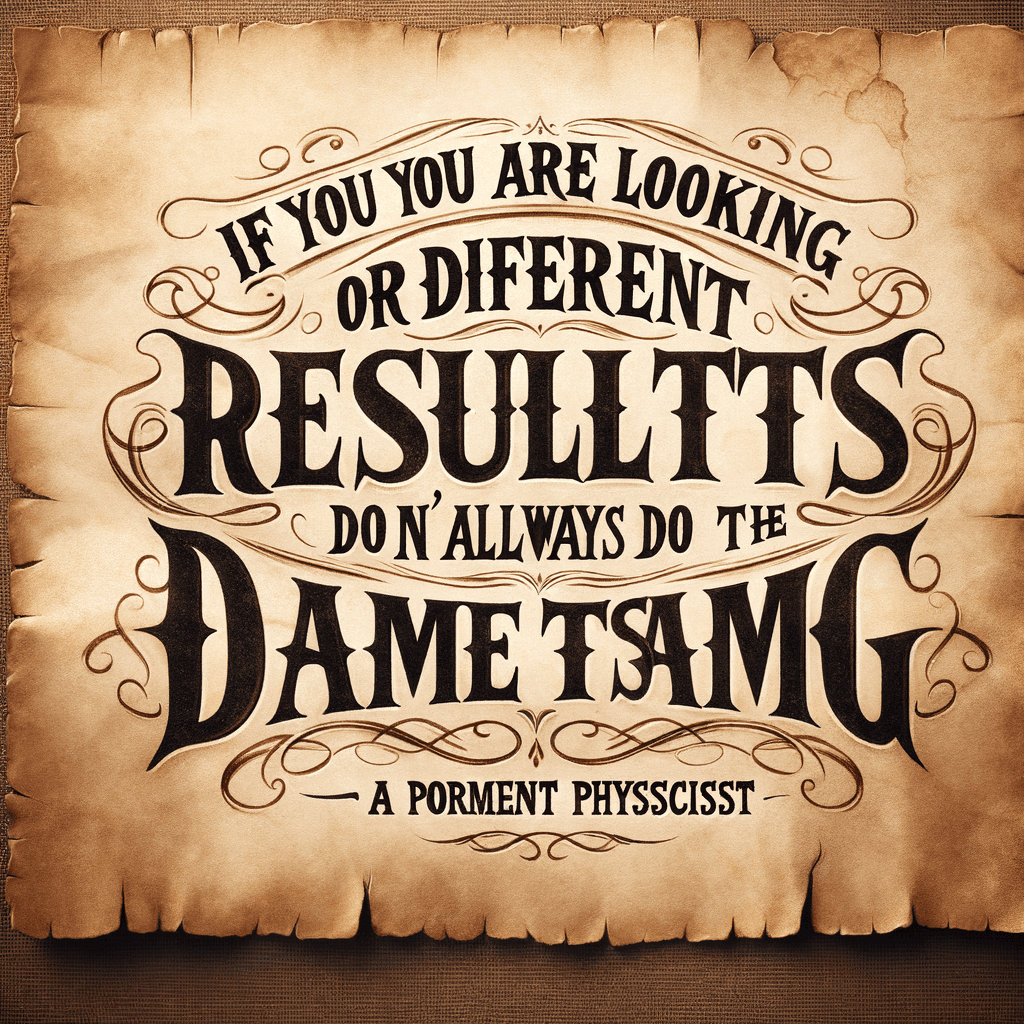
If you are looking for different results, do not always do the same thing. - Albert Einstein
—What lingers after this line?
Change and Innovation
This quote emphasizes the necessity of change and innovation to achieve different outcomes. Repeating the same actions will likely yield the same results; therefore, trying new approaches is essential for progress.
Personal Growth
On a personal level, this statement encourages individuals to break out of their routine and comfort zone. Trying new things and adopting different strategies can lead to personal development and unexpected success.
Problem-Solving
In problem-solving contexts, this advice highlights the importance of thinking outside the box. Persistently using the same methods to solve a problem won't lead to new solutions.
Scientific Approach
As a scientist, Einstein understood that experimentation and varied approaches are fundamental to discovery. This quote reflects a scientific mindset geared towards hypothesis testing and adaptive learning.
Historical Context
Albert Einstein, a renowned physicist known for his theory of relativity, lived during a time of great scientific advancements. His insights into the nature of innovation and discovery are rooted in his observations and experiences within the scientific community of the early 20th century.
One-minute reflection
What feeling does this quote bring up for you?
Related Quotes
6 selectedIf you're making a mistake, it's better to make a new one. — Pearl Bailey
Pearl Bailey
Pearl Bailey’s line sounds playful, but it carries a sharp philosophy: once you realize you’re wrong, repeating the same error isn’t loyalty to a decision—it’s inertia. By suggesting it’s “better to make a new one,” she...
Read full interpretation →Turn hesitation into an experiment; failure is data, not a verdict. — Ada Lovelace
Ada Lovelace
Ada Lovelace’s line begins by rescuing hesitation from its usual stigma. Instead of treating uncertainty as weakness, she invites us to view it as the natural threshold of discovery, where questions form and assumptions...
Read full interpretation →Treat failure as a hypothesis to be tested, not a verdict to accept. — Albert Camus
Albert Camus
Camus’ line pivots on a simple but radical shift: failure is not a final judgment about who you are, but information about what happened. A verdict closes the case—guilty, inadequate, finished—whereas a hypothesis keeps...
Read full interpretation →Turn obstacles into experiments; results will teach your next move. — Richard Feynman
Richard Feynman
Feynman’s line reframes frustration as curiosity. An obstacle, in this view, is not a dead end but an unanswered question: What happens if I try this instead?
Read full interpretation →Let each attempt be a small experiment, not a final verdict. — Marie Curie
Marie Curie
Marie Curie’s insight invites a fundamental shift in how we view our own efforts. Instead of treating each attempt as a pass-or-fail judgment, she frames it as a small experiment—one step in a longer process of discovery...
Read full interpretation →Do not wait to know what you can do; start doing it. — Henri Matisse, France.
Henri Matisse, France.
This quote emphasizes the importance of taking initiative and acting rather than waiting for the perfect moment or full clarity on one's capabilities.
Read full interpretation →More From Author
More from Albert Einstein →Be a loner. That gives you time to wonder, to search for the truth. Have holy curiosity. Make your life worth living. — Albert Einstein
At first glance, Einstein’s advice to “be a loner” may sound like a rejection of society, yet his deeper point is about protecting the inner space where thought can mature. Solitude gives a person room to hear their own...
Read full interpretation →The best of community does give one a deep sense of belonging and well-being; and in that sense, community takes away loneliness. — Albert Einstein
Einstein’s observation begins with a quiet but profound insight: loneliness is not solved merely by being around other people, but by feeling meaningfully connected to them. In his phrasing, the “best of community” offer...
Read full interpretation →It is entirely possible that behind the perception of our senses, worlds are hidden of which we are unaware. — Albert Einstein
At first glance, Einstein’s remark invites intellectual humility. He suggests that what we see, hear, and touch may represent only a thin surface of reality, not its full depth.
Read full interpretation →It is not that I'm so smart, it's just that I stay with problems longer. — Albert Einstein
At first glance, Einstein’s remark sounds like modesty, yet it does more than downplay genius. By saying he simply ‘stays with problems longer,’ he shifts attention from innate talent to sustained effort, suggesting that...
Read full interpretation →