
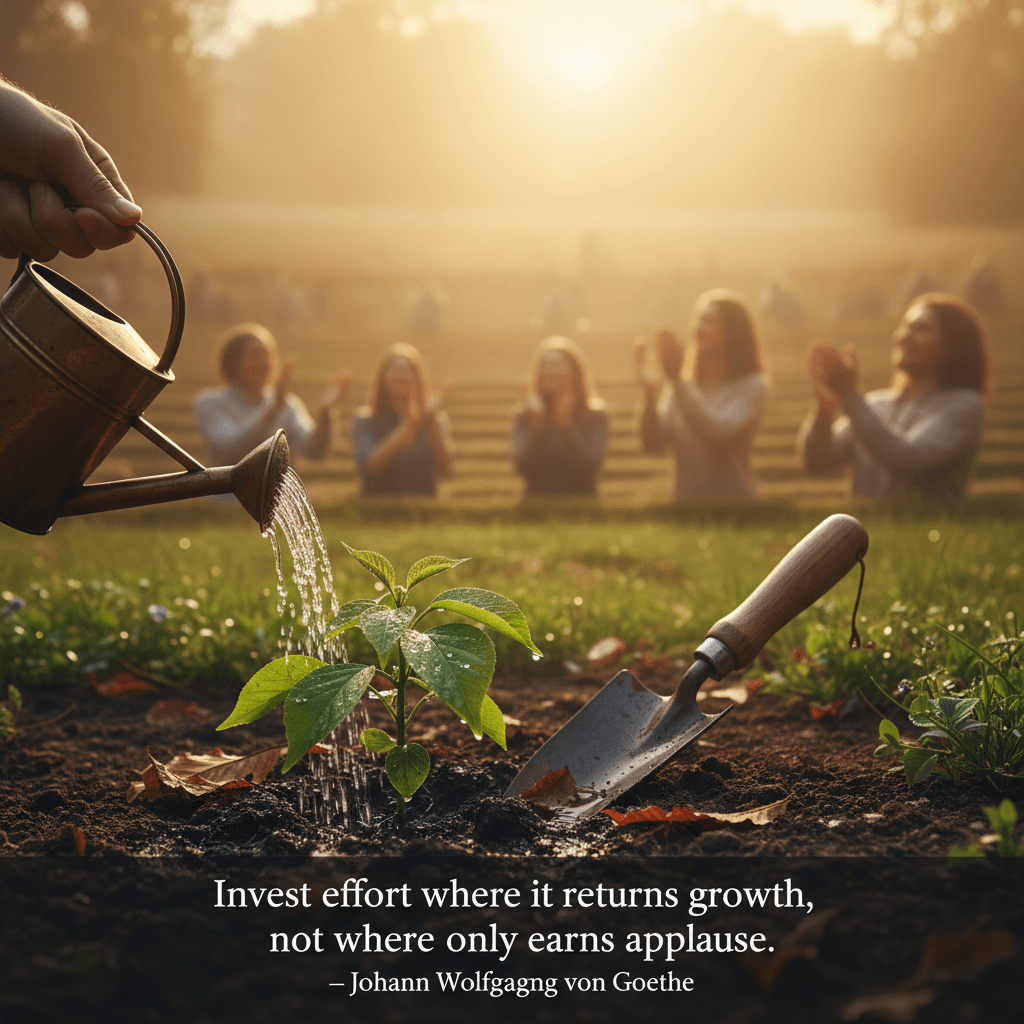
Invest effort where it returns growth, not where it only earns applause. — Johann Wolfgang von Goethe
—What lingers after this line?
From Praise to Progress
At root, the quote contrasts two currencies of effort: applause, which is immediate and flattering, and growth, which is slower but compounding. Goethe urges a reallocation—from chasing recognition to cultivating capability—because only the latter expands the range of what we can do. This shift reframes success as stewardship of one’s development rather than management of others’ impressions. Applause fades with the room; growth changes the room you can enter next. Thus the question becomes not “Who noticed?” but “What expanded?”
Goethe’s Lifelong Apprenticeship
Historically, Goethe modeled his advice. He worked on Faust for decades—Part I (1808) and the posthumous Part II (1832)—demonstrating patience with craft over spectacle. The applause came and went; the work kept deepening. Likewise, Wilhelm Meister’s Apprenticeship (1795–96) explores Bildung, the self-cultivation of character and competence. By threading maturation into narrative, Goethe shows that durable achievement accrues from iterative refinement, not momentary ovations.
Motivation: Intrinsic Beats Extrinsic
Psychology reinforces this pivot. Self-Determination Theory argues that autonomy, mastery, and purpose fuel sustained motivation better than external rewards (Deci & Ryan, 1985). Applause primes short bursts; growth supports long arcs. Moreover, Carol Dweck’s work on growth mindset shows that praise for innate talent can hinder risk-taking, while valuing effort and strategy promotes resilience (Dweck, 2006). Thus, applause may seduce us into safety, whereas growth invites the productive discomfort where learning compounds.
Deliberate Practice, Not Perpetual Performance
In practice, excellence emerges from targeted struggle. Research on deliberate practice shows elites focus on weaknesses with immediate feedback, not on performing what already earns cheers (Ericsson et al., 1993). A violinist repeats the difficult bar offstage so that the stage later requires less heroics. Relatedly, Teresa Amabile’s “progress principle” finds that small, meaningful advances are the strongest daily motivator at work (Amabile & Kramer, 2011). Progress, not praise, sustains the grind that leads to breakthroughs.
Metrics That Compound
Consequently, the measures we choose matter. Goodhart’s Law warns that when a metric becomes a target, it ceases to be a good metric (Goodhart, 1975). Vanity counts—likes, downloads, applause lines—often displace learning. By contrast, compounding indicators—error rates reduced, concepts mastered, cycle time shortened, customer retention improved—track capability. As in investing, long horizons and reinvested gains, à la Warren Buffett, convert modest edges into durable advantage.
Practical Reallocation of Effort
Finally, we can operationalize Goethe’s counsel. Protect deep-practice blocks; design feedback that diagnoses, not flatters; and set growth metrics alongside delivery metrics. When applause arrives, mine it for specific signals, then return to the workshop. Build career capital by becoming “so good they can’t ignore you” (Cal Newport, 2012), not so visible they can’t stop clapping. In time, the paradox resolves: the more you invest in growth over approval, the more any applause that does appear is earned—and the less you need it.
One-minute reflection
What does this quote ask you to notice today?
Related Quotes
6 selectedSmall daily improvements over time lead to stunning results. — Robin Sharma
Robin Sharma
At first glance, Robin Sharma’s quote seems almost too simple: small daily improvements hardly look dramatic in the moment. Yet that is precisely his point.
Read full interpretation →We are doing ourselves no favors when we look to the crowd to tell us where we are. — Erin Loechner
Erin Loechner
Erin Loechner’s line points to a quiet habit many of us treat as normal: using other people’s reactions to locate our worth, success, or direction. When we “look to the crowd,” we hand over the compass, letting likes, pr...
Read full interpretation →If you are tempted to look outside yourself for approval, you have compromised your integrity. — Epictetus
Epictetus
Epictetus compresses a whole Stoic ethic into a blunt caution: the moment you feel pulled to secure someone else’s approval, you risk trading your inner standards for external rewards. In his view, integrity isn’t a repu...
Read full interpretation →Stop outsourcing so much of your joy and peace to what others think of you online. — Todd Perelmuter
Todd Perelmuter
Todd Perelmuter’s line points to a quiet trade many people make online: exchanging inner steadiness for the unpredictable reactions of strangers. When joy depends on likes, reposts, or flattering comments, peace becomes...
Read full interpretation →You cannot be free until you are no longer a slave to the opinions of people who don't even know who you are. — Nawal El Saadawi
Nawal El Saadawi
Nawal El Saadawi frames freedom less as a legal status and more as an internal state: you may move without chains and still live as if restrained. The quote points to a quieter captivity—measuring your worth by judgments...
Read full interpretation →Your worth is not a fluctuating market. You are not a commodity to be traded for the approval of others. — Vironika Tugaleva
Vironika Tugaleva
Vironika Tugaleva’s line begins by snapping a common illusion: that a person’s value rises and falls like a market price. In everyday life, feedback can feel like a ticker—praise lifts you, criticism drops you—yet the qu...
Read full interpretation →More From Author
More from Johann Wolfgang von Goethe →A really great talent finds its happiness in execution. — Johann Wolfgang von Goethe
Goethe’s remark shifts attention away from talent as mere possession and toward talent as practice. A gift, however impressive, remains incomplete until it is exercised; in this sense, happiness does not come from being...
Read full interpretation →Everybody wants to be somebody; nobody wants to grow. — Johann Wolfgang von Goethe
At first glance, Goethe’s remark exposes a quiet contradiction in human desire: people long for significance, recognition, and identity, yet often resist the difficult transformation such becoming requires. To ‘be somebo...
Read full interpretation →The most original of authors are not so because they advance what is new, but more because they know how to say something as if it had never been said before. — Johann Wolfgang von Goethe
Goethe begins by shifting originality away from mere invention and toward expression. In his view, a writer does not become original simply by producing unheard-of thoughts; rather, originality emerges when familiar trut...
Read full interpretation →In nature we never see anything isolated, but everything in connection with something else which is before it, beside it, under it and over it. — Johann Wolfgang von Goethe
Goethe’s remark begins with a simple observation and expands into a profound worldview: nothing in nature exists alone. Every plant, stone, current, and creature belongs to a web of relations shaped by time, place, and s...
Read full interpretation →