
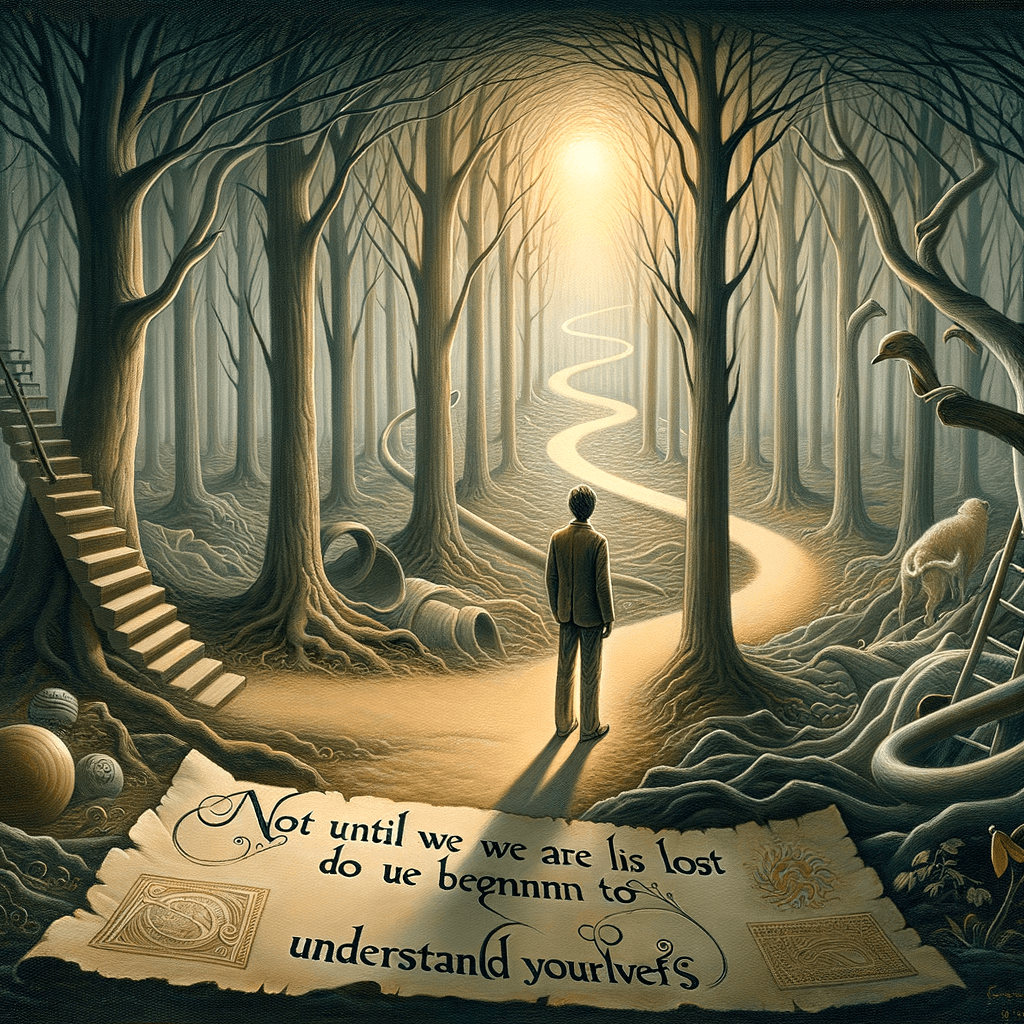
Not until we are lost do we begin to understand ourselves. - Henry David Thoreau
—What lingers after this line?
Self-Discovery Through Adversity
This quote suggests that it is only when we face significant challenges or confusion that we truly start to understand our own capabilities, values, and identities.
The Value of Being Lost
Being 'lost' can be metaphorical for experiencing uncertainty or hardship. Thoreau implies that these moments are crucial for personal growth and self-awareness.
Reflection and Introspection
When we find ourselves lost, it forces us to reflect and introspect, leading to a deeper understanding of our wants, needs, and emotions.
Breaking Comfort Zones
The state of being lost often pushes us out of our comfort zones, encouraging us to discover new directions and forge new paths that we might have never considered otherwise.
Philosophical Context
Henry David Thoreau, an American philosopher and transcendentalist, believed in the importance of nature, simple living, and personal introspection. This quote aligns with his philosophy that personal crises can lead to profound self-realization.
One-minute reflection
What feeling does this quote bring up for you?
Related Quotes
6 selectedNot until we are lost do we begin to understand ourselves. - Henry David Thoreau
Henry David Thoreau
This quote suggests that it is often through experiencing loss or confusion that we come to truly understand our own identity and inner strengths. Adversity serves as a catalyst for self-discovery.
Read full interpretation →The best way to find yourself is to lose yourself in the service of others. — Mahatma Gandhi
Mahatma Gandhi
This quote suggests that one can truly understand themselves by dedicating their time and efforts to helping others. It implies that self-awareness and personal growth are achieved through acts of service.
Read full interpretation →You have to get lost before you can be found. — Jeff Goins
Jeff Goins
This quote suggests that sometimes, losing your way or facing challenges is a necessary part of personal and emotional growth. It highlights that one must go through difficult phases to find clarity and purpose.
Read full interpretation →To discover your path, you must first lose your way. — Joan Chittister
Joan Chittister
This quote suggests that personal growth and self-discovery often come through moments of confusion and uncertainty. Losing one’s way is a part of the journey toward finding true purpose and direction.
Read full interpretation →You will never be able to experience everything. So, please, do poetical justice to your soul and simply experience yourself. — Albert Camus
Albert Camus
Camus begins from a humbling truth: no person can live every possible life, see every landscape, or test every path. Because existence is finite, the dream of total experience becomes a source of restlessness rather than...
Read full interpretation →You cannot express something you have not first discovered. — Carl Jung
Carl Jung
At its core, Jung’s remark suggests that authentic expression begins not with performance but with discovery. A person cannot meaningfully speak, create, or reveal what has never been encountered within the self.
Read full interpretation →More From Author
More from Henry David Thoreau →In the long run, men hit only what they aim at. Therefore, they had better aim at something high. — Henry David Thoreau
Thoreau’s statement begins with a simple but demanding truth: over time, people tend to arrive where their intentions point them. In other words, even imperfect effort has a direction, and that direction matters.
Read full interpretation →Me thinks that the minute my legs begin to move my thoughts begin to flow. — Henry David Thoreau
At first glance, Thoreau’s remark seems simple: as soon as his body starts moving, his mind comes alive. Yet the line captures a deeper truth about the intimate bond between physical motion and mental clarity.
Read full interpretation →It is not enough to be industrious; so are the ants. What are you being industrious about? — Henry David Thoreau
Thoreau’s remark begins by puncturing a common illusion: activity is not the same as purpose. Ants are famously industrious, yet their labor is automatic, instinctive, and unquestioned.
Read full interpretation →A man is rich in proportion to the number of things which he can afford to let alone. — Henry David Thoreau
Thoreau’s line turns the usual definition of wealth inside out. Instead of measuring richness by what someone owns, he measures it by what someone can ignore without feeling deprived.
Read full interpretation →