
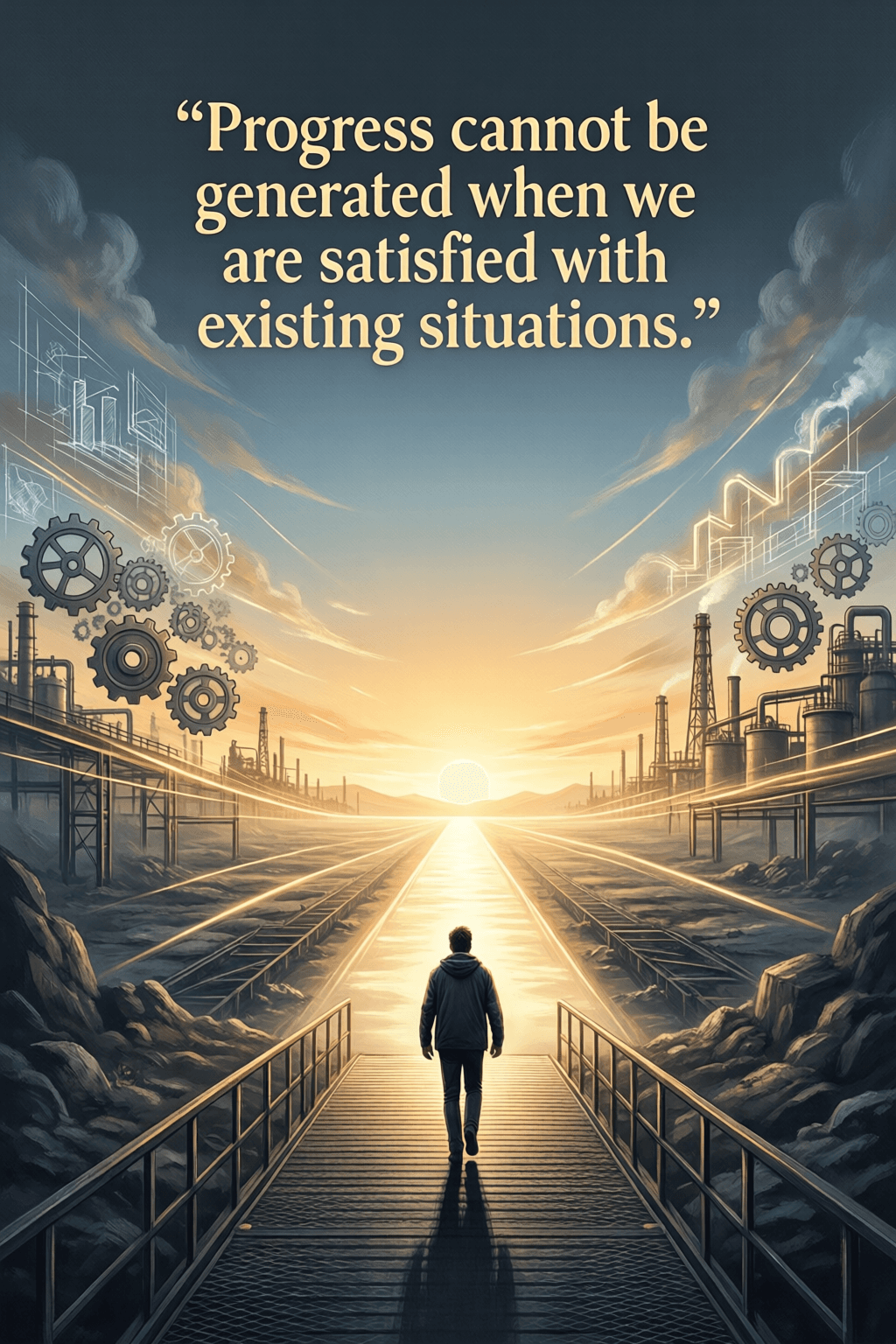
Progress cannot be generated when we are satisfied with existing situations. — Taiichi Ohno
—What lingers after this line?
The Productive Edge of Discontent
Taiichi Ohno’s statement begins with a challenge to comfort: if we become satisfied with the way things are, improvement loses its urgency. In this sense, dissatisfaction is not mere complaining but a disciplined awareness that any process, habit, or system can be made better. Rather than celebrating unrest for its own sake, Ohno points to a constructive unease that keeps people alert to waste, delay, and missed potential. This idea matters because satisfaction can quietly harden into complacency. Once that happens, flaws that once seemed obvious begin to look normal. Therefore, progress often starts with the refusal to accept inefficiency as inevitable, a mindset that turns frustration into a first step toward change.
Roots in the Toyota Production System
Seen in context, the quote reflects Ohno’s role in building the Toyota Production System in postwar Japan. In works such as Taiichi Ohno’s Toyota Production System: Beyond Large-Scale Production (1978), he argued that improvement depends on identifying muda, or waste, in every form—excess motion, overproduction, waiting, and needless complexity. His dissatisfaction was practical: every inefficiency represented lost value. From there, the logic becomes clear. If workers and leaders assume the current method is good enough, they stop seeing opportunities to simplify and refine. By contrast, a culture of continual questioning makes progress habitual, not occasional, which is why Ohno’s insight became central to modern lean thinking.
Why Comfort Can Obscure Problems
Moreover, existing situations often feel acceptable simply because they are familiar. Psychologists describe this tendency through concepts like status quo bias, explored by Samuelson and Zeckhauser (1988), which shows how people prefer current arrangements even when better alternatives exist. Familiarity reduces friction in the short term, but it can also dull the desire to innovate. As a result, organizations and individuals may confuse stability with excellence. A slow approval process, a flawed routine, or an outdated product can persist for years because no one feels sufficiently disturbed to challenge it. Ohno’s remark cuts through that illusion by insisting that discomfort is often the clearest sign that improvement is still possible.
Innovation Begins with Better Questions
Once dissatisfaction is accepted as useful, it naturally leads to inquiry. Instead of asking whether something works at all, people begin asking whether it works well, efficiently, and sustainably. This shift mirrors the continuous improvement principle of kaizen, where small, ongoing changes accumulate into significant transformation over time. In practice, progress is rarely born from self-congratulation; it comes from careful scrutiny. For example, a factory worker who asks why tools are stored so far from the workstation is already participating in innovation. Likewise, a teacher who notices wasted class time or a nurse who questions a cumbersome handoff procedure is doing the same. Thus, dissatisfaction becomes valuable when it sharpens observation and produces better questions.
The Difference Between Cynicism and Improvement
However, Ohno’s point should not be mistaken for permanent negativity. There is a crucial difference between corrosive cynicism and purposeful dissatisfaction. Cynicism assumes nothing can improve, while Ohno’s mindset assumes improvement is always possible if we look honestly at present conditions. One attitude paralyzes; the other activates. This distinction explains why his quote feels demanding rather than despairing. It asks people to resist comfort without abandoning hope. In that way, dissatisfaction becomes a form of responsibility: we notice defects not to dwell on them, but to remove them. Progress, then, depends less on frustration itself than on what we choose to do with it.
A Principle for Everyday Life
Finally, the quote reaches far beyond manufacturing. In personal growth, relationships, education, and public life, progress often begins when people stop saying, ‘This is just how it is.’ An athlete improves by refusing to plateau, a writer revises by distrusting the first draft, and communities reform institutions by challenging long-accepted shortcomings. In each case, dissatisfaction becomes the engine of better outcomes. Yet the lesson is best applied with balance. We do not need to reject every achievement in order to keep improving; rather, we can appreciate what exists while still believing it can be refined. That is the enduring force of Ohno’s insight: gratitude may help us endure the present, but constructive dissatisfaction is what moves us beyond it.
One-minute reflection
What does this quote ask you to notice today?
Related Quotes
6 selectedWhere people fail is that they wish to elect a state and remain in it. — Anaïs Nin
Anaïs Nin
Anaïs Nin points to a common human temptation: treating life as a set of destinations rather than an unfolding process. We imagine that if we can finally “elect a state”—confidence, happiness, success, certainty—we can s...
Read full interpretation →Success is not about being the best. It's about always getting better. — Behdad Sami
Behdad Sami
This quote emphasizes the importance of continual personal and professional development rather than striving to outshine others. True success is seen in the steady progress and improvements you make over time.
Read full interpretation →Your most unhappy customers are your greatest source of learning. — Bill Gates
Bill Gates
This quote highlights the importance of feedback from dissatisfied customers. Their negative experiences can provide critical insights that help businesses identify areas for improvement.
Read full interpretation →To improve is to change; to be perfect is to change often. — Winston S. Churchill, United Kingdom. This quote emphasizes the importance of adaptability and continuous improvement, encouraging individuals to embrace change as a pathway to growth and success. Its universal message resonates with diverse audiences globally, making it an excellent choice for an engaging and expressive visual representation.
Winston S. Churchill, United Kingdom. This quote emphasizes the importance of adaptability and continuous improvement, encouraging individuals to embrace change as a pathway to growth and success. Its universal message resonates with diverse audiences globally, making it an excellent choice for an engaging and expressive visual representation.
This quote highlights the necessity of being open to change as a means of personal and professional development. Adaptability is portrayed as a key trait for those seeking to grow and improve in various aspects of life.
Read full interpretation →Even if you’re on the right track, you’ll get run over if you just sit there. — Will Rogers, United States.
Will Rogers, United States.
This quote highlights the necessity of taking action, even when one is on the right path. Simply knowing the correct route is insufficient; one must actively move forward to avoid stagnation.
Read full interpretation →Just keep going. Everybody gets better if they keep at it. — Ted Williams, United States.
Ted Williams, United States.
This quote emphasizes the importance of perseverance in achieving success. It suggests that persistence in efforts will eventually lead to improvement and mastery.
Read full interpretation →More From Author
More from Taiichi Ohno →