
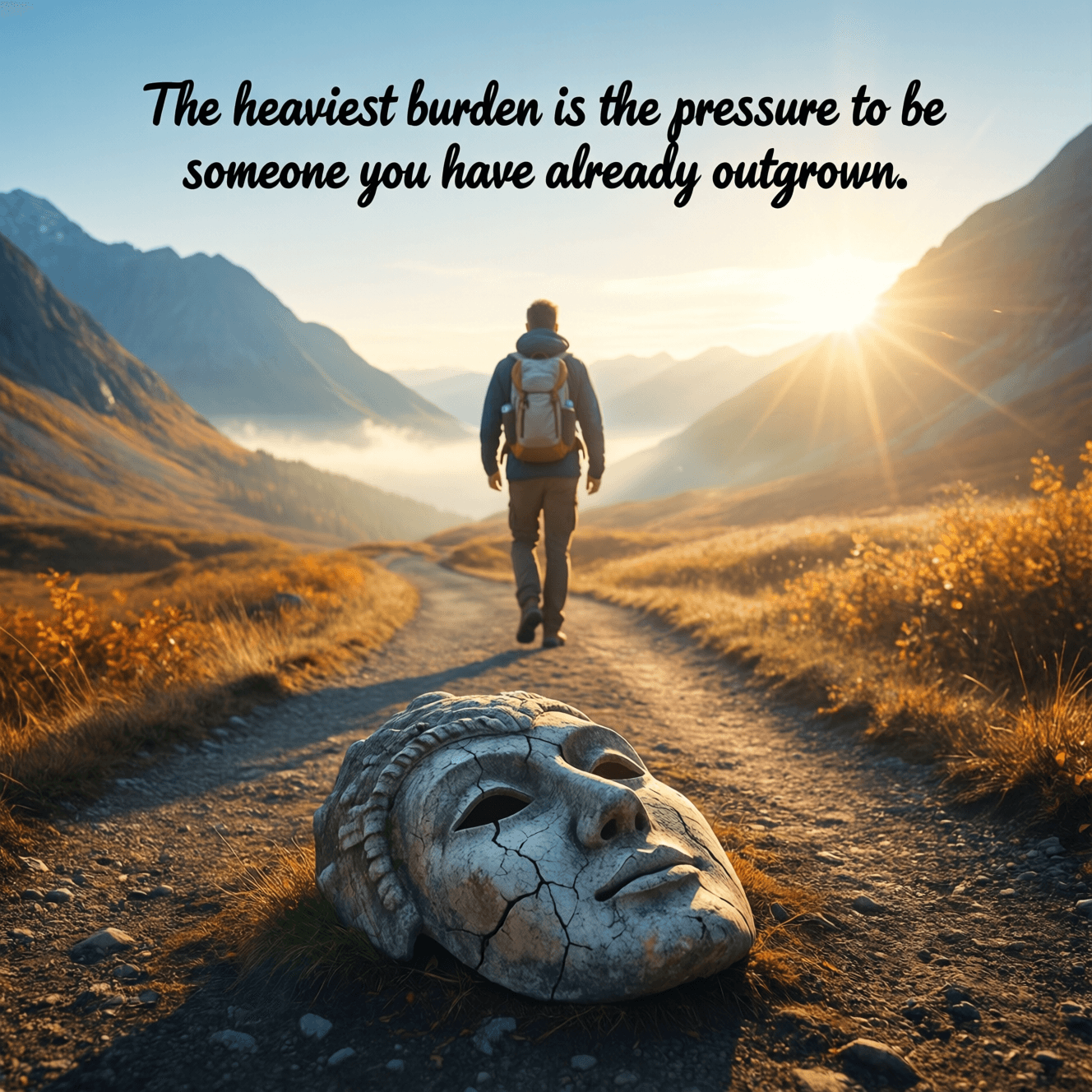
The heaviest burden is the pressure to be someone you have already outgrown. — Unknown
—What lingers after this line?
A Weight Made of Expectations
The quote frames a special kind of heaviness: not the strain of work or loss, but the pressure to keep performing an identity that no longer fits. It suggests that the burden is intensified by repetition—being asked, implicitly or explicitly, to act like yesterday’s self even when today’s self has changed. From there, the “pressure” becomes the central force. It isn’t always imposed by a single person; it can come from routines, institutions, family roles, or the quiet fear that change will disappoint others. The heaviness, then, is less about growth itself and more about resisting it for the sake of familiarity.
Identity as a Role You Can Outgrow
Moving deeper, the line assumes identity is not fixed but developmental—something we revise as we learn, grieve, heal, and mature. This aligns with the broader modern view that the self is constructed over time rather than discovered once; William James’ The Principles of Psychology (1890) distinguishes between different facets of selfhood, implying a person can evolve beyond earlier self-definitions. In practice, outgrowing can be subtle: a former “people pleaser” begins to set boundaries, or a high-achiever stops equating worth with output. The role may have once been adaptive, even protective, yet staying in it later can feel like carrying armor long after the danger has passed.
Social Scripts and the Cost of Consistency
Even when growth is natural, social life rewards consistency. Others often prefer the version of you they understand because it makes their world predictable; the past self becomes a script they can rely on. As a result, changing can trigger friction—friends may say you’ve “changed” as if it were a betrayal rather than a milestone. This is where the burden grows heavier: maintaining the old identity requires constant self-monitoring. You start editing your opinions, dampening new interests, or staying silent to avoid rocking the relational boat. Ironically, the effort to keep relationships stable can destabilize the relationship you have with yourself.
Inner Conflict and the Psychology of Dissonance
At the personal level, the quote points to an internal tug-of-war between who you are becoming and who you feel obligated to remain. Leon Festinger’s theory of cognitive dissonance (1957) explains how psychological discomfort arises when our actions conflict with our beliefs or evolving self-concept; performing an outdated identity can create exactly that friction. Over time, this dissonance can show up as irritability, numbness, or a vague sense of being “stuck,” because your daily behavior is anchored to old narratives. The burden isn’t just emotional—it’s attentional and energetic, draining the resources that could otherwise support learning, creativity, and authentic connection.
When Growth Threatens Belonging
Next comes the relational risk: outgrowing a self can feel like outgrowing a community. Many people learn early that belonging is conditional—based on being agreeable, successful, helpful, or low-maintenance. So when a person starts to change, they may fear rejection, even if no one has explicitly threatened it. A common real-world example is the “responsible one” in a family who later chooses a less predictable path—moving away, changing careers, entering therapy, or setting boundaries. The new self may be healthier, yet the old system may push back because roles kept everything functioning. The quote captures the ache of choosing growth while grieving the comfort of fitting in.
Releasing the Old Self Without Erasing It
Finally, the line implies a compassionate resolution: you can honor who you were without being trapped by it. Outgrowing doesn’t mean the past self was wrong; it means it served its season. In that sense, the burden lifts not by denying your history but by loosening your obligation to reenact it. Practically, this can look like small acts of congruence—stating preferences, renegotiating commitments, or allowing others to adjust to your change. The heaviest pressure often breaks when you permit yourself to be seen in transition, accepting that maturity is not a single identity but an ongoing process of becoming.
One-minute reflection
Why might this line matter today, not tomorrow?
Related Quotes
6 selectedGrowth feels uncomfortable because you are evolving. — Unknown (Wait, skip: Use) Growth is painful, change is painful, but nothing is as painful as staying stuck where you do not belong. — Mandy Hale
Mandy Hale
Mandy Hale’s line frames pain not as a single experience, but as a comparison between two kinds of suffering. On one side is the pain of growth and change—the strain of leaving habits, roles, or relationships that once f...
Read full interpretation →Optimization is a cage with silver bars; true health is the wild, unmeasured rhythm of your own breath. — Unknown
Unknown
“Optimization is a cage with silver bars” points to a modern paradox: the pursuit of better health can become a refined form of confinement. The “silver” suggests something attractive—clean data, wearable metrics, discip...
Read full interpretation →Stop trying to be everyone's cup of tea. You're clearly whiskey, and most people are just looking for a chamomile vibe. — Unknown
Unknown
The quote frames personality as taste: whiskey is strong, distinctive, and not designed to be universally soothing, while chamomile suggests gentleness and broad comfort. In that contrast, it gently exposes the trap of t...
Read full interpretation →Your authenticity is the only thing that cannot be automated. — Unknown
Unknown
The quote argues that while many tasks can be replicated by systems and procedures, authenticity resists replication because it originates in lived experience. In that sense, “cannot be automated” isn’t only a technical...
Read full interpretation →Rest is not a reward for your work. It is the soil where your future self grows. Stop running on empty and begin the recovery immediately. — Unknown
Unknown
The quote begins by challenging a familiar belief: that rest must be earned after productivity proves our worth. By rejecting rest as a “reward,” it reframes recovery as a basic condition of being human rather than a lux...
Read full interpretation →Learning to love yourself is like learning to walk – essential, life-changing, and the only way to stand tall. — Vironika Tugaleva
Vironika Tugaleva
Vironika Tugaleva’s comparison begins with a simple but powerful truth: self-love is not a luxury, but a basic human necessity. Just as walking allows a child to move through the world with growing independence, learning...
Read full interpretation →More From Author
More from Unknown →The language is the substrate. The architecture is the contract.
The line sets up a deliberate pairing: language lies beneath everything, while architecture governs everything above it. In other words, what you can express determines what you can build, and what you commit to structur...
Read full interpretation →A scroll is not a break; it is a trap disguised as rest. — Unknown
The quote begins by challenging a familiar story we tell ourselves: that a brief scroll is a harmless pause between tasks. On the surface, it looks like recovery—no effort, no decision, no commitment.
Read full interpretation →Don't let your ice cream melt while you're counting someone else's sprinkles. — Unknown
The quote uses ice cream as a simple stand-in for life’s fleeting pleasures: what you have is delicious, but it won’t last forever if you ignore it. Meanwhile, “counting someone else’s sprinkles” captures the habit of mo...
Read full interpretation →If your absence doesn't affect them, your presence never mattered. — Unknown
The quote frames absence as a revealing experiment: remove yourself, and the reaction—concern, curiosity, indifference—becomes a kind of data. If nothing changes when you’re gone, it suggests your role was never integrat...
Read full interpretation →