
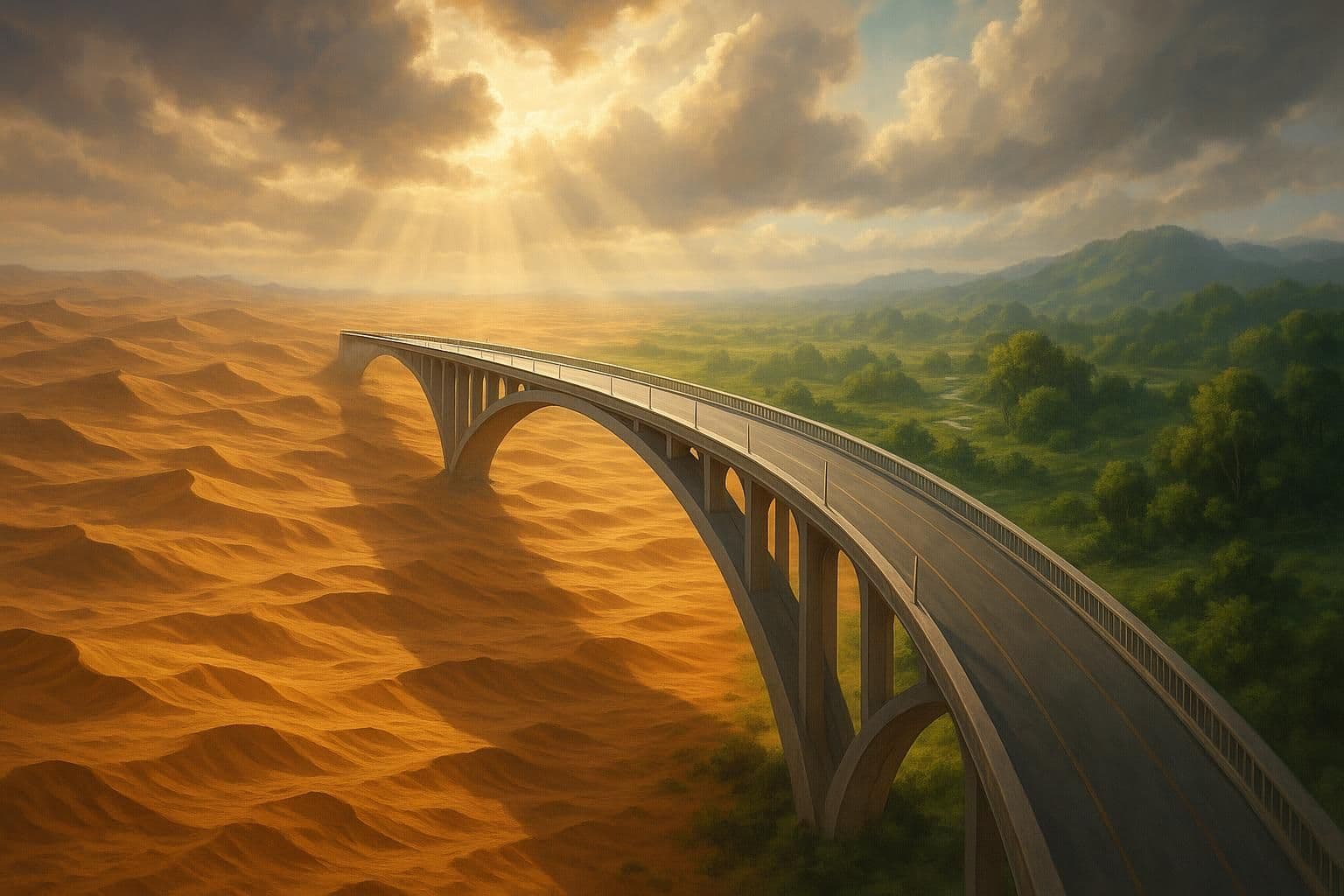
To build bridges, you must first cross deserts. — Naguib Mahfouz
—What lingers after this line?
The Metaphor of Deserts and Bridges
Naguib Mahfouz’s evocative metaphor urges us to recognize that real connection—represented by bridges—can only be achieved by first enduring isolation and difficulty—the deserts. This pairing establishes a progression: before we can unite disparate people or ideas, we must confront personal or collective barren stretches, highlighting the necessity of struggle as part of the process.
Transformation Through Adversity
Tracing this metaphor further, deserts symbolize not only external hardships but also internal journeys of growth. Just as literal deserts test and shape travelers, personal challenges compel individuals to develop resilience and empathy. History abounds with examples—such as the wanderings of Moses and his people in the Sinai desert (Exodus)—where enduring hardship prepared the way for future unity and purpose.
Bridging Differences After Separation
Once the desert has been crossed, the act of bridge-building can begin. This stage signifies reconciliation and cooperation after estrangement or conflict. Consider the reconciliation processes after historical divisions—such as Germany’s reunification after decades of separation—where shared struggle laid the foundation for renewed connection.
Creativity and Progress Born from Trials
Furthermore, crossing metaphorical deserts often sparks creativity and innovation. Mahfouz’s own novels, set against the backdrop of social and political upheaval, demonstrate how artists, thinkers, and societies frequently generate transformative ideas after periods of adversity. Innovation is often the bridge that emerges from a collective desert, as seen in technological leaps following wartime hardship.
The Ongoing Journey Toward Unity
Ultimately, Mahfouz’s wisdom suggests that building bridges is not a one-time task but an ongoing process. As new deserts arise—be they personal disappointments, societal divisions, or global crises—each journey through hardship creates fresh opportunities for understanding and connection. The cyclical crossing of deserts and crafting of bridges defines human progress and enduring community.
One-minute reflection
What does this quote ask you to notice today?
Related Quotes
6 selectedWe are wired for connection, but we must be intentional about how we bridge the gap. — Vivek H. Murthy
Vivek H. Murthy
Vivek H. Murthy’s words begin with a simple truth: human beings are not designed for isolation.
Read full interpretation →The most significant shift underway is not technological. It is relational. People are tired of being audiences. They want to belong. — Mariana F. Silva
Mariana F. Silva
At the heart of Mariana F. Silva’s observation is a subtle but powerful correction to the way modern change is usually described.
Read full interpretation →We cannot be more connected to others than we are to ourselves. — Brené Brown
Brené Brown
Brené Brown’s statement begins with a simple but demanding truth: our relationships with others are limited by the relationship we have with ourselves. If we are estranged from our own feelings, needs, and fears, then ou...
Read full interpretation →Belonging is neither abstract nor soft. It is visceral. It arrives in moments when you feel recognized, needed, connected, and changed in the presence of others. — ASA RISE
ASA RISE
At first glance, belonging can sound like a gentle social luxury, something pleasant but optional. Yet this quote sharply rejects that idea by insisting that belonging is neither abstract nor soft.
Read full interpretation →Connection is not optional. Agency grows when shared, and the world becomes more manageable when people carry it together. — Ayerhs Magazine
Ayerhs Magazine
At its core, the quote rejects the idea that human beings can thrive in isolation. By saying connection is not optional, it frames relationships not as luxuries but as conditions for emotional survival, practical resilie...
Read full interpretation →Connection is not found in the scrolling, but in the pausing. Look up, breathe, and find the person standing right in front of you. — Pico Iyer
Pico Iyer
Pico Iyer’s reflection begins with a quiet reversal of modern habit: instead of searching for connection through constant motion, he locates it in stillness. The phrase “not found in the scrolling, but in the pausing” su...
Read full interpretation →More From Author
More from Naguib Mahfouz →Events are not the result of chance; they are the consequences of what we have done or failed to do. — Naguib Mahfouz
Naguib Mahfouz’s line pushes back against the comforting idea that life simply “happens” to us. Instead, it frames events as outcomes—sometimes immediate, sometimes delayed—of choices we make and responsibilities we avoi...
Read full interpretation →Build a life of honest labor and the city of your soul will shine. — Naguib Mahfouz
Mahfouz frames the inner life as a “city,” implying streets, foundations, and long-term maintenance rather than a single grand revelation. A city becomes livable through countless ordinary tasks—cleaning, repairing, buil...
Read full interpretation →Turn your questions into action; curiosity is the engine of change. — Naguib Mahfouz
Mahfouz’s line compresses a whole philosophy: inquiry should not idle in abstraction; it must set reality in motion. As a novelist of Cairo’s tight alleys and wide upheavals, he knew that small questions unsettle settled...
Read full interpretation →Find the lesson in hardship, then use it to design new doors, not new walls. — Naguib Mahfouz
Mahfouz’s line reframes adversity as a design brief: extract the insight, then build openings—not barricades. A “wall” is a reflex of fear, meant to shut out future pain; a “door” is a deliberate structure that channels...
Read full interpretation →