
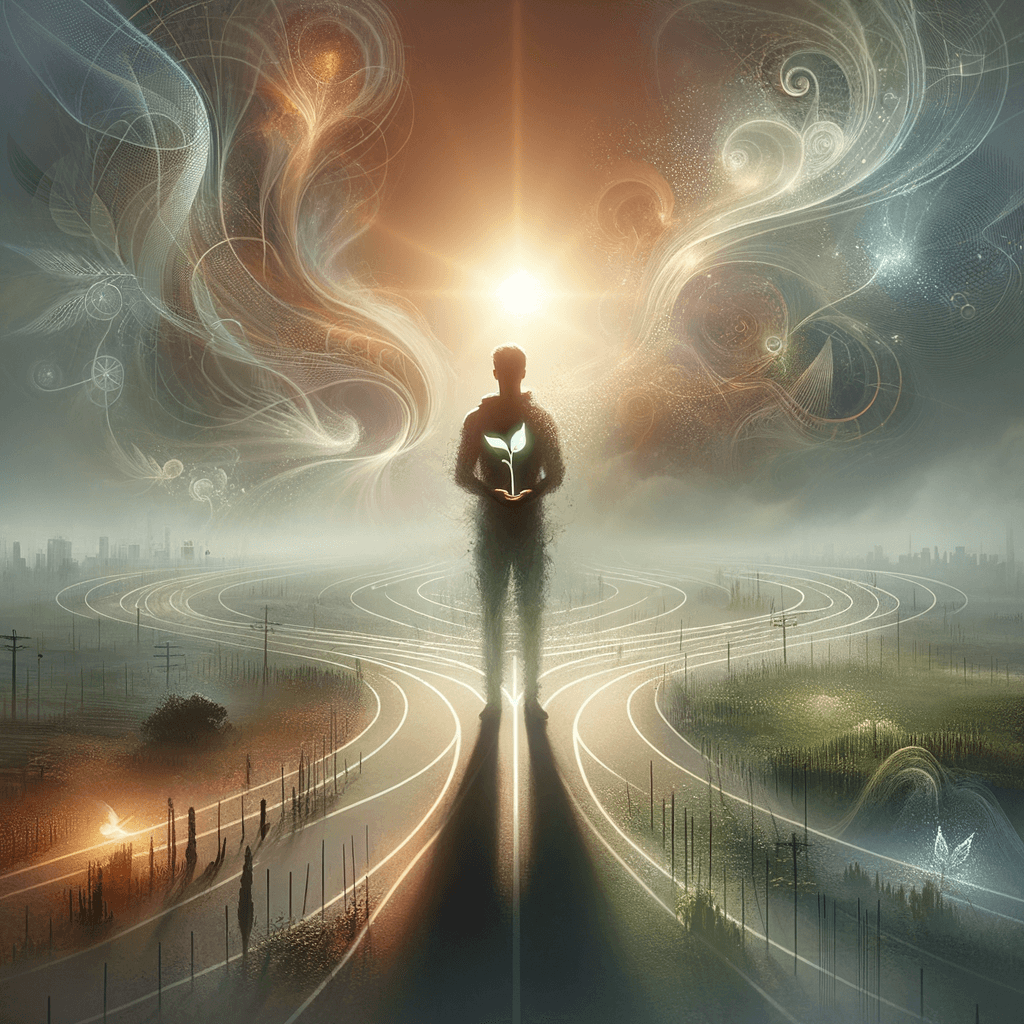
We are not what we were born, but what we choose to become. — Paul Valéry
—What lingers after this line?
Human Agency and Free Will
The quote emphasizes the idea of free will, suggesting that our identity or destiny is not dictated by our birth but shaped by the choices we make throughout life.
Self-Determination
It highlights the power of self-determination, encouraging individuals to take responsibility for themselves and their futures, rather than being defined by circumstances or external factors.
Personal Growth
The quote stresses that personal development and growth are continuous processes. It points out that we have the ability to grow beyond our origins through decisions, experiences, and learning.
Rejecting Preconceptions and Stereotypes
Valéry pushes against the idea of being confined by societal expectations or stereotypes based on race, class, or birthright. Instead, he invites us to define ourselves by our actions and ambitions.
Philosophical Reflection
The quote holds philosophical meaning, encouraging deep reflection on human existence and identity. It prompts the reader to think about the role of choice, autonomy, and personal effort in shaping one's life.
Historical Context
Paul Valéry, a French poet and philosopher, lived during the late 19th and early 20th century. His works often delved into introspective and philosophical themes. This particular quote reflects the existential questions that were prominent in European intellectual discourse during that time.
One-minute reflection
What's one small action this suggests?
Related Quotes
6 selectedMy will shall shape my future. Whether I fail or succeed shall be no man's doing but my own. — Elaine Maxwell
Elaine Maxwell
At its core, Elaine Maxwell’s statement is a declaration of personal agency. By saying that her will shall shape her future, she rejects the idea that destiny is merely handed down by circumstance, luck, or the judgments...
Read full interpretation →If it is to be, it is up to me. — William H. Johnsen
William H. Johnsen
At first glance, William H. Johnsen’s line compresses an entire philosophy into a few plain words: desired outcomes do not arrive by wish alone, but through personal action.
Read full interpretation →The road ahead is not some predetermined path that I am forced to trod, but it is a rich byway that I can help create. — Craig D. Lounsbrough
Craig D. Lounsbrough
At its core, Craig D. Lounsbrough’s quote resists the idea that life is a rigid script already written for us.
Read full interpretation →I didn't know what I wanted to do, but I always knew the woman I wanted to be. — Diane von Furstenberg
Diane von Fürstenberg
Diane von Furstenberg’s line separates two kinds of knowing: the uncertainty of career direction and the clarity of self-concept. Not knowing what you want to do can feel like drift, yet knowing who you want to be provid...
Read full interpretation →You have to be a person first. Everything else comes second. — Katherine May
Katherine May
Katherine May’s line sounds almost obvious at first—be a person first—but its power lies in how often we reverse the order. In daily life, it’s easy to introduce ourselves through our outputs: job titles, productivity, u...
Read full interpretation →If you don't see a clear path for a career, sometimes you have to make it yourself. — Mindy Kaling
Mindy Kaling
Mindy Kaling’s line begins with a candid observation: not everyone is handed a clear career roadmap. In many fields, the “path” is more myth than method—job titles are ambiguous, internships are scarce, and the steps fro...
Read full interpretation →More From Author
More from Paul Valéry →An artist never really finishes his work, he merely abandons it. — Paul Valéry
At first glance, Paul Valéry’s remark sounds severe, yet it captures a familiar truth about artistic labor: a work rarely reaches a perfect, final state in the artist’s mind. Instead, there comes a moment when revision m...
Read full interpretation →What is simple is false and what is not is useless. -- Paul Valery
Paul Valéry’s line compresses a lifelong skepticism into a single dilemma: if an explanation is too simple, it distorts reality; if it captures reality’s full complexity, it becomes unusable. The quote therefore isn’t me...
Read full interpretation →The best way to make your dreams come true is to wake up. — Paul Valéry
This quote emphasizes the importance of taking action and being proactive in order to achieve your dreams. It highlights that dreams alone are not sufficient; they require effort and dedication to realize.
Read full interpretation →The respectable thing is not to lose one’s self at all. — Paul Valery
This quote emphasizes the importance of maintaining one's self-identity and integrity. Valéry suggests that it is more admirable to stay true to who you are, regardless of external influences or pressures.
Read full interpretation →