
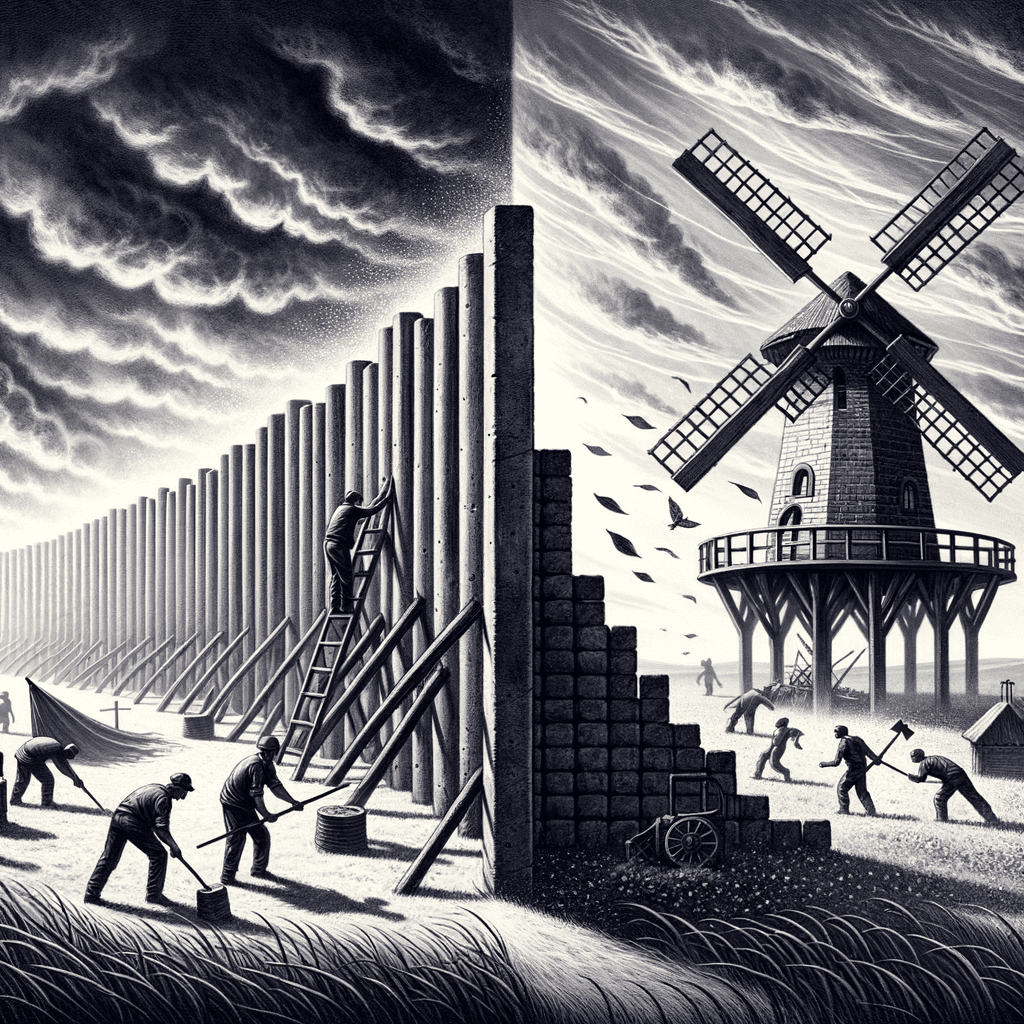
When the winds of change blow, some people build walls and others build windmills.
—What lingers after this line?
Adapting to Change
This quote highlights the different ways people react to change. Some resist it by building walls, trying to keep things as they were, while others embrace it and find ways to benefit from the new circumstances, symbolized by building windmills.
Opportunities vs. Resistance
Building walls represents resistance to change and a desire to stay within a comfort zone. In contrast, building windmills symbolizes seeing change as an opportunity for growth and innovation.
Mindset and Perspective
The quote underscores the importance of mindset in dealing with change. It suggests that a constructive and proactive approach (building windmills) is more beneficial than a defensive and reactive one (building walls).
Embracing Innovation
Windmills convert wind into useful energy, signifying the ability to transform challenges into productive outcomes. This implies that those who can adapt and innovate will thrive in changing conditions.
Cultural and Social Implications
On a broader scale, the quote can be applied to societies and cultures, where some may resist new ideas and reforms while others may harness these changes to foster progress and development.
One-minute reflection
What's one small action this suggests?
Related Quotes
6 selectedIn a storm, some people build walls while others build windmills.
Unknown
This quote highlights that people respond to challenges and adversities in various ways. Some choose to protect themselves by building walls, while others find ways to harness the situation to their advantage by building...
Read full interpretation →If there is a will, there is a way.
Unknown
This phrase suggests that when someone is determined and committed to achieving something, they will find a method to accomplish it, regardless of the obstacles they face.
Read full interpretation →Emotional resilience refers to your ability to roll with the punches, adapt to adversity, and bounce back after setbacks. — Bettendorf Counseling Center
Bettendorf Counseling Center
At its core, the Bettendorf Counseling Center’s definition frames emotional resilience as a flexible strength rather than a hard shell. To “roll with the punches” is not to avoid pain or pretend setbacks do not matter; i...
Read full interpretation →The artist is not a solid, static being. The artist is fluid, like water, moving with the tides and changing form. — James McCrae
James McCrae
James McCrae’s image of the artist as fluid immediately challenges the common idea that creative people possess a single, fixed essence. Instead, he suggests that artistry is a process of becoming, not a stable condition...
Read full interpretation →The mind adapts and converts to its own purposes the obstacle to our acting. — Marcus Aurelius
Marcus Aurelius
At its heart, Marcus Aurelius’s line expresses a central Stoic conviction: external events do not fully determine our lives; rather, our judgments about them shape what they become. In his Meditations (c.
Read full interpretation →Adaptability is not imitation. It means power of resistance and assimilation. — Rabindranath Tagore
Rabindranath Tagore
At the heart of Tagore’s statement lies a careful distinction between changing and merely copying. Adaptability, he argues, is not the passive act of becoming like one’s surroundings; rather, it is an active power that a...
Read full interpretation →More From Author
More from Unknown →The language is the substrate. The architecture is the contract.
The line sets up a deliberate pairing: language lies beneath everything, while architecture governs everything above it. In other words, what you can express determines what you can build, and what you commit to structur...
Read full interpretation →A scroll is not a break; it is a trap disguised as rest. — Unknown
The quote begins by challenging a familiar story we tell ourselves: that a brief scroll is a harmless pause between tasks. On the surface, it looks like recovery—no effort, no decision, no commitment.
Read full interpretation →Don't let your ice cream melt while you're counting someone else's sprinkles. — Unknown
The quote uses ice cream as a simple stand-in for life’s fleeting pleasures: what you have is delicious, but it won’t last forever if you ignore it. Meanwhile, “counting someone else’s sprinkles” captures the habit of mo...
Read full interpretation →If your absence doesn't affect them, your presence never mattered. — Unknown
The quote frames absence as a revealing experiment: remove yourself, and the reaction—concern, curiosity, indifference—becomes a kind of data. If nothing changes when you’re gone, it suggests your role was never integrat...
Read full interpretation →