
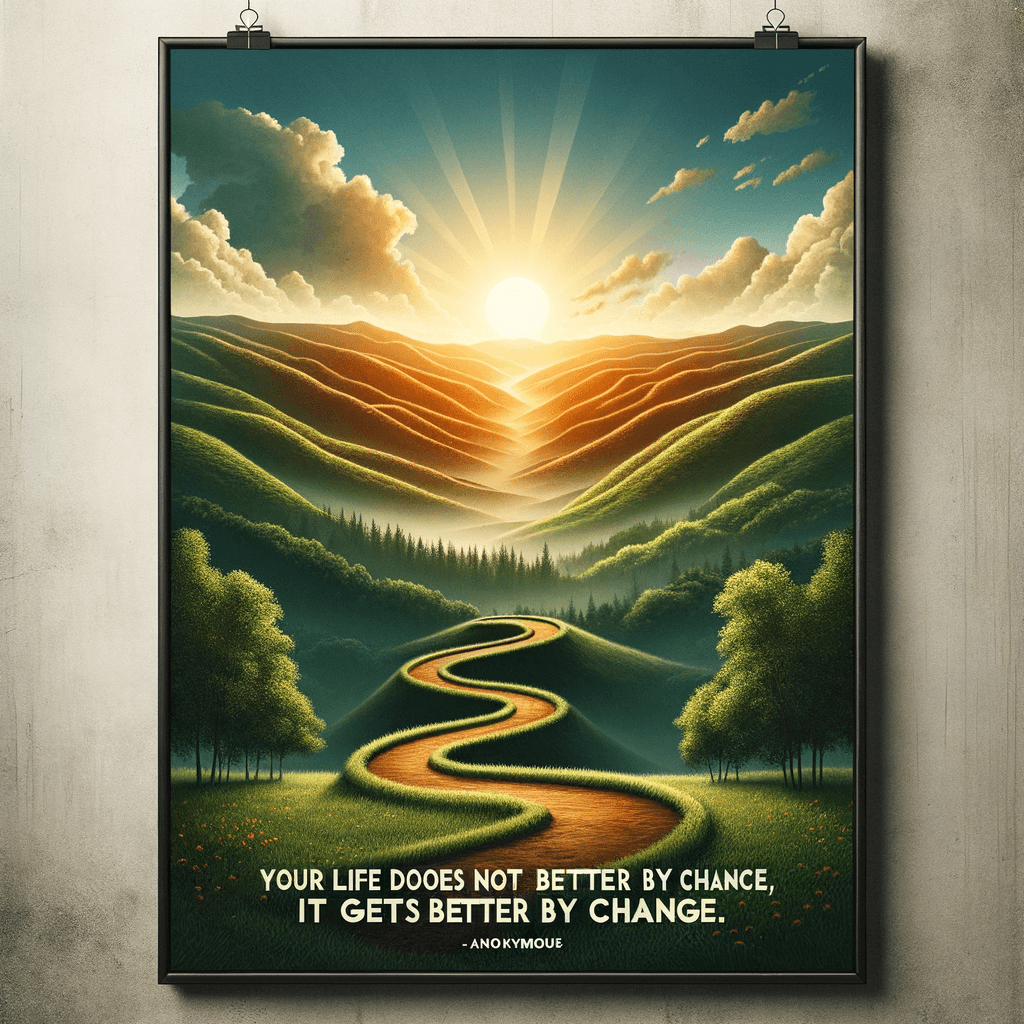
Your life does not get better by chance, it gets better by change. – Jim Rohn
—What lingers after this line?
Proactive Improvement
This quote emphasizes the necessity of taking intentional action to improve one's life. Relying on chance alone is insufficient; active change is required.
Personal Responsibility
It highlights the role of personal responsibility in shaping one's life. Success and improvement come from making conscious decisions and efforts rather than leaving things to luck.
Growth Mindset
The quote advocates for a growth mindset, where one believes that abilities and situations can be developed and improved through dedication and hard work.
Empowerment
Jim Rohn's words serve to empower individuals, encouraging them to take control of their destinies and make the changes necessary to achieve their goals.
Motivational Context
As a renowned motivational speaker and entrepreneur, Jim Rohn's quote is part of his broader philosophy that emphasizes self-improvement, discipline, and strategic action as keys to success.
One-minute reflection
What feeling does this quote bring up for you?
Related Quotes
6 selectedLearning to love yourself is like learning to walk – essential, life-changing, and the only way to stand tall. — Vironika Tugaleva
Vironika Tugaleva
Vironika Tugaleva’s comparison begins with a simple but powerful truth: self-love is not a luxury, but a basic human necessity. Just as walking allows a child to move through the world with growing independence, learning...
Read full interpretation →The most gifted members of the human species are at their creative best when they cannot have their way, and must compensate for what they miss by realizing and cultivating their capacities. — Bryant H. McGill
Bryant H. McGill
Bryant H. McGill’s observation begins with a striking reversal: gifted people may not reach their highest potential when everything comes easily, but when something blocks their path.
Read full interpretation →A mind grows by staying with difficulty long enough for the experience to change it. — Mary Catherine Bateson
Mary Catherine Bateson
Mary Catherine Bateson’s observation begins with a quiet but demanding truth: the mind does not grow merely by encountering difficulty, but by remaining with it. Challenge becomes transformative only when we resist the u...
Read full interpretation →Consistency is a superpower. — Ryan Holiday
Ryan Holiday
Ryan Holiday’s line begins with a deceptively simple idea: greatness is rarely built through dramatic gestures. More often, it emerges from repeated actions that seem ordinary in isolation but become extraordinary over t...
Read full interpretation →Confidence is silent. Insecurities are loud. — Unknown (Wait—skip/replace with: True nobility is being superior to your former self. — Ernest Hemingway)
Ernest Hemingway
At its core, Hemingway’s line redefines nobility as an inward achievement rather than a social rank. Instead of measuring worth by wealth, pedigree, or dominance over others, it points to a quieter standard: becoming bet...
Read full interpretation →You are under no obligation to be consistent with the person you were yesterday. — James McCrae
James McCrae
At its core, James McCrae’s line challenges the quiet pressure to remain legible to others. Many people feel bound to opinions, habits, or identities simply because they once claimed them, as though consistency were a mo...
Read full interpretation →More From Author
More from Jim Rohn →Learn to be thankful for what you already have, while you pursue all that you want. — Jim Rohn
Jim Rohn’s advice begins with a delicate balance: appreciation for the present should not cancel ambition for the future. Instead, gratitude and aspiration can move together, like two steps in the same journey.
Read full interpretation →It is easier to discipline yourself now than to regret your lack of discipline later. — Jim Rohn
Jim Rohn’s saying turns discipline into a simple comparison of costs. On one side is the discomfort of acting now: waking up early, saving money, studying longer, or saying no to distraction.
Read full interpretation →Beyond a wholesome discipline, be gentle with yourself. — Jim Rohn
At first glance, Jim Rohn’s line places two values side by side that are often treated as opposites: discipline and gentleness. Yet the force of the quote lies in its quiet correction.
Read full interpretation →Your level of success is determined by your level of discipline and your ability to protect your own energy, not just your capacity to endure. — Jim Rohn
At first glance, Jim Rohn’s quote challenges a common cultural myth: that success belongs mainly to those who can suffer the longest. Instead, he shifts attention toward discipline and energy management, suggesting that...
Read full interpretation →