
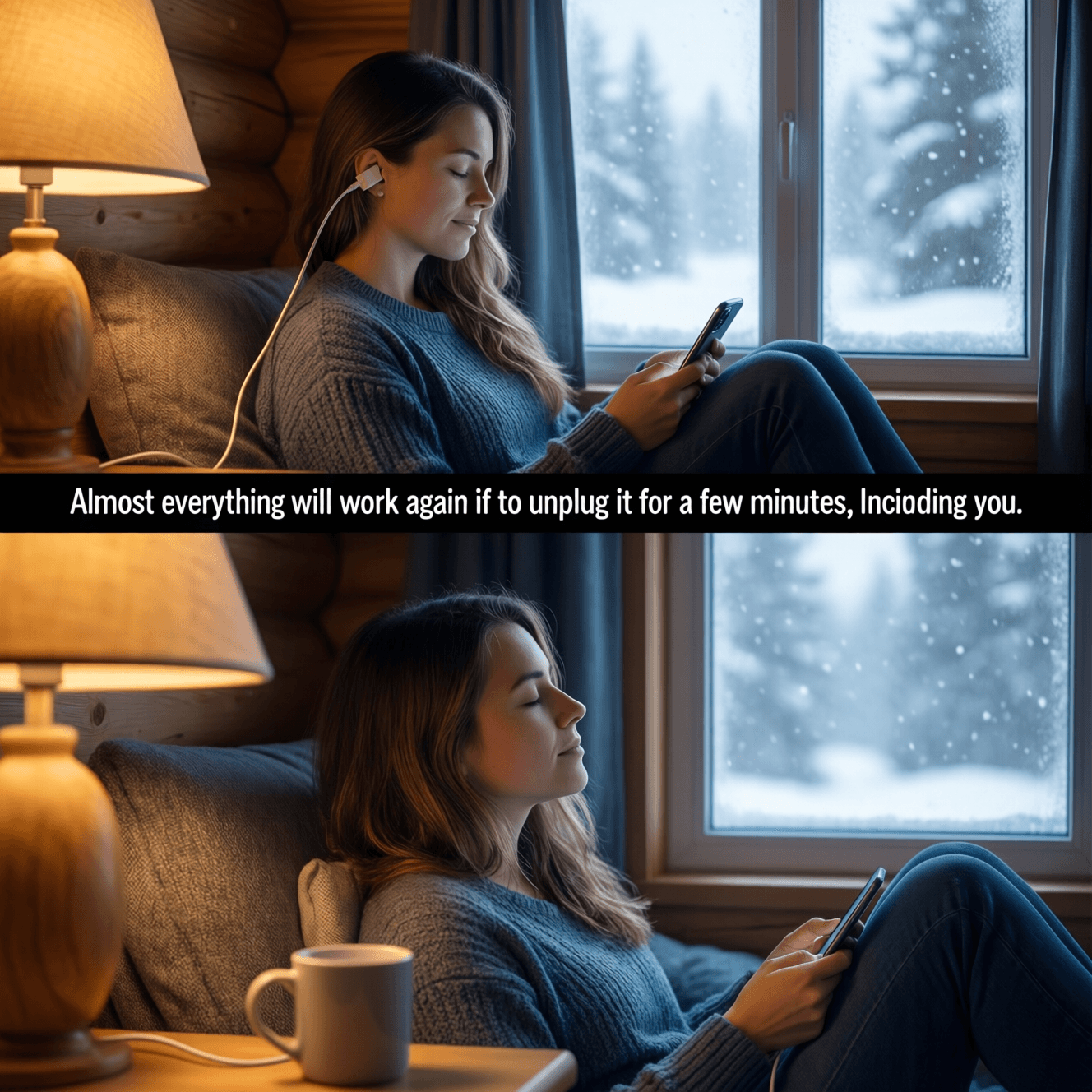
Almost everything will work again if you unplug it for a few minutes, including you. — Anne Lamott
—What lingers after this line?
A Homely Metaphor with Real Weight
Anne Lamott’s line begins with a familiar troubleshooting ritual: when a device freezes, you unplug it and wait. By adding “including you,” she turns a domestic metaphor into a humane instruction, suggesting that people, too, can become glitchy under constant strain. The charm of the quote is its plainness—it doesn’t glamorize burnout or promise instant transformation, but it does insist that interruption can be restorative. From there, the idea quietly expands: if our minds and bodies are also systems with limits, then “resetting” is not indulgence but maintenance. In other words, stepping away is less a retreat from life than a way to re-enter it with functioning parts.
Why Constant Onness Breaks Us Down
Moving from metaphor to mechanism, the quote points to what happens when we run without pauses: attention frays, emotions become reactive, and small problems feel unmanageably loud. Modern work and digital culture make this especially easy—notifications, multitasking, and the pressure to be reachable can mimic a device stuck in an endless loop. Seen this way, Lamott is naming a common pattern: when we ignore early signs of overload, we often require a bigger reset later. The unplugging she recommends is a preventative interruption, a small break that keeps minor malfunctions from turning into systemic failure.
Rest as a Reset, Not a Reward
The next implication is ethical as much as practical: rest is not something you earn after suffering, but something you need in order to function with care and clarity. This challenges the cultural habit of treating exhaustion as proof of worth. If unplugging is basic maintenance, then skipping it is like refusing to sleep because you haven’t “deserved” it. Lamott’s phrasing also carries permission. By normalizing the need to power down, she reframes self-care away from luxury and toward necessity—closer to drinking water than taking a vacation.
The Science of the Pause
Shifting into a more empirical register, the idea aligns with what sleep and stress research repeatedly suggests: recovery periods are when the body recalibrates. Sleep supports memory consolidation and emotional regulation, and chronic stress without recovery can dysregulate systems like cortisol rhythms. Even brief breaks can reduce cognitive fatigue and restore decision quality, much like a forced restart clears a stalled process. Importantly, “a few minutes” doesn’t have to be literal to be useful. It can mean a short walk, a quiet room, a nap, or a screen-free interval—small interventions that create enough distance for the nervous system to soften its grip.
Unplugging as a Boundary, Not an Escape
However, the quote works best when unplugging is paired with intention. The goal isn’t avoidance of responsibility but a boundary that prevents responsibilities from consuming every hour and inner resource. In practice, this might look like ending the workday at a set time, turning off push notifications, or taking a lunch break without a device in hand. That boundary-making matters because many people don’t burn out from one crisis; they burn out from the absence of edges. Lamott’s advice becomes a small act of reclaiming agency: you decide when you are available, and when you are recharging.
Returning to Life More Fully Awake
Finally, the most hopeful part of Lamott’s sentence is the word “again.” It implies that malfunction is not identity; it is a temporary state. After unplugging, you don’t become a different person—you become more yourself: calmer, clearer, and less stuck in the narrow tunnel of urgency. The quote thus ends as a quiet promise and a practical instruction. When you feel like you can’t think, can’t cope, or can’t connect, the first step may not be to push harder. It may be to power down long enough to come back online with steadier light.
One-minute reflection
Why might this line matter today, not tomorrow?
Related Quotes
6 selectedAlmost everything will work again if you unplug it for a few minutes, including you. — Anne Lamott
Anne Lamott
Anne Lamott’s line borrows the language of everyday troubleshooting to make a surprisingly tender point about being human. When a device freezes, we don’t argue with it or shame it—we simply power it down and give it tim...
Read full interpretation →Almost everything will work again if you unplug it for a few minutes—including you. — Anne Lamott
Anne Lamott
Anne Lamott’s line reads like a piece of homespun tech advice, but it lands as something closer to wisdom: when systems get overloaded, the simplest intervention is to stop and reset. By placing “you” beside a machine, s...
Read full interpretation →Almost everything will work again if you unplug it for a few minutes, including you. — Anne Lamott
Anne Lamott
Anne Lamott’s line begins with an ordinary troubleshooting tip—unplug the device, wait, then try again—but it quickly widens into a humane philosophy. The charm is in its everyday accuracy: many glitches are solved not b...
Read full interpretation →Almost everything will work again if you unplug it for a few minutes, including you. — Anne Lamott
Anne Lamott
Anne Lamott frames a familiar tech fix as a life philosophy: when something malfunctions, step away and let it reset. The line lands because it’s funny, but it stays with us because it’s true—many problems intensify when...
Read full interpretation →Slow down. You are not a machine designed for constant output; you are a human meant for intentional being. — Anne Lamott
Anne Lamott
Anne Lamott’s line begins as a gentle interruption, yet it lands like a critique of modern life. By saying, “Slow down,” she challenges a culture that rewards constant motion and treats rest as weakness.
Read full interpretation →Almost everything will work again if you unplug it for a few minutes... including you. — Anne Lamott
Anne Lamott
Anne Lamott’s quip borrows the plain wisdom of troubleshooting: when a device glitches, you power it down, wait, and restart. By extending that logic to people, she turns a tech cliché into a humane parable—one that gent...
Read full interpretation →More From Author
More from Anne Lamott →Recovery is not a race. You don't have to feel guilty if it takes you longer than you thought it would. — Anne Lamott
Anne Lamott’s reminder begins by challenging one of the quiet cruelties of recovery: the belief that healing should follow a predictable schedule. Whether the wound is physical, emotional, or spiritual, people often comp...
Read full interpretation →Do not mistake your digital silence for peace. Real strength is found in the courage to speak the truth to the people who hold your heart. — Anne Lamott
At first glance, Anne Lamott’s quote challenges a familiar illusion: silence can resemble peace without actually creating it. Choosing not to speak may keep conflict out of sight, yet beneath that quiet surface, hurt, co...
Read full interpretation →Your worth is not a spreadsheet. You are not a project to be completed, but a life to be experienced. Stop measuring and start breathing. — Anne Lamott
Anne Lamott’s quote begins by confronting a habit many people barely notice: treating human value as if it could be tabulated. A spreadsheet symbolizes order, productivity, and comparison, yet it also reduces complexity...
Read full interpretation →The art of living is not about being a finished masterpiece; it is about being a work in progress that still knows how to laugh at its own paint spills. — Anne Lamott
At its heart, Anne Lamott’s remark reframes life from a quest for perfection into an ongoing act of creation. Instead of imagining ourselves as polished masterpieces, she invites us to see our days as brushstrokes still...
Read full interpretation →