
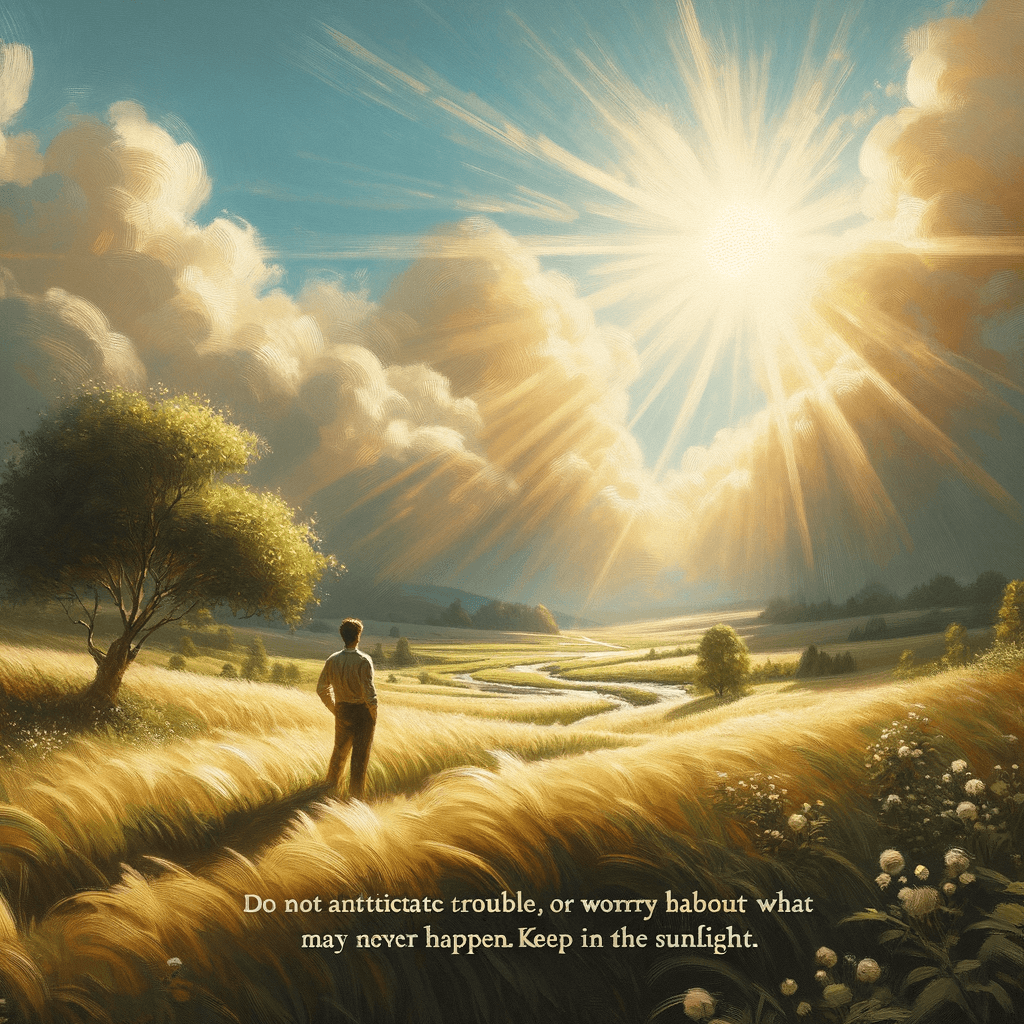
Do not anticipate trouble, or worry about what may never happen. Keep in the sunlight. — Benjamin Franklin
—What lingers after this line?
Avoiding Unnecessary Worry
This quote advises against spending time and energy worrying about potential problems that may never come to pass. By doing so, one can avoid unnecessary stress and anxiety.
Living in the Present
It encourages living in the present and focusing on the current moment instead of being preoccupied with future uncertainties. This mindset helps in maintaining a more positive and peaceful mental state.
Optimism and Positivity
The phrase 'keep in the sunlight' suggests staying optimistic and positive. By concentrating on the brighter side of life, individuals can cultivate a more hopeful outlook.
Stress Management
By not anticipating trouble, one can manage stress more effectively. This approach can lead to better mental health and overall well-being, as excessive worrying often leads to emotional and physical strain.
Practical Wisdom
Benjamin Franklin, one of the Founding Fathers of the United States, was known for his practical wisdom and insightful advice. This quote is a reflection of his belief in rational thinking and emotional resilience.
One-minute reflection
What feeling does this quote bring up for you?
Related Quotes
6 selectedOptimist: someone who figures that taking a step backward after taking a step forward is not a disaster, it's more like a cha-cha. — Robert Brault
Robert Brault
Robert Brault’s line begins with a witty redefinition: an optimist is not someone who denies backward motion, but someone who interprets it differently. Instead of treating a setback as proof of failure, the optimist see...
Read full interpretation →If things go wrong, don't go with them. — Roger Babson
Roger Babson
At first glance, Roger Babson’s line sounds simple, yet it captures a difficult discipline: when events begin to unravel, we do not have to unravel with them. Problems often create their own momentum, pulling emotions, j...
Read full interpretation →A deadline is, simply put, optimism in its most kick-ass form. — Chris Baty
Chris Baty
At first glance, Chris Baty’s remark sounds like a joke about stress, yet it quickly turns into something sharper: a deadline is faith disguised as urgency. To set a date for finishing anything is to believe, perhaps stu...
Read full interpretation →Anxiety is just the imagination working overtime, and most of that overtime is completely unpaid. — Alain de Botton
Alain de Botton
At first glance, Alain de Botton’s remark frames anxiety with disarming humor: the mind behaves like an overworked employee, generating scenarios, rehearsing disasters, and collecting no reward for the effort. By calling...
Read full interpretation →Don't believe every worried thought you have. Worried thoughts are notoriously inaccurate. — Renee Jain
Renee Jain
At its core, Renee Jain’s quote confronts a habit many people barely notice: treating every anxious thought as if it were reliable evidence. Worry often arrives with urgency, and because it feels protective, it can masqu...
Read full interpretation →Your anxiety is not a failure; it is a signal. Stop trying to silence it and start listening to what it is trying to teach you about your boundaries. — Bessel van der Kolk
Bessel van der Kolk
At first glance, anxiety often feels like evidence that something is wrong within us. Yet Bessel van der Kolk reverses that assumption, suggesting that anxiety is not simply a defect to erase but a message to interpret.
Read full interpretation →More From Author
More from Benjamin Franklin →It is easier to suppress the first desire than to satisfy all that follow. — Benjamin Franklin
Benjamin Franklin’s remark turns self-control into a matter of timing. Rather than warning only against excess, he suggests that the earliest moment of temptation is the easiest and most decisive place to act.
Read full interpretation →Whatever is begun in anger, ends in shame. — Benjamin Franklin
At first glance, Benjamin Franklin’s line offers a compact moral lesson, yet its force comes from how accurately it describes human behavior. When something is begun in anger, judgment narrows, pride takes control, and t...
Read full interpretation →It is easier to prevent bad habits than to break them. — Benjamin Franklin
At its core, Benjamin Franklin’s remark captures a simple but enduring truth: habits are far easier to avoid at the beginning than to undo once they become routine. A repeated action gradually slips beneath conscious cho...
Read full interpretation →He that cannot obey, cannot command. — Benjamin Franklin
At its core, Benjamin Franklin’s statement argues that authority is not truly earned by status alone. A person who has never learned to follow rules, accept correction, or work within a larger order lacks the discipline...
Read full interpretation →