
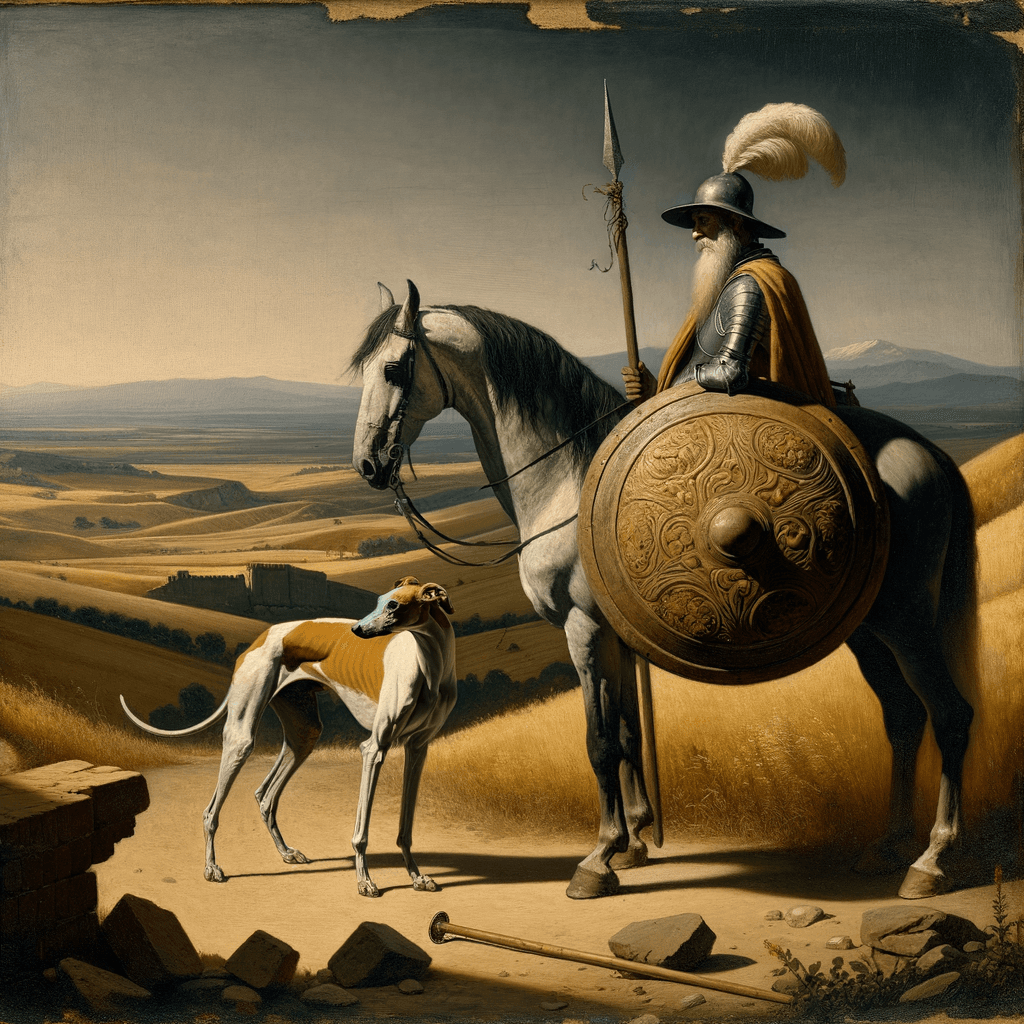
In a place in La Mancha, whose name I do not want to remember, not long ago lived a hidalgo, one of those with a lance in the rack, an ancient shield, a skinny horse, and a swift greyhound.
—What lingers after this line?
Introduction to the Setting
This quote introduces the setting of the novel, 'Don Quixote'. It takes place in the region of La Mancha in Spain, setting the stage for the adventures of the protagonist.
Character Description
The quote describes the main character, a hidalgo (a member of the Spanish nobility) who is introduced with characteristic elements like a lance, shield, skinny horse, and a greyhound. These details highlight his noble but modest status.
Narrative Tone
The phrase 'whose name I do not want to remember' adds a subtle, almost whimsical tone to the narration, suggesting a story filled with both nostalgia and a hint of humor.
Historical Context
Miguel de Cervantes wrote 'Don Quixote' in the early 17th century. The references to medieval weaponry and a greyhound reflect the social and cultural environment of that era in Spain.
Foreshadowing
The description of the protagonist's possessions hints at the forthcoming satire of chivalric romance, as these outdated items reflect his fixation on old notions of knighthood and chivalry.
One-minute reflection
What feeling does this quote bring up for you?
Related Quotes
6 selectedIn a place in La Mancha, whose name I do not wish to recall, not long ago there lived a nobleman with a lance in the rack, an ancient shield, a skinny horse, and a swift greyhound.
Unknown
The opening line sets the scene in La Mancha, a historical and geographical region of Spain. The author deliberately chooses not to specify the exact place, adding a sense of mystery.
Read full interpretation →In a place in La Mancha, the name of which I do not wish to recall, there lived not long ago a nobleman of those with a lance in the rack, an old shield, a scrawny horse, and a greyhound.
Unknown
The quote introduces the reader to a vague and unspecified place in La Mancha, a region in Spain. This sets the tone for a story that blends reality with fiction.
Read full interpretation →In a place in La Mancha, whose name I do not wish to remember, not long ago lived a gentleman of those with a lance in the rack, an old shield, a skinny nag, and a greyhound for racing.
Unknown
This opening line sets the scene in La Mancha, an arid region in central Spain known for its windmills and rustic landscapes. It establishes the rural and historical context of the story.
Read full interpretation →In a village of La Mancha, the name of which I have no desire to call to mind, there lived not long since one of those gentlemen that keep a lance in the lance-rack, an old buckler, a lean hack, and a greyhound for coursing. - Miguel de Cervantes
Miguel de Cervantes
This is the opening line of Miguel de Cervantes' famous novel, 'Don Quixote.' It sets the stage for introducing the main character, an aging gentleman who is to become the titular knight-errant.
Read full interpretation →In a corner of the soul where only the wind reaches, I have kept your caresses in a chest of memories. - Anonymous
Unknown
This quote illustrates how deeply personal and cherished memories are stored in the most secluded parts of one's soul, untouched by the outside world except for the faintest whisper of the wind.
Read full interpretation →I think we are well-advised to keep on nodding terms with the people we used to be. — Joan Didion
Joan Didion
Joan Didion’s line frames personal history as a relationship—one that can be tended, neglected, or openly severed. To be on “nodding terms” is not to embrace every past decision with pride, but to acknowledge that the pe...
Read full interpretation →More From Author
More from Unknown →The language is the substrate. The architecture is the contract.
The line sets up a deliberate pairing: language lies beneath everything, while architecture governs everything above it. In other words, what you can express determines what you can build, and what you commit to structur...
Read full interpretation →A scroll is not a break; it is a trap disguised as rest. — Unknown
The quote begins by challenging a familiar story we tell ourselves: that a brief scroll is a harmless pause between tasks. On the surface, it looks like recovery—no effort, no decision, no commitment.
Read full interpretation →Don't let your ice cream melt while you're counting someone else's sprinkles. — Unknown
The quote uses ice cream as a simple stand-in for life’s fleeting pleasures: what you have is delicious, but it won’t last forever if you ignore it. Meanwhile, “counting someone else’s sprinkles” captures the habit of mo...
Read full interpretation →If your absence doesn't affect them, your presence never mattered. — Unknown
The quote frames absence as a revealing experiment: remove yourself, and the reaction—concern, curiosity, indifference—becomes a kind of data. If nothing changes when you’re gone, it suggests your role was never integrat...
Read full interpretation →