
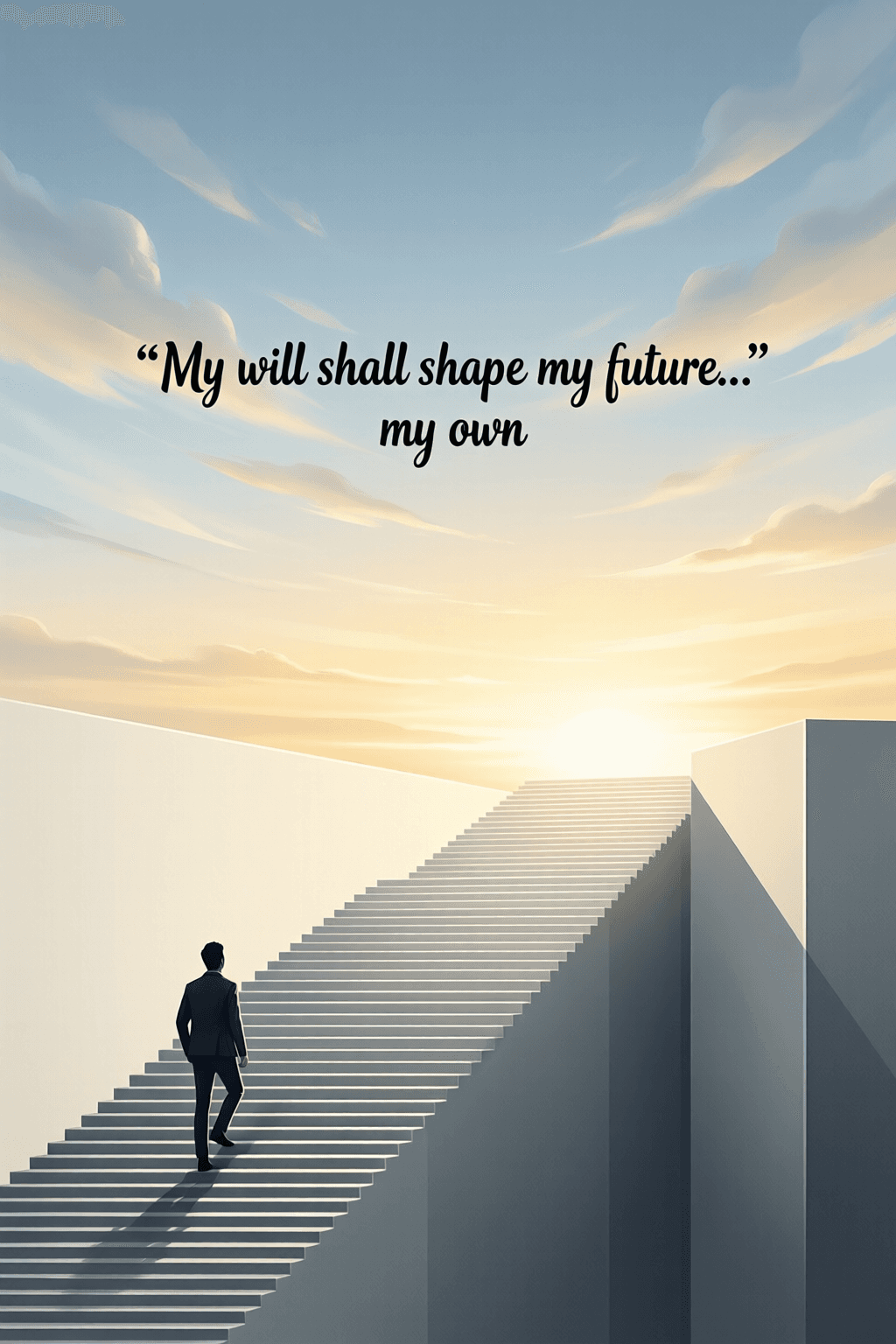
My will shall shape my future. Whether I fail or succeed shall be no man's doing but my own. — Elaine Maxwell
—What lingers after this line?
Claiming Ownership of One’s Path
At its core, Elaine Maxwell’s statement is a declaration of personal agency. By saying that her will shall shape her future, she rejects the idea that destiny is merely handed down by circumstance, luck, or the judgments of others. In this view, success and failure are not random verdicts imposed from outside, but consequences tied to inner resolve and deliberate action. This opening claim immediately sets a tone of self-possession. Rather than waiting for permission or rescue, the speaker places responsibility squarely on herself. That shift matters, because once a person accepts ownership of the path ahead, even obstacles begin to look less like fixed barriers and more like tests of character and persistence.
The Moral Weight of Responsibility
From that foundation, the quote moves naturally into a sterner lesson: freedom is inseparable from responsibility. If no man determines whether one fails or succeeds, then there is no convenient figure to blame when plans collapse. This is a demanding philosophy, because it strips away excuses along with helplessness. In that sense, Maxwell’s words echo the self-reliant spirit found in Ralph Waldo Emerson’s essay “Self-Reliance” (1841), which urges individuals to trust their own thought and strength. Both perspectives suggest that maturity begins when a person stops measuring life by external approval and starts answering for what they choose, endure, and pursue.
Will as a Creative Force
Yet the quote does more than praise responsibility; it presents will as something actively creative. The future here is not a static destination but a shapeable outcome, molded by determination over time. This idea gives human effort a kind of sculptor’s power, implying that persistence can gradually turn intention into reality. Seen this way, will is not just stubbornness or raw desire. Rather, it is disciplined direction—the capacity to return, again and again, to a chosen aim. Viktor Frankl’s “Man’s Search for Meaning” (1946) similarly argues that even under crushing conditions, people retain an inner freedom in how they respond. Maxwell’s line carries that same conviction: the inner stance we adopt can become the first cause of the life we build.
Resistance to Victimhood
At the same time, the quotation resists the temptation to define oneself primarily through injury, opposition, or social doubt. By insisting that neither failure nor success will be another man’s doing, the speaker refuses to let rivals, critics, or gatekeepers occupy the center of her story. That refusal is powerful because it turns attention away from resentment and back toward action. History offers many examples of this mindset. Frederick Douglass, in his autobiographical writings such as “Narrative of the Life of Frederick Douglass” (1845), repeatedly shows how the assertion of inner will becomes a first act of liberation, even before outward conditions fully change. Maxwell’s statement belongs to that broader tradition of refusing psychological surrender.
Confidence Without Illusion
Still, the quote should not be mistaken for naïve optimism. To say that one’s will shapes the future is not to deny hardship, inequality, or misfortune; rather, it is to insist that these forces do not possess the final word. The speaker acknowledges the possibility of failure, but she frames it as something to be met on her own terms, not as a sentence delivered by others. Because of that, the line carries a sober kind of confidence. It does not promise easy victory. Instead, it affirms that dignity lies in authorship—in being able to say that one’s life was directed by conviction rather than passivity. In this way, Maxwell transforms ambition into an ethical stance as much as a personal hope.
A Philosophy of Self-Determined Living
Ultimately, the quotation gathers all these strands into a compact philosophy of self-determined living. It argues that the future is most meaningfully faced not with dependency or fear, but with will, accountability, and inward command. Each phrase reinforces the next, so that personal destiny becomes less a mystery and more a task. Therefore, Maxwell’s words continue to resonate because they speak to a universal human desire: to become an active maker of one’s life. Even when circumstances remain imperfect, the statement reminds us that resolve can still define the quality of our response. In that enduring sense, the future begins as an act of will before it becomes a matter of fate.
Recommended Reading
As an Amazon Associate, we earn from qualifying purchases.
One-minute reflection
Why might this line matter today, not tomorrow?
Related Quotes
6 selectedYou cannot build a life of meaning on a foundation of excuses. Your circumstances are the starting point, not the excuse for staying still. — David Goggins
David Goggins
At its core, David Goggins’s statement redraws the map between hardship and identity. He does not deny that circumstances can be painful, unfair, or limiting; instead, he insists they are only the opening conditions of a...
Read full interpretation →If it is to be, it is up to me. — William H. Johnsen
William H. Johnsen
At first glance, William H. Johnsen’s line compresses an entire philosophy into a few plain words: desired outcomes do not arrive by wish alone, but through personal action.
Read full interpretation →If you want to be successful, you must take 100% responsibility for everything that you experience in your life. — Jack Canfield
Jack Canfield
At its heart, Jack Canfield’s statement argues that success starts when a person stops treating life as something that merely happens to them. To take “100% responsibility” does not mean blaming oneself for every event i...
Read full interpretation →You are not responsible for fixing everything that is broken. You are only responsible for showing up to your own life. — Elizabeth Gilbert
Elizabeth Gilbert
Elizabeth Gilbert’s quote begins by dismantling a common illusion: that a good, caring person must somehow repair every failure, soothe every conflict, and hold together every fraying edge of life. Instead, she draws a b...
Read full interpretation →The road ahead is not some predetermined path that I am forced to trod, but it is a rich byway that I can help create. — Craig D. Lounsbrough
Craig D. Lounsbrough
At its core, Craig D. Lounsbrough’s quote resists the idea that life is a rigid script already written for us.
Read full interpretation →Those who will not govern themselves are condemned to find masters to govern over them. — Steven Pressfield
Steven Pressfield
At its heart, Steven Pressfield’s line argues that freedom begins as an inner discipline before it becomes a political or social condition. If people refuse the hard work of governing their impulses, habits, and fears, t...
Read full interpretation →More From Author
More from Elaine Maxwell →