
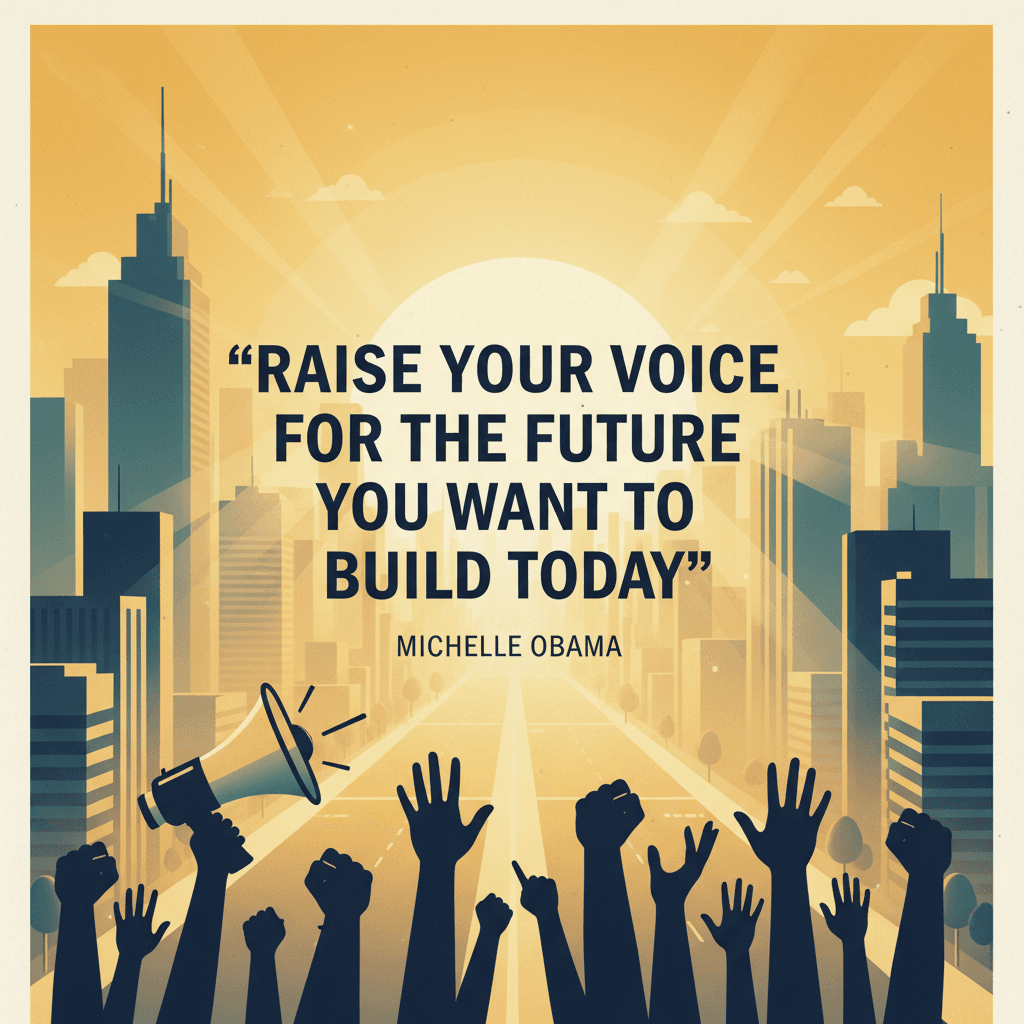
Raise your voice for the future you want to build today — Michelle Obama
—What lingers after this line?
A Call to Immediate Agency
Michelle Obama’s exhortation links voice to construction: the future is not discovered; it is built. By urging us to speak now, she insists that aspirations must be translated into present-tense action. The line echoes her broader civic message, seen in initiatives like When We All Vote (launched 2018), which frames participation as the daily work of democracy. Thus, the quote rejects passive hope. It proposes a craftsman’s ethic, where words are tools—plans, measurements, and scaffolds—for a future assembled in real time. Vision becomes credible only when anchored in what we do today.
From Expression to Civic Architecture
Voice, in this framework, is not merely opinion; it is a lever that moves institutions. Voting, testifying at school boards, meeting representatives, organizing neighbors, and shaping local budgets all convert speech into structure. John Dewey’s Democracy and Education (1916) underscores this: democracy thrives when citizens learn by doing. Consequently, every email to a councilmember, every coalition meeting, and every public comment becomes a rivet in the civic edifice. Expression grows into architecture when it reliably influences decisions and allocates resources.
Historical Proof That Voices Reframe History
The Civil Rights Movement shows how raised voices remake law and culture. Fannie Lou Hamer’s 1964 testimony before the Democratic National Convention broadcast the brutality of voter suppression, helping shift national conscience; SNCC’s organizing built the grassroots power that fed the Voting Rights Act of 1965. These examples reveal a pattern: when marginalized people speak in organized chorus, policy follows. The past therefore validates Obama’s claim—the future is not waiting; it responds to persistent, public, collective voice.
Youth as Today’s Builders, Not Tomorrow’s
Recent youth movements prove that age is no barrier to building. Parkland students helped spark March for Our Lives (2018), pushing gun-safety debates into legislatures. Greta Thunberg’s school strike (2018) reframed climate urgency, catalyzing global demonstrations. Similarly, Malala Yousafzai’s advocacy linked education to peace and gender equity. Because these efforts operate in the present tense, they embody the quote’s logic: young people are not merely future leaders; they are current constructors whose actions recalibrate the terms of tomorrow.
The Craft of Persuasion: Going High and Going Far
How we speak determines what we can build together. Obama’s 2016 DNC refrain—“When they go low, we go high”—offers a discipline for persuasion that widens, rather than narrows, coalitions. Aristotle’s Rhetoric reminds us that durable influence blends ethos, pathos, and logos; Marshall Rosenberg’s Nonviolent Communication (2003) adds tools for clarity without contempt. Therefore, raising one’s voice is not shouting; it is designing language that invites opponents into solvable problems, converting resistance into workable consensus.
From Moments to Institutions That Endure
Finally, to “build today” is to create vehicles that outlast headlines. Stacey Abrams’s Fair Fight (2018) transformed outrage into enduring infrastructure for voter access. Elsewhere, participatory budgeting—pioneered in Porto Alegre (1989)—lets residents steer real money, while community land trusts preserve affordable housing across generations. In this light, the future is assembled by systems, not bursts of passion alone. Voices that found organizations, policies, and shared rituals turn today’s energy into tomorrow’s stability.
One-minute reflection
What feeling does this quote bring up for you?
Related Quotes
6 selectedCarve out a tomorrow that makes your heart sing. — Unknown
Unknown
This quote encourages proactive efforts to shape a future that brings joy and satisfaction. It highlights the importance of planning and taking steps today to ensure happiness and fulfillment in the days to come.
Read full interpretation →Transform your life. Create your tomorrow. — Reza Aslan
Reza Aslan
This quote emphasizes the power of personal change. It suggests that individuals have the ability to transform their lives through conscious choices and actions.
Read full interpretation →Every voice matters; let yours be heard. — Gloria Steinem
Gloria Steinem
This quote emphasizes that every person's voice is valuable and deserves to be acknowledged. No matter how small or insignificant one may feel, their perspective and opinions hold weight.
Read full interpretation →History belongs to those who actively participate in it. — Nelson Mandela
Nelson Mandela
This quote encourages individuals to take an active role in shaping their societies. It implies that passivity leads to historical irrelevance, while those who engage and act become part of the narrative.
Read full interpretation →To build a better world, you must stand up and be counted. — Margaret Mead
Margaret Mead
This quote emphasizes that each person has a role to play in making the world a better place. Social progress depends on individuals taking a stand and actively participating, rather than remaining passive observers.
Read full interpretation →The artist’s brush is a sword that fights the battle for tomorrow’s vision. — Ai Weiwei
Ai Weiwei
Ai Weiwei’s metaphor draws a deliberate comparison between the artist’s brush and a sword, suggesting that creative expression is fundamentally combative. Art, in this view, is not merely decorative or passive—it stands...
Read full interpretation →More From Author
More from Michelle Obama →Confidence is not absence of fear; it is the quiet recognition that you have survived every hard day so far. — Michelle Obama
At first glance, confidence is often mistaken for boldness without hesitation, yet Michelle Obama’s words gently overturn that myth. She frames confidence not as the absence of fear, but as a steadier inner knowledge: yo...
Read full interpretation →We were planting seeds of change, the fruit of which we might never see. We had to be patient. — Michelle Obama
Michelle Obama’s quote frames social progress through the language of cultivation: people plant seeds now, even when the harvest may come much later. In that image, change is not sudden or theatrical but gradual, organic...
Read full interpretation →I've learned that it's harder to hate up close. — Michelle Obama
Michelle Obama’s observation begins with a simple but powerful truth: distance makes it easier to turn people into abstractions, while closeness restores their full humanity. When we know others only as labels, stereotyp...
Read full interpretation →Inspiration on its own was shallow; you had to back it up with hard work. — Michelle Obama
Michelle Obama’s remark begins with a necessary correction to a popular myth: feeling inspired is not the same as accomplishing something meaningful. Inspiration can ignite ambition, but on its own it is fleeting, emotio...
Read full interpretation →