
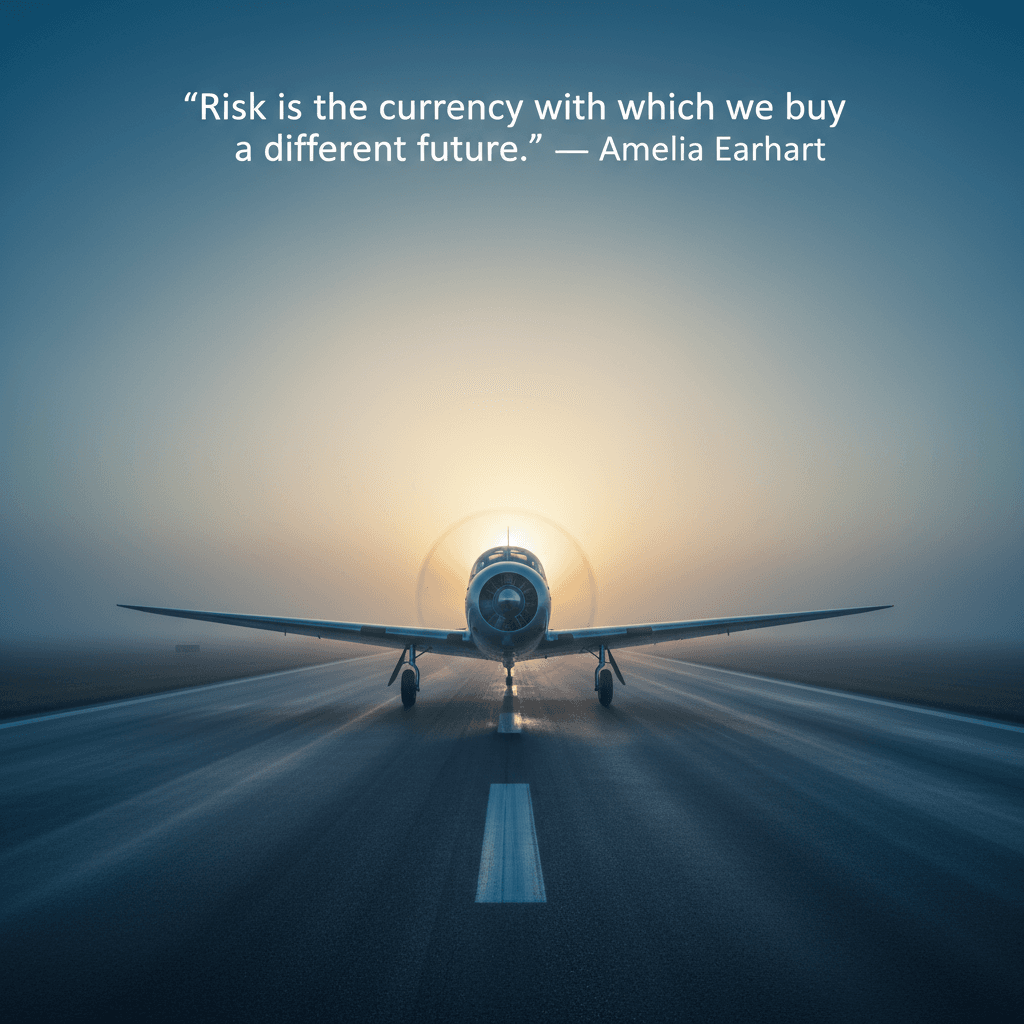
Risk is the currency with which we buy a different future. — Amelia Earhart
—What lingers after this line?
Risk as Spendable Currency
Earhart’s line reframes risk not as recklessness but as a medium of exchange: we trade present certainty for the possibility of a transformed tomorrow. Like currency, risk has denominations, liquidity, and an exchange rate shaped by preparation, timing, and context. By choosing when and how to “spend,” we decide which futures become affordable. Seen this way, risk-taking becomes a budgeting exercise rather than a dare. We can accumulate capability (skills, data, allies) to stretch every unit of risk further, just as prudent savers compound capital. This sets up a more nuanced question than “Should we risk?”—namely, “What future is worth the price, and how do we pay wisely?”
Earhart’s Ledger of Bold Flights
This metaphor was not abstract for Earhart. Her 1932 solo transatlantic flight—first by a woman—bought entry into a different cultural future, one where women’s competence in the cockpit was indisputable. Three years later, she flew solo from Honolulu to Oakland (1935), converting danger into public proof that oceanic skies could be traversed by skill and planning. In The Fun of It (1932), she argues for meticulous preparation over bravado, underscoring that smart risks are rarely impulsive. Even her 1937 round-the-world attempt, which ended in disappearance near Howland Island, complicates the ledger: some futures cost more than we can pay. Yet the attempt itself widened aviation’s horizon, illustrating how individual wagers can yield societal dividends, even when personal returns are never realized.
The Economics of Uncertainty
Earhart’s intuition aligns with economics. Frank Knight’s Risk, Uncertainty, and Profit (1921) distinguishes measurable risk from true uncertainty; profit, he argues, is the reward for bearing what cannot be fully insured. Likewise, Schumpeter’s creative destruction (Capitalism, Socialism and Democracy, 1942) shows how entrepreneurial bets disrupt stasis to create new value. In practice, innovators convert uncertainty into option value: small trials keep future choices alive, while scaling follows evidence (Dixit and Pindyck’s Investment under Uncertainty, 1994). Thus, risk becomes a portfolio problem: diversify bets, cap downside, and double down where signals improve. In this framework, boldness is not the opposite of prudence—it is prudence applied to possibility.
Why Our Minds Misprice Risk
However, our psychology often distorts the exchange rate. Prospect theory (Kahneman and Tversky, 1979) shows that losses loom larger than gains, causing underinvestment in high-upside, moderate-downside ventures. Meanwhile, availability bias and dread amplify vivid hazards—like air travel—while muting everyday risks, as Paul Slovic’s work on risk perception demonstrates (Science, 1987). Bridging this gap requires deliberate counterweights: base-rate thinking, checklists that expose hidden assumptions, and precommitments that prevent last-minute retreat. When we correct our mental bookkeeping, worthy futures stop looking prohibitively expensive.
Collective Bets That Bent History
Societies also spend risk to buy better futures. Kennedy’s lunar pledge in 1961 culminated in Apollo 11 (1969), a national wager that yielded not only moon rocks but decades of technological spillovers. The 1954 Salk polio field trials—1.8 million “Polio Pioneers”—exposed uncertainties under rigorous oversight, purchasing a world where paralysis faded from childhood (Jonas Salk, 1955 results). Likewise, civil rights activists risked freedom and safety to redraw America’s moral landscape—demonstrating how concentrated courage can shift the trajectory for millions. These cases show that shared risk, transparently managed, can amortize the cost of progress across a generation rather than a single hero.
Ethics: Who Pays, Who Benefits
Yet every purchase raises equity questions. Ulrich Beck’s Risk Society (1986) argues that modernity redistributes hazards unevenly, often onto those with least voice. Ethical risk-taking therefore demands consent, compensation, and recourse. The Belmont Report (1979) codified respect for persons, beneficence, and justice in research, establishing a template: risks must be minimized, benefits fairly distributed, and participation informed. Extending that logic beyond labs, sound policy buffers downside with safety nets, clear accountability, and transparency—so the futures we buy are not subsidized by the vulnerable without their say.
A Practical Playbook for Smart Risk
To translate principle into practice, start with reversible bets—cheap experiments that preserve optionality (Taleb’s Antifragile, 2012). Use a premortem to imagine failure in advance and redesign accordingly (Gary Klein, 2007). Size stakes with the Kelly criterion’s spirit—never bet so much that a loss ends the game (Kelly, 1956). Define explicit stop-loss and success thresholds, pair bold pilots with rigorous measurement, and conduct postmortems that convert scar tissue into process improvements. In short, treat risk as an asset under management, not an impulse to indulge or suppress.
Choosing the Future We Can Afford
Circling back, Earhart’s aphorism is both invitation and audit. We are always spending—through action or avoidance—purchasing either a changed world or the status quo. The task is to align costs with convictions: pay deliberately, hedge humanely, and invest where the upside compounds for others as well as ourselves. When we budget risk with care and courage, the future stops being something that happens to us—and becomes something we buy, build, and share.
One-minute reflection
What feeling does this quote bring up for you?
Related Quotes
6 selectedRisk is the price you pay for opportunity. — Mark E. Hordesky
Mark E. Hordesky
This quote highlights the intrinsic connection between risk and opportunity. It implies that to access new chances or possibilities, one must be willing to face uncertainty or potential failure.
Read full interpretation →Embrace risk as the price of progress; comfort keeps the clock of your life frozen. — Frida Kahlo
Frida Kahlo
Frida Kahlo’s line frames progress as a purchase: you pay for it with risk. In that sense, “embrace” is not a motivational flourish but an instruction to stop treating uncertainty as an error and start treating it as a t...
Read full interpretation →We did not come to fear the future. We came here to shape it. — Barack Obama
Barack Obama
Obama’s statement reframes why we are present in any pivotal moment—whether in a nation, a classroom, or a community. Rather than existing simply to endure uncertainty, he insists we are here to act upon it.
Read full interpretation →Listen to the future whispering in the choices you make this hour. — Emily Dickinson
Emily Dickinson
Emily Dickinson’s line invites us to pause and treat this single hour as a sacred threshold between what has been and what might be. By narrowing our focus to “this hour,” she resists vague ideas about destiny and insist...
Read full interpretation →My interest is in the future because I am going to spend the rest of my life there. — Charles F. Kettering
Charles F. Kettering
To begin, Kettering reframes the future from an abstract concept into a destination—the only one we are guaranteed to inhabit. Because time moves in a single direction, attention and effort that point backward inevitably...
Read full interpretation →The future belongs to those who believe in the beauty of their dreams. - Eleanor Roosevelt
Eleanor Roosevelt
This quote highlights the importance of having a strong belief in one's dreams. Believing in the beauty and possibility of your dreams is the first step towards turning them into reality.
Read full interpretation →More From Author
More from Amelia Earhart →Chart your own sky and trust the winds you call your own. — Amelia Earhart
Amelia Earhart’s line opens with an imperative—“Chart your own sky”—that frames life as a journey requiring personal authorship rather than passive compliance. The “sky” suggests vast possibility, but also exposure: ther...
Read full interpretation →The most effective way to do it, is to do it. — Amelia Earhart
This quote emphasizes the importance of taking action rather than endlessly planning, pondering, or procrastinating. It advocates for direct action as the best approach to accomplish tasks.
Read full interpretation →Adventure is worthwhile in itself. — Amelia Earhart
This quote reflects the idea that the experience of adventure is valuable on its own, regardless of any external rewards or outcomes. Merely engaging in adventure brings worth and enrichment to life.
Read full interpretation →A single steady hand can steer a ship through fog; be that hand. — Amelia Earhart
Fog obscures landmarks and magnifies doubt, yet Earhart’s line insists that one calm, consistent agent can still chart a course. The image of a single hand on the helm rejects both paralysis and frenzy; it favors measure...
Read full interpretation →