
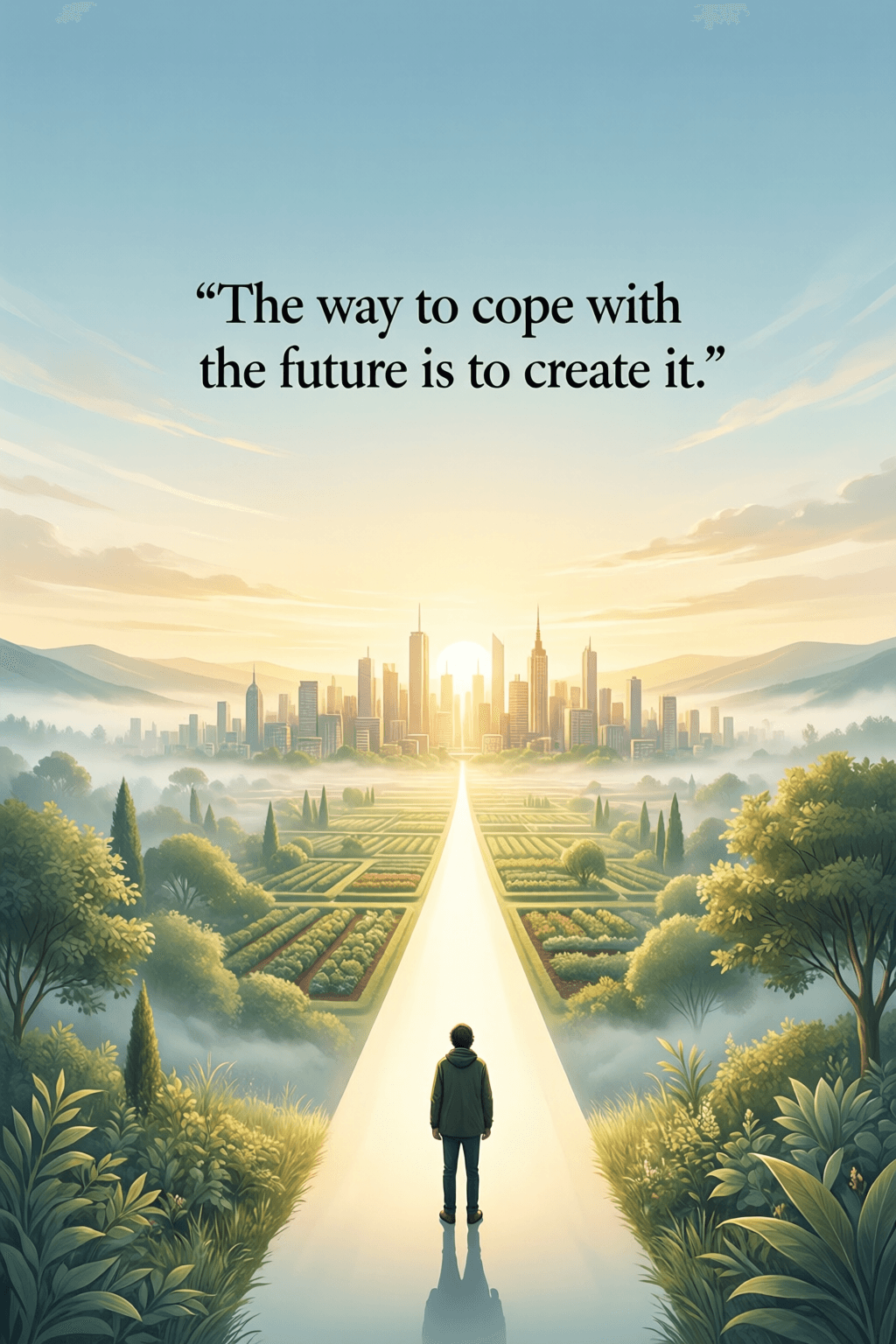
The way to cope with the future is to create it. — Ilya Prigogine
—What lingers after this line?
From Prediction to Participation
At first glance, Ilya Prigogine’s remark shifts our stance toward time itself. Instead of treating the future as a distant event to be forecast and feared, he invites us to see it as something shaped by human action. In that sense, coping is no longer passive endurance; it becomes active participation in what is still unfolding. This change in perspective matters because uncertainty often feels overwhelming precisely when people believe they have no influence over what comes next. By contrast, Prigogine suggests that agency is the antidote to anxiety. We manage tomorrow not by waiting for clarity, but by building conditions under which a better tomorrow can emerge.
Prigogine’s Scientific Imagination
This idea becomes even richer when viewed alongside Prigogine’s scientific work. In Order Out of Chaos (1984), written with Isabelle Stengers, he explored how complex systems evolve through instability rather than rigid predictability. Far from seeing disorder as mere collapse, Prigogine argued that moments of turbulence can open pathways to new forms of order. Consequently, his quote carries more than motivational force. It reflects a worldview in which the future is not a fixed destination already waiting for us. Rather, as in nature itself, novelty arises through interaction, adaptation, and creative response. What looks uncertain may also be fertile.
Creation as a Response to Fear
From there, the quote speaks directly to a common human habit: trying to cope with uncertainty by seeking total control. Yet complete control is rarely possible, whether in personal life, politics, or science. Prigogine offers a more resilient alternative—make something. Start a project, found an institution, teach a skill, or define a principle that did not exist before. In this way, creation becomes a practical answer to fear. A community garden in a declining neighborhood, for example, does not eliminate every future risk, but it changes the local future by producing food, trust, and shared responsibility. Step by step, action reduces helplessness.
A Philosophy of Responsibility
At the same time, to create the future is also to accept responsibility for it. The statement does not celebrate blind ambition or fantasy; instead, it implies that our choices leave structures behind us. Hannah Arendt’s The Human Condition (1958) similarly emphasizes action as the means by which people enter the world and alter its course. Therefore, Prigogine’s thought carries an ethical undertone. If we help make the future, then we cannot speak of it as though it were entirely someone else’s problem. Families, leaders, inventors, and citizens all participate in shaping what later generations will inherit.
Innovation in Everyday Life
Importantly, creating the future does not belong only to scientists, presidents, or entrepreneurs. It also happens in ordinary decisions that accumulate over time. A parent who teaches patience, a student who learns a difficult craft, or a worker who improves a flawed process is already nudging reality in a new direction. Seen this way, the quote becomes deeply democratic. It reminds us that the future is built not only in dramatic breakthroughs but also in daily habits. Small acts of preparation and imagination, repeated consistently, often become the foundations on which larger transformations rest.
Hope as Deliberate Construction
Finally, Prigogine’s sentence redefines hope. Hope is often mistaken for optimism, as though it were merely a feeling that things will turn out well. But here, hope is something sturdier: it is the decision to construct possibilities even when outcomes remain uncertain. Thus the quote ends where it began, but with greater force. To cope with the future is not to master every variable or silence every fear. It is to answer uncertainty with invention, responsibility, and work. In that sense, the future becomes less a fate to endure than a reality to help bring into being.
One-minute reflection
Where does this idea show up in your life right now?
Related Quotes
6 selectedIn action, we create our future. — Friedrich Nietzsche
Friedrich Nietzsche
Nietzsche’s proclamation underscores the foundational role of action in the human experience. Rather than seeing the future as a mere product of fate or passive circumstance, he elevates deliberate deeds to the status of...
Read full interpretation →Draw from the well of your personal experience to create a future you’ll love. — Tanya Markul
Tanya Markul
This quote highlights the value of using one's own life experiences as a guiding force. Your past challenges, lessons, and triumphs are critical resources for shaping a meaningful future.
Read full interpretation →The future is uncertain… but this uncertainty is at the very heart of human creativity. — Ilya Prigogine
Ilya Prigogine
At first glance, uncertainty seems like a condition to resist, since people often associate it with instability, fear, and loss of control. Yet Ilya Prigogine turns that assumption inside out, arguing that uncertainty is...
Read full interpretation →The best way to predict the future is to create it. – Peter Drucker
Peter Drucker
This quote emphasizes the importance of taking a proactive approach to life. Instead of waiting for things to happen or trying to guess what might come, it suggests that one should actively work towards shaping their own...
Read full interpretation →The best way to predict the future is to invent it. — Alan Kay
Alan Kay
This quote encourages a proactive attitude. Instead of waiting to see what the future holds, one should take active steps to shape their own destiny.
Read full interpretation →The best way to predict your future is to create it. — Abraham Lincoln
Abraham Lincoln
This quote empowers individuals to take control of their own destinies. It emphasizes that our future is not set in stone, but can be shaped by our actions and decisions.
Read full interpretation →More From Author
More from Ilya Prigogine →