
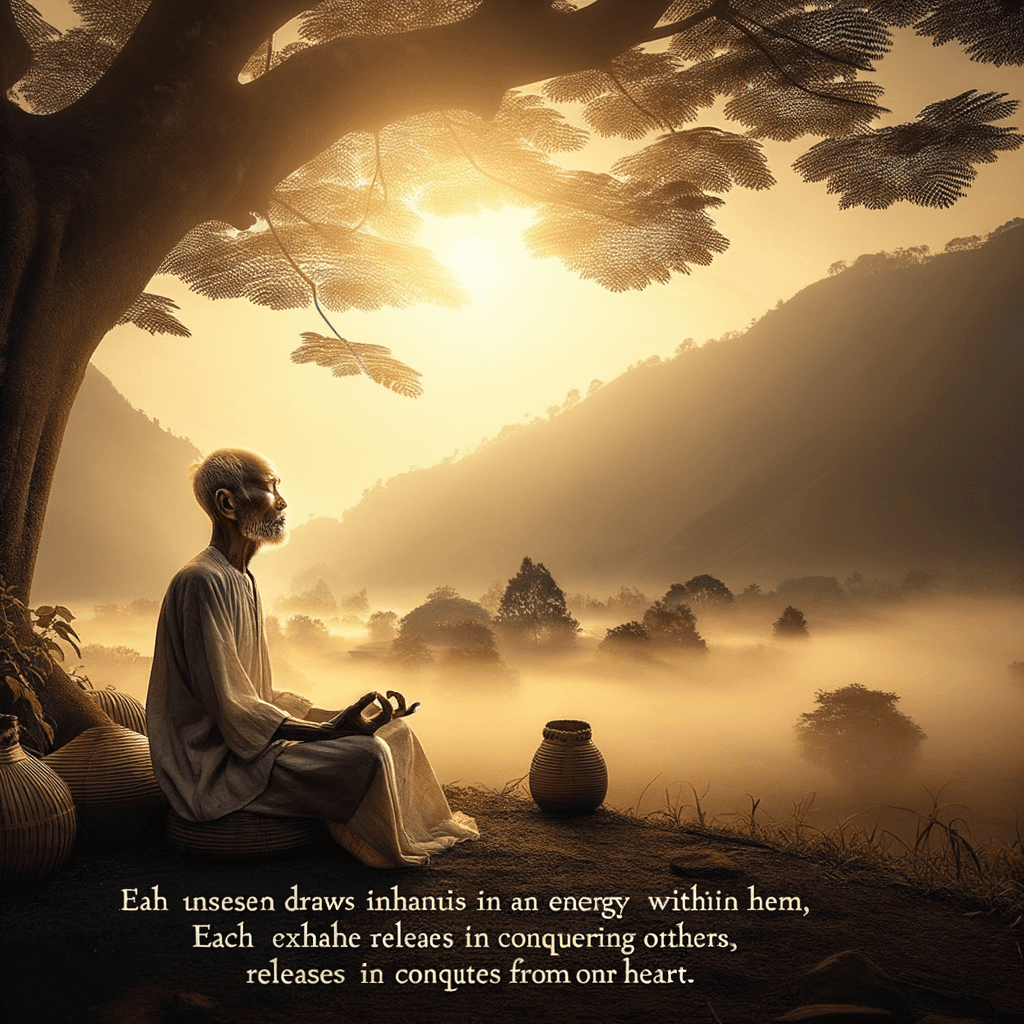
In the silence of the early morning, an old man sat alone meditating under a tree. He gently closed his eyes, his breath resonating in harmony with the wind. With each inhalation, he absorbed the energy of the universe; with each exhalation, he released the clutter of his mind. Gradually, he felt an invisible force flowing within him, a tranquility and strength emanating from deep within. From that moment, he understood that true strength lies not in conquering others, but in conquering oneself.
—What lingers after this line?
Setting the Scene
The story begins in the early morning, a time often associated with peace and reflection. The old man meditates under a tree, symbolizing a connection with nature and a quest for inner peace.
Harmony with Nature
His breath resonates in harmony with the wind, illustrating a deep connection with the natural world. This interconnectedness emphasizes the idea that true peace comes from aligning oneself with the rhythms of the universe.
Mindfulness Practice
Through meditation, the old man focuses on his breathing, absorbing universal energy and releasing mental clutter. This practice of mindfulness helps to clear his mind and cultivate inner calm.
Inner Strength
As he meditates, he feels an invisible force flowing within him, representing the inner strength and tranquility derived from self-awareness and inner peace.
Self-Conquest
The story concludes with the realization that true strength lies in conquering oneself rather than others. This highlights the importance of self-mastery and inner harmony as the ultimate forms of strength.
Philosophical Insight
The narrative delivers a philosophical message that inner peace and self-conquest are more powerful than external victories. It encourages readers to look within themselves for true strength and fulfillment.
One-minute reflection
What's one small action this suggests?
Related Quotes
6 selectedThe most modern way to live is not to do more, but to protect the peace you have already built. — Unknown
Unknown
The quote quietly challenges a common assumption: that progress is measured by acceleration. Instead, it proposes that the most contemporary lifestyle is not defined by constant upgrades—more tasks, more goals, more outp...
Read full interpretation →Quiet ambition is the new power move. You do not have to announce your progress to a crowd to make it count; your peace of mind is the loudest trophy. — Unknown
Unknown
The quote reframes success away from public recognition and toward private integrity. Instead of measuring achievement by applause, it suggests that what “counts” is the substance of your growth—skills built, habits chan...
Read full interpretation →The first sign of a settled mind is that it can stay in one place and spend time with itself.
Unknown
The quote frames mental steadiness not as constant happiness or unbroken focus, but as a quieter achievement: the ability to remain where you are without immediately needing an escape. A “settled mind” suggests inner ord...
Read full interpretation →If it costs you your peace, it is too expensive. — Unknown
Unknown
The quote frames peace as a kind of inner currency—finite, valuable, and easily spent. Instead of measuring cost only in money or effort, it asks you to calculate the hidden fees: anxiety, dread, resentment, and the cons...
Read full interpretation →A quiet life is not a small life. — Unknown
Unknown
The saying challenges a common assumption: that a life without constant activity, visibility, or outward achievement must be diminished. By pairing “quiet” with “not small,” it invites a redefinition of scale—one measure...
Read full interpretation →Your peace is a form of resistance in a world that demands your constant attention. — Unknown
Unknown
The quote reframes peace as something more muscular than calmness: it becomes an act of refusal. In a culture that prizes speed, reaction, and perpetual engagement, choosing inner steadiness challenges the default expect...
Read full interpretation →More From Author
More from Unknown →The language is the substrate. The architecture is the contract.
The line sets up a deliberate pairing: language lies beneath everything, while architecture governs everything above it. In other words, what you can express determines what you can build, and what you commit to structur...
Read full interpretation →A scroll is not a break; it is a trap disguised as rest. — Unknown
The quote begins by challenging a familiar story we tell ourselves: that a brief scroll is a harmless pause between tasks. On the surface, it looks like recovery—no effort, no decision, no commitment.
Read full interpretation →Don't let your ice cream melt while you're counting someone else's sprinkles. — Unknown
The quote uses ice cream as a simple stand-in for life’s fleeting pleasures: what you have is delicious, but it won’t last forever if you ignore it. Meanwhile, “counting someone else’s sprinkles” captures the habit of mo...
Read full interpretation →If your absence doesn't affect them, your presence never mattered. — Unknown
The quote frames absence as a revealing experiment: remove yourself, and the reaction—concern, curiosity, indifference—becomes a kind of data. If nothing changes when you’re gone, it suggests your role was never integrat...
Read full interpretation →