
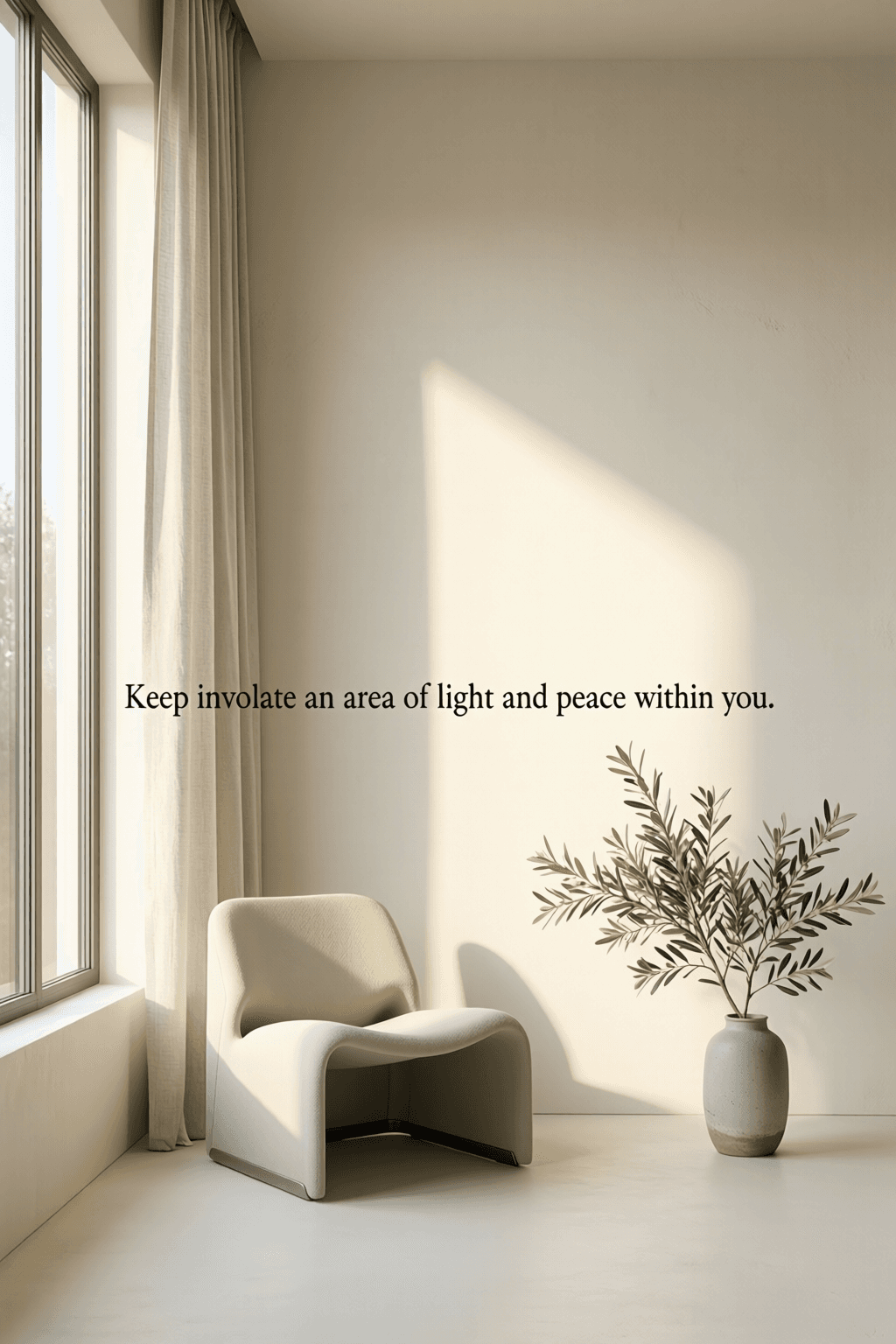
Keep inviolate an area of light and peace within you. — Marcus Aurelius
—What lingers after this line?
A Stoic Call to Inner Sanctuary
At first glance, Marcus Aurelius’ line reads like a gentle instruction, yet it carries the full weight of Stoic discipline. In his Meditations (c. 170–180 AD), he repeatedly urges himself to protect the ruling center of the mind from agitation, vanity, and fear. The ‘area of light and peace’ is not a physical refuge but an inward sanctuary that remains untouched by outer chaos. From this starting point, the quote suggests that peace is not something the world grants us but something we must actively preserve. In other words, the mind becomes a place of custody as well as clarity, and character depends on what we allow to enter and remain there.
Peace as a Practiced Discipline
Building on that idea, Aurelius does not present inner calm as a passive mood. Instead, Stoicism frames tranquility as the result of steady practice: examining impressions, restraining impulsive reactions, and distinguishing what lies within our control from what does not. Epictetus’ Enchiridion (c. 125 AD) makes the same point, arguing that distress arises when we cling to externals. As a result, keeping this inner space ‘inviolate’ means defending it through habit. A modern parallel might be someone who, despite a hostile workplace, pauses before responding, chooses measured speech, and refuses to let another person’s anger colonize the day. Peace, then, is maintained through repeated acts of inner governance.
Light as Moral Clarity
The image of light adds an important dimension, because Aurelius is concerned not only with calm but with lucid goodness. Throughout Meditations, he returns to justice, humility, and service, implying that inner brightness comes from living in accord with reason and nature. Thus, light suggests moral orientation: the ability to see clearly what is right even when circumstances are confused. In this sense, the quote moves beyond self-soothing. It asks a person to preserve a conscience that remains unclouded by resentment or pettiness. Plato’s Republic (c. 375 BC) similarly links light with truth and knowledge, and Aurelius adapts that ancient symbolism into an ethical practice of clear-sighted living.
Resistance to a Turbulent World
From there, the saying gains force when placed against the realities of Aurelius’ life. He was not writing from a secluded garden but while governing an empire beset by war, plague, and political strain. That context makes the advice more compelling: it is not the luxury of a sheltered philosopher, but the survival method of a ruler under relentless pressure. Consequently, the quote teaches that serenity is strongest when it coexists with difficulty. Much like Viktor Frankl’s Man’s Search for Meaning (1946) later argued that freedom survives in one’s inner response, Aurelius insists that external turmoil need not dictate internal ruin. The guarded self becomes an act of quiet resistance.
A Message for Modern Life
Finally, the quote feels especially modern because contemporary life constantly invades attention with noise, outrage, and speed. Social media, nonstop news, and professional demands can erode the very interiority Aurelius wants us to protect. His counsel therefore reads as both ancient wisdom and practical remedy: create boundaries, cultivate reflection, and keep some part of the self free from constant disturbance. In everyday terms, this may mean beginning the morning without a screen, taking reflective walks, or refusing to let public chaos become private disorder. By ending on this note, Aurelius reminds us that inner peace is not withdrawal from life, but the condition that allows us to meet life without losing ourselves.
One-minute reflection
What does this quote ask you to notice today?
Related Quotes
6 selectedSometimes, protecting your peace is the better choice. — Marcus Aurelius
Marcus Aurelius
At first glance, the saying frames peace not as passivity but as discipline. To protect one’s peace is to recognize that not every conflict deserves entry into the mind.
Read full interpretation →The mind is a citadel, and it is within your power to keep it tranquil by refusing to be moved by things that are not your own. — Marcus Aurelius
Marcus Aurelius
Marcus Aurelius imagines the mind as a citadel, a fortified place whose safety depends less on outer conditions than on inner discipline. In this image, tranquility is not something granted by luck or politics; rather, i...
Read full interpretation →Nowhere can man find a quieter or more untroubled retreat than in his own soul. — Marcus Aurelius
Marcus Aurelius
Marcus Aurelius proposes a kind of sanctuary that does not depend on geography, wealth, or other people: the inner life. Unlike a villa in the countryside or a day without obligations, the soul’s retreat remains availabl...
Read full interpretation →The tranquility that comes when a man is not concerned with what his neighbor says or does or thinks, but only with what he does himself. — Marcus Aurelius
Marcus Aurelius
Marcus Aurelius frames tranquility not as a pleasant mood granted by circumstances, but as a stable condition earned through attention. When we stop orbiting around our neighbor’s opinions and choices, mental noise quiet...
Read full interpretation →The nearer a man comes to a calm mind, the closer he is to strength. — Marcus Aurelius
Marcus Aurelius
Marcus Aurelius reframes strength as an inner condition rather than an outward display. In this line, power is not measured by dominance, volume, or speed of reaction, but by the degree to which a person can remain menta...
Read full interpretation →Protecting your peace is not an act of selfishness, but a necessary act of survival. — Pema Chödrön
Pema Chödrön
At first glance, guarding one’s inner calm can seem like withdrawal from others, yet Pema Chödrön reframes it as a basic necessity. Her statement challenges the moral pressure many people feel to be endlessly available,...
Read full interpretation →More From Author
More from Marcus Aurelius →The art of life is more like the wrestler's art than the dancer's; stand ready and firm to meet sudden and unexpected onsets. — Marcus Aurelius
Marcus Aurelius contrasts two arts to clarify what living well demands. A dancer suggests elegance, rhythm, and practiced beauty; a wrestler, by contrast, suggests balance under pressure, resistance, and constant readine...
Read full interpretation →How much time he gains who does not look to see what his neighbour says or does or thinks, but only at what he does himself, to make it just and holy. — Marcus Aurelius
Marcus Aurelius argues that a great deal of life is wasted in watching other people—what they say, what they do, and even what they might be thinking. Instead, he recommends a disciplined inward turn: focus on your own c...
Read full interpretation →Sometimes, protecting your peace is the better choice. — Marcus Aurelius
At first glance, the saying frames peace not as passivity but as discipline. To protect one’s peace is to recognize that not every conflict deserves entry into the mind.
Read full interpretation →Don't go expecting perfection; be satisfied with even the smallest progress. — Marcus Aurelius
Marcus Aurelius advises against the exhausting demand for flawlessness and redirects attention toward modest improvement. In the spirit of Stoic thought, especially in his Meditations (c.
Read full interpretation →