
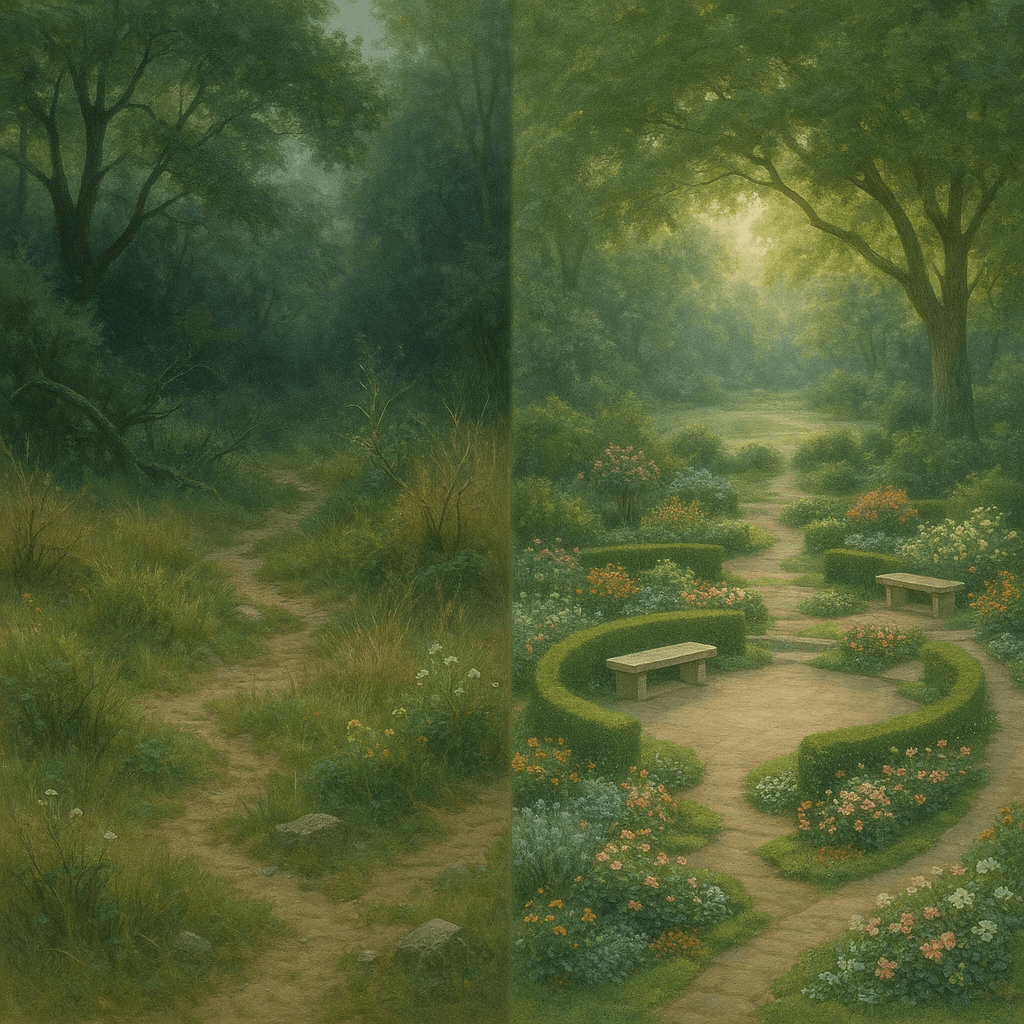
To tame the mind, build a garden of silent waiting. — Rabindranath Tagore
—What lingers after this line?
The Mind as an Untamed Wilderness
Tagore’s evocative metaphor likens the mind to an ungoverned expanse—untamed, teeming, and often wild with restless thoughts. Before one can aspire to clarity or focus, it’s crucial to recognize this innate turbulence. From ancient times, thinkers such as the Buddha have described the mind as a monkey, leaping from branch to branch. Understanding this nature is a foundational step toward meaningful self-mastery.
The Garden: A Symbol of Cultivated Serenity
Transitioning from chaos to calm, Tagore invites us to tend inner soil much like a gardener. Gardens require intention, patience, and care—qualities also essential for nurturing a rested mind. In Japanese Zen traditions, for instance, raked gravel gardens offer more than aesthetic pleasure; they serve as tools for meditation, reminding practitioners that tranquility must be cultivated, not imposed.
Silent Waiting: Patience as an Active Practice
However, the heart of Tagore’s advice lies in ‘silent waiting.’ This is not passive idleness, but an active, attentive patience. Rather than forcing the mind into submission, one must create space for thoughts to settle naturally. The Christian contemplative Thomas Merton emphasized similar wisdom, advocating for quiet vigilance—attending gently to the present moment, allowing insights to arise within silence.
The Transformative Power of Stillness
Building on this, true transformation emerges not from noise or relentless striving, but from deliberate stillness. Neuroscientific research, such as studies on mindfulness meditation by Jon Kabat-Zinn (1990), demonstrates that periods of silent reflection can reduce stress and clarify thought. As one waits in silence, the ‘garden’ of the mind grows more harmonious, yielding resilience against invasive worries.
Fostering Patience in a Modern World
Finally, Tagore’s wisdom becomes even more relevant amidst the distractions of contemporary life. The practice of gardening patience—cultivating moments of quiet and acceptance—acts as a gentle antidote to daily overstimulation. By consciously creating and tending this silent inner garden, individuals find grounding, enabling them to meet the world’s tumult with composed presence and gentle strength.
One-minute reflection
Why might this line matter today, not tomorrow?
Related Quotes
6 selectedIn the quiet of your own mind, you hold the power to reclaim your attention from the chaos of the world. — Thich Nhat Hanh
Thich Nhat Hanh
Thich Nhat Hanh’s words begin with a gentle but radical claim: the mind contains a quiet space that cannot be fully colonized by the world’s noise. Rather than portraying attention as something stolen forever by distract...
Read full interpretation →Let your life lightly dance on the edges of time like dew on the tip of a leaf. — Rabindranath Tagore
Rabindranath Tagore
Tagore's quote encourages embracing each moment with grace and presence, suggesting that one should not be weighed down by the past or future.
Read full interpretation →Let your thoughts pass like clouds, and remember — you are the sky, not the storm. — Keshava Francis
Keshava Francis
At its core, Keshava Francis’s line invites a gentle shift in identity: instead of treating every thought or emotion as the whole self, it asks us to see consciousness as something larger and steadier. Thoughts may darke...
Read full interpretation →The little things? The little moments? They aren't little. — Jon Kabat-Zinn
Zinn
At first glance, Jon Kabat-Zinn’s line overturns an ordinary habit of thought: we tend to rank experiences by size, drama, or public importance. Yet his point is that what we casually call “little” often carries the true...
Read full interpretation →Mindfulness is a way of befriending ourselves and our experience. — Jon Kabat-Zinn
Zinn
At its core, Jon Kabat-Zinn’s statement reframes mindfulness as an act of friendship rather than self-improvement. To be mindful is not merely to pay attention, but to meet our thoughts, feelings, and bodily sensations w...
Read full interpretation →Don't underestimate the value of Doing Nothing, just going along, listening to all the things you can't hear, and not bothering. — A.A. Milne
A. A. Milne
At first glance, A.A. Milne’s line sounds playful, almost like permission to be lazy.
Read full interpretation →More From Author
More from Rabindranath Tagore →Adaptability is not imitation. It means power of resistance and assimilation. — Rabindranath Tagore
At the heart of Tagore’s statement lies a careful distinction between changing and merely copying. Adaptability, he argues, is not the passive act of becoming like one’s surroundings; rather, it is an active power that a...
Read full interpretation →It is not the speed of the work, but the intention behind it that grants it value. — Rabindranath Tagore
At first glance, Tagore’s statement challenges a modern habit of equating worth with speed. In many settings, quick results are praised as signs of competence, yet he redirects attention to the inner motive that shapes t...
Read full interpretation →When I stand before thee at the day's end, thou shalt see my scars and know that I had my wounds and also my healing. — Rabindranath Tagore
At its heart, Tagore imagines an ultimate moment of reckoning in which nothing essential can be hidden. To stand before another “at the day’s end” suggests the close of life, a spiritual homecoming, or simply the end of...
Read full interpretation →A home is not a mere transient shelter of brick and stone, but a place where hearts dwell and souls are nurtured. — Rabindranath Tagore
At its core, Tagore’s statement rejects the idea that a home can be defined by architecture alone. Walls, roofs, and doors may provide protection, yet they do not automatically create belonging.
Read full interpretation →