
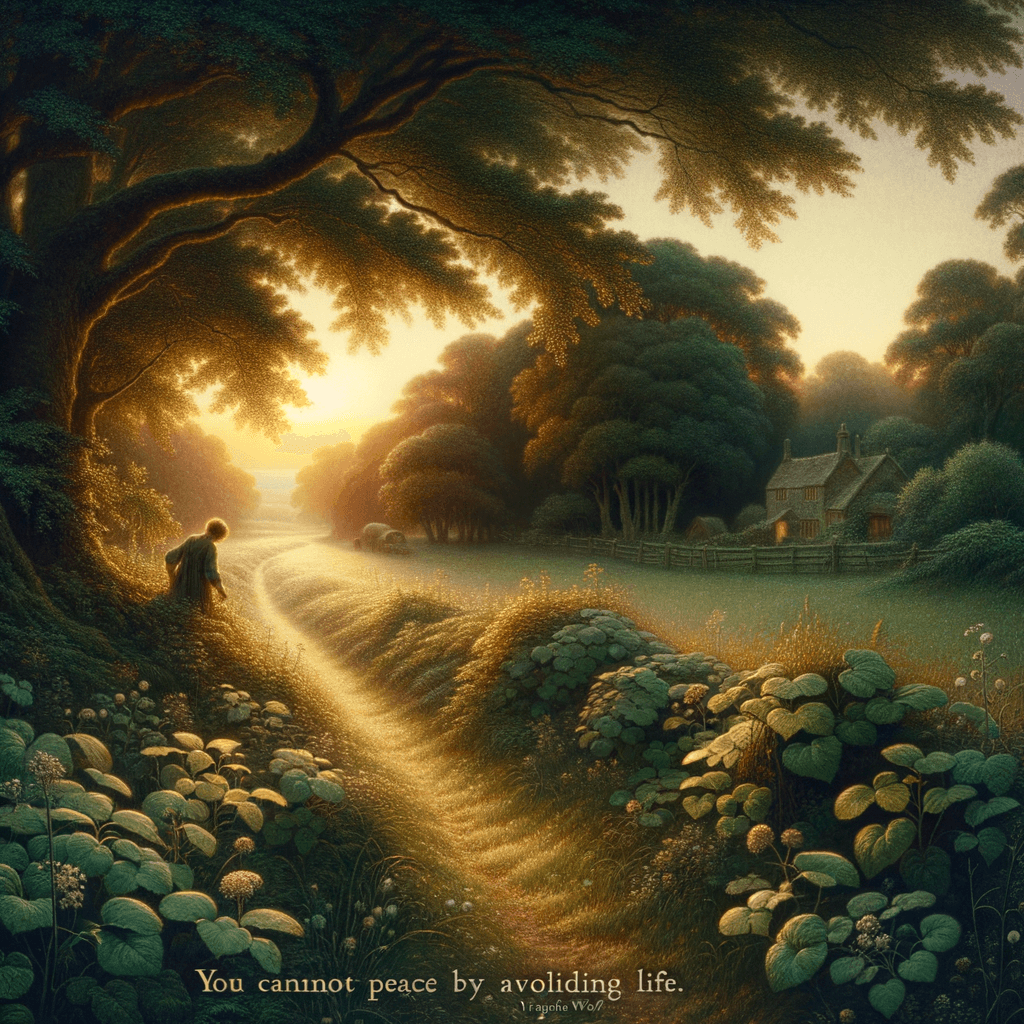
You cannot find peace by avoiding life. — Virginia Woolf
—What lingers after this line?
Confronting Challenges
This quote underscores the idea that true peace comes from facing life’s challenges rather than evading them. Engaging with life's difficulties is essential for personal growth and inner tranquility.
Emotional Acceptance
Woolf suggests that to find peace, one must accept the full spectrum of life experiences, including pain, joy, and everything in between. Avoidance can lead to a superficial existence devoid of true contentment.
Value of Experience
Experiencing life, both its highs and lows, contributes to wisdom and understanding. Embracing all experiences can lead to a more profound sense of peace and fulfillment.
Mental Health Implications
The quote also speaks to the importance of addressing mental health. Avoidance can exacerbate feelings of anxiety or depression, while confronting issues can lead to healing and peace.
Virginia Woolf's Life and Philosophy
Woolf, a prominent modernist writer, often explored themes of consciousness and emotional depth in her works. Her own struggles with mental health and societal expectations inform this powerful perspective on finding peace through engagement with life.
Recommended Reading
As an Amazon Associate, we earn from qualifying purchases.
One-minute reflection
What's one small action this suggests?
Related Quotes
6 selectedWhen you can bear your own silence, you are free. — Mooji
Mooji
At first glance, Mooji’s statement appears simple, yet it points to a demanding inner test: can a person remain alone with silence without immediately reaching for distraction? To ‘bear’ one’s own silence suggests more t...
Read full interpretation →Everything in our life keeps changing—our inner moods, our bodies, our work. We can't hold on to anything. — Tara Brach
Tara Brach
At its heart, Tara Brach’s reflection points to impermanence as the basic condition of human life. Our feelings rise and fall, our bodies age and heal, and even the work that structures our days shifts in ways we cannot...
Read full interpretation →Being at ease with not knowing is crucial for answers to come to you. — Eckhart Tolle
Eckhart Tolle
At its core, Eckhart Tolle’s statement reframes uncertainty as a condition for insight rather than a failure of thought. To be at ease with not knowing is not to become passive; instead, it means loosening the mind’s com...
Read full interpretation →The boundary to what we can accept is the boundary to our freedom. — Tara Brach
Tara Brach
At first glance, Tara Brach’s statement suggests that freedom is not only shaped by external circumstances but also by our inner willingness to face reality. What we cannot accept—whether grief, uncertainty, fear, or imp...
Read full interpretation →Control your perceptions. Direct your actions properly. Willingly accept what is outside your control. — Ryan Holiday
Ryan Holiday
At its core, Ryan Holiday’s line condenses Stoicism into three practical commands: govern your mind, guide your behavior, and accept reality as it arrives. Rather than promising comfort, this framework offers steadiness.
Read full interpretation →Self-mastery begins the moment you decide that your internal peace is more valuable than the external approval you were chasing. — Epictetus
Epictetus
At its core, this saying frames self-mastery as a decisive inner shift. The moment a person values peace of mind over praise, status, or acceptance, power begins to move inward rather than outward.
Read full interpretation →More From Author
More from Virginia Woolf →There is a kind of victory in good sense about not wanting to be everything at once. — Virginia Woolf
Virginia Woolf’s line turns an apparent restraint into a form of triumph. Rather than treating ambition without boundaries as admirable, she suggests that good sense lies in refusing the exhausting wish to be everything...
Read full interpretation →The artist is a sort of emotional archivist, recording the truth of a moment before it slips away into the digital noise. — Virginia Woolf
At its core, the quote imagines the artist as someone who rescues experience from disappearance. A feeling, a gesture, or a passing atmosphere can fade almost as soon as it arrives; therefore, the artist’s work becomes a...
Read full interpretation →Clarity is the counterbalance of complexity. - Virginia Woolf
Virginia Woolf’s remark frames thought and expression as a delicate balance rather than a simple choice. Complexity is often unavoidable because reality is layered, contradictory, and difficult to reduce; yet without cla...
Read full interpretation →No need to hurry. No need to sparkle. No need to be anybody but oneself. — Virginia Woolf
Virginia Woolf’s triad—don’t hurry, don’t sparkle, don’t be anybody but oneself—begins by dismantling the sense that life is an audition. “Hurry” signals the anxious tempo of proving worth through speed and productivity,...
Read full interpretation →