
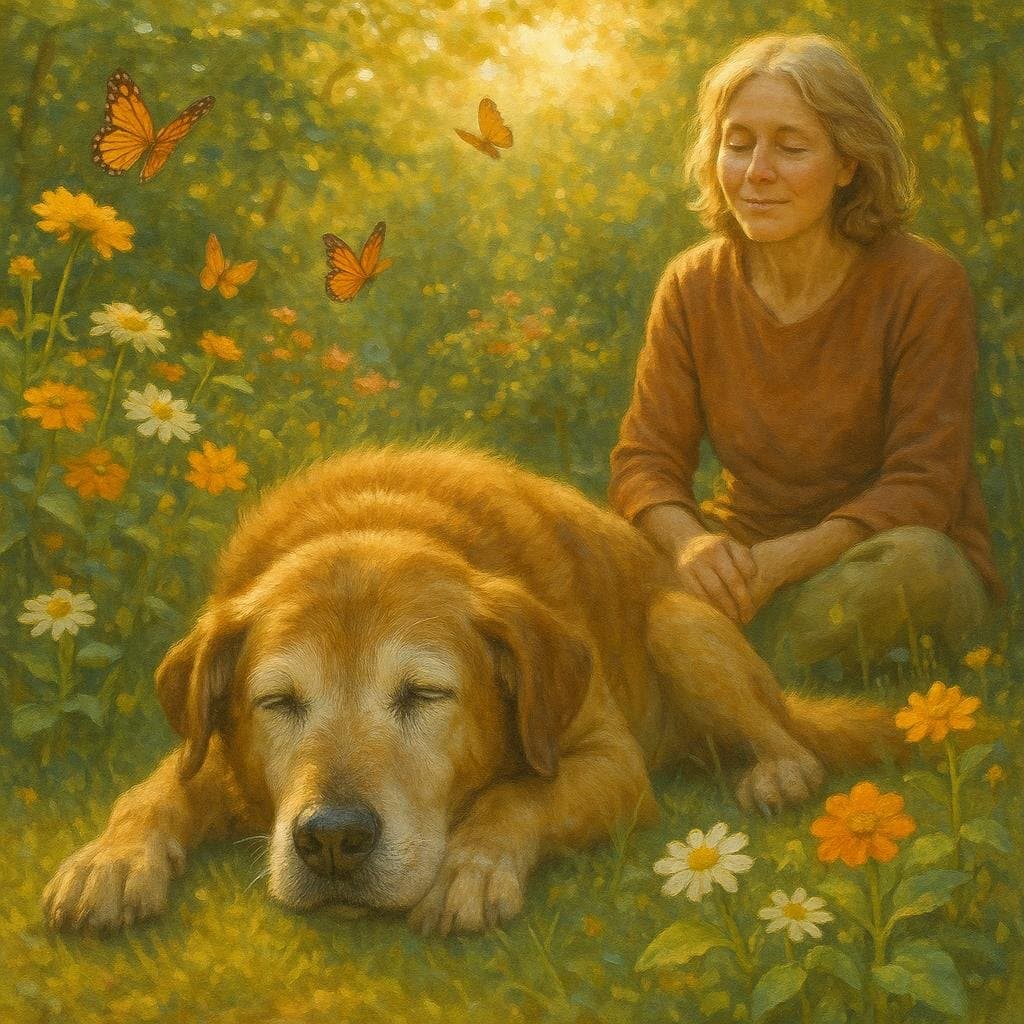
Blessed is the person who has earned the love of an old dog. — Sidney Jeanne Seward
—What lingers after this line?
The Gentle Wisdom of Old Dogs
To appreciate the sentiment in Sidney Jeanne Seward’s words, we must first recognize the unique qualities that older dogs possess. Marked by softened mannerisms and timeworn patience, old dogs exude a calm that comes only with years. Unlike exuberant puppies, their affection isn’t given freely; it is measured, thoughtful, and deeply genuine. This makes any love they offer all the more profound, as it is the result of much shared history and understanding.
Trust Earned Over Time
Building on this, the bond between a person and an elderly dog is forged over countless moments of trust and care. Whereas a young dog may shower anyone with attention, an older dog’s loyalty emerges from enduring companionship—nurtured by consistent kindness. As John Grogan recounts in ‘Marley & Me’ (2005), it is through the steadfast rituals of daily life that true affection grows, transforming into a quiet, irreplaceable connection.
Love That Reflects Shared Experience
Transitioning from trust, the love of an old dog is steeped in shared memories. Every wag of the tail, every contented sigh beside your chair reflects a tapestry woven with both joy and hardship. This mirrors human relationships, where deep bonds are not simply formed in moments of happiness, but through weathered challenges together. The old dog, in this way, becomes a gentle chronicler of shared journeys and mutual resilience.
The Subtle Lessons of Acceptance
Having earned the love of an aging companion, we also learn invaluable lessons in acceptance and presence. As dogs age, they require patience and adaptation from their humans—inviting us to embrace imperfection and vulnerability. Noted animal behaviorist Patricia McConnell, in ‘The Other End of the Leash’ (2002), highlights how these relationships can teach empathy and the appreciation of life’s quiet moments, guiding us to cherish what is fleeting yet meaningful.
A Blessing Rooted in Gratitude
Ultimately, Seward’s statement reminds us that the affection of an old dog is a true blessing—one that must be earned, not demanded. This gift of love, shaped by time and tenderness, invites a profound gratitude. In the closing years of a dog’s life, their unwavering loyalty and gentle companionship leave an indelible mark, offering a lesson in the beauty of devotion both simple and profound. Thus, to be loved by an old dog is to be truly blessed.
Recommended Reading
As an Amazon Associate, we earn from qualifying purchases.
One-minute reflection
Where does this idea show up in your life right now?
Related Quotes
6 selectedPurpose grows when you share your first step with another. — Mother Teresa
Mother Teresa
Mother Teresa’s line suggests that purpose is not a sudden revelation but something that unfolds as we move. The “first step” symbolizes a small, perhaps uncertain, action toward what matters to us.
Read full interpretation →In the sky, we wish to be two birds flying together; on the earth, we wish to be two branches growing intertwined.
Unknown
This quote highlights a desire for unity and togetherness in love. It expresses a wish to be inseparable and connected in both freedom and stability.
Read full interpretation →In the heavens, we wish to be two birds flying wing to wing; on Earth, we wish to be two trees with branches intertwined.
Unknown
This quote highlights the desire for unity in love, symbolizing lovers as two birds flying together in harmony, and as two trees connected deeply on Earth, showcasing a profound and inseparable bond.
Read full interpretation →Act with integrity and you will never be alone. — Leo Buscaglia
Leo Buscaglia
This quote underscores the importance of integrity. Acting with honesty and strong moral principles attracts respect and fosters meaningful relationships, reducing feelings of loneliness.
Read full interpretation →Sometimes it is better to be unhappy than to have nothing at all. — Victor Hugo
Victor Hugo
This quote suggests that experiencing emotions, even negative ones like unhappiness, is preferable to feeling empty or indifferent. Having something to feel, even if it's sorrow, is part of a meaningful life.
Read full interpretation →Don’t walk behind me; I may not lead. Don’t walk in front of me; I may not follow. Just walk beside me. — Albert Camus
Albert Camus
Albert Camus’s quote immediately undermines the notion of leadership or subservience within relationships, favoring companionship as the foundation. He cautions against both leading and following, emphasizing the unpredi...
Read full interpretation →More From Author
More from Sidney Jeanne Seward →