
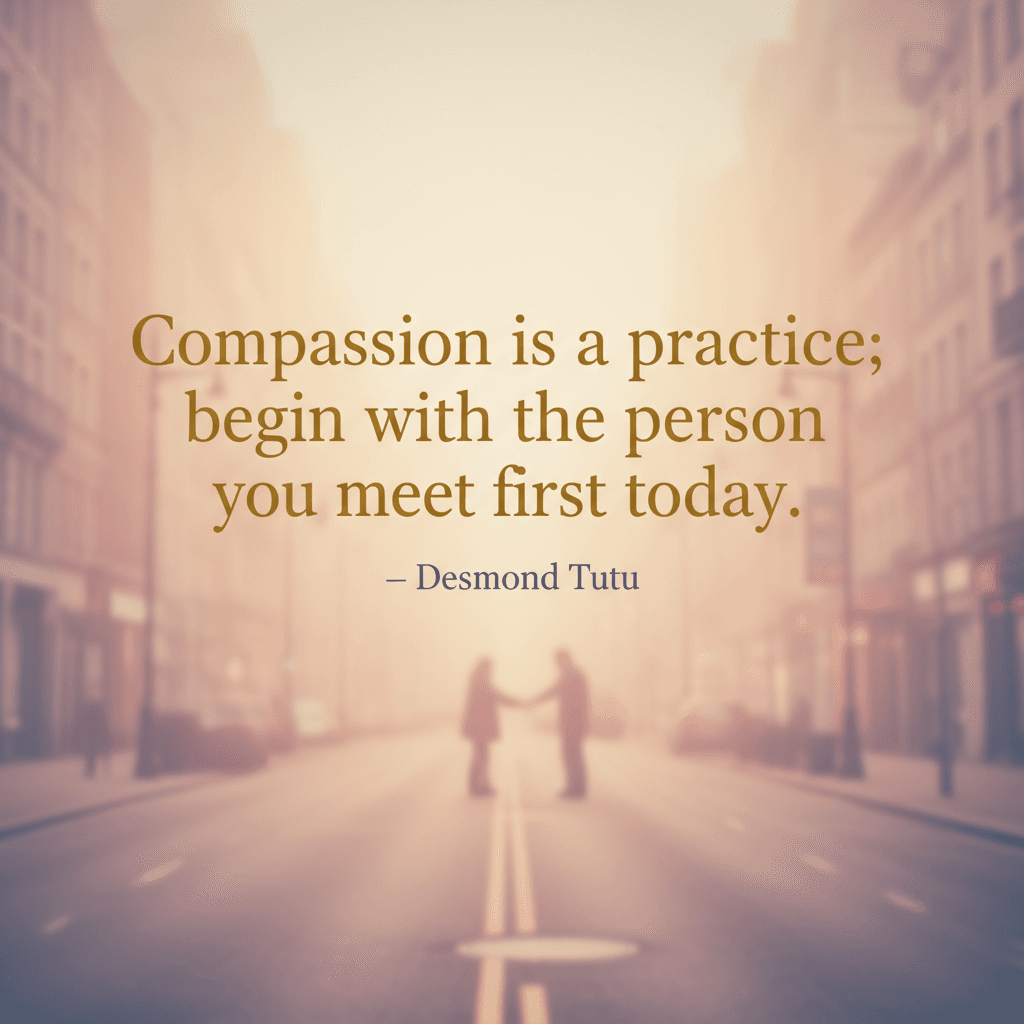
Compassion is a practice; begin with the person you meet first today. — Desmond Tutu
—What lingers after this line?
Practice, Not Passing Sentiment
Desmond Tutu reframes compassion as a skill rather than a mood, and skills grow through deliberate repetition. By urging us to begin with the first person we meet today, he strips compassion of abstraction and turns it into a concrete, time-bound task. The instruction is small but specific, and therefore doable. Because practice needs repetition, feedback, and a clear cue, this morning encounter becomes the daily locus where intention becomes behavior. In this way, compassion stops being a grand ideal and starts being a routine, as ordinary—and as formative—as brushing one’s teeth.
Tutu’s Ubuntu, Lived in Public
To see the principle at work, consider Tutu’s leadership of South Africa’s Truth and Reconciliation Commission (1996–1998). Rooted in ubuntu—often summarized as I am because we are—he insisted that each testimony, whether from survivor or perpetrator, be received with dignity. His book No Future Without Forgiveness (1999) shows how public healing was built conversation by conversation, eye to eye. The emphasis was not on abstract mercy but on meeting a person, now, as fully human. Thus, the daily discipline of greeting the first person with care mirrors the larger moral project he advanced: societal repair begins with how we recognize the face before us.
Why First Encounters Matter
Behavioral science explains why this narrow starting point works. Implementation intentions—if-then plans identified by Peter Gollwitzer (1999)—bind an intention to a cue: if I meet the first person today, then I will act kindly. Wendy Wood’s habit research (Good Habits, Bad Habits, 2019) shows that stable cues drastically reduce friction, turning values into automatic actions. Likewise, BJ Fogg’s Tiny Habits (2019) emphasizes shrinking a behavior until it is easy to start; a brief, respectful greeting or small helpful act meets that criterion. By anchoring compassion to the first encounter, we remove decision fatigue and build a consistent behavioral groove that can later expand to more demanding situations.
Sustaining Care Without Burning Out
Even with good habits, caring can exhaust us if it remains raw empathic resonance. Neuroscience distinguishes empathic distress from compassion: Tania Singer and colleagues (2014) found that compassion training shifts experience from personal overwhelm toward warm care, activating neural systems linked to affiliation and approach. In practice, this means we do not need to feel another’s pain to be moved to help; we can cultivate a steady, supportive stance. Tutu’s counsel aligns with this evidence: act benevolently in the small, immediate moment, and let action—not only shared anguish—carry the moral weight. Over time, this stance proves both effective and emotionally sustainable.
Facing Bias, Fatigue, and Boundaries
Still, obstacles arise. Compassion tends to favor the familiar; in-group bias can narrow our circle without our noticing. Paul Slovic’s research on psychic numbing (2007) shows that concern can paradoxically shrink as the number of those suffering grows. Tutu’s focus on the first person counters both problems by personalizing attention and setting a human-scale horizon. Equally vital are boundaries: Kristin Neff’s work on self-compassion (2011) indicates that caring for oneself supports steadier care for others. Thus, if the first person is demanding or our capacity is low, we can choose a small, appropriate kindness—listening for one minute, offering a clear yes or no—so compassion remains honest, safe, and renewable.
A Simple Morning Protocol
Accordingly, turn the invitation into a short ritual. Before stepping into your day, pause and set a cue-linked intention: When I meet the first person, may they feel seen. Then perform one tiny act: greet by name, make eye contact, ask a generous question, or relieve a minor burden—holding the door, sharing a resource, or giving unhurried attention. Afterward, take one breath to reflect: What did they need? What did I learn? Such micro-reflection closes the loop and strengthens the habit. If your first contact is online, send a brief, specific appreciation before any requests. In this way, the day inherits its tone from a practiced moment of regard.
From One Person to Shared Culture
Finally, repetition scales. Individual routines become local norms when modeled and named. Hospitals that host Schwartz Rounds (launched in the late 1990s by The Schwartz Center) institutionalize reflective conversations on patient care, and staff often report improved connection and resilience. Schools that greet students at the door have documented gains in belonging and behavior, echoing the power of first encounters. Likewise, teams that start meetings with brief appreciations nudge collaboration toward trust. These examples show a common thread: cultures of compassion form the same way personal habits do—one reliable cue, one simple act, repeated until it feels like the natural way to begin.
One-minute reflection
Where does this idea show up in your life right now?
Related Quotes
6 selectedJoy is found where we lend our hands to another's burden. — Desmond Tutu
Desmond Tutu
Desmond Tutu’s line reframes joy as something discovered rather than stored up—an experience that arises when our lives intersect with someone else’s needs. Instead of treating happiness like a private achievement, he su...
Read full interpretation →Balance ambition with compassion; success is hollow without care for others. — Desmond Tutu
Desmond Tutu
Desmond Tutu’s warning starts with a simple truth: ambition is a powerful engine, but alone it can drive us toward empty destinations. We may reach milestones, win accolades, and amass wealth, only to discover a vacuum w...
Read full interpretation →To widen the circle of compassion is the greatest challenge of our time. — Desmond Tutu
Desmond Tutu
Desmond Tutu’s insight asks us to nurture a more expansive sense of empathy than ever before. The phrase ‘widen the circle of compassion’ suggests moving beyond personal, familial, or national boundaries to embrace a bro...
Read full interpretation →Forge your soul in kindness, for strength without compassion is hollow. — Desmond Tutu
Desmond Tutu
Archbishop Desmond Tutu’s words remind us that the worth of strength is not inherent, but derived from the presence of kindness. Renowned for his moral leadership during South Africa’s struggle against apartheid, Tutu’s...
Read full interpretation →You must love in such a way that the person you love feels free. — Thich Nhat Hanh
Thich Nhat Hanh
At its core, Thich Nhat Hanh’s statement redefines love as an act of care that does not confine. To love someone so that they feel free means offering affection without turning it into control, guilt, or dependence.
Read full interpretation →Walk with compassion as your companion and doors will open where walls stood — Desmond Tutu
Desmond Tutu
Desmond Tutu’s image of walking with compassion presents kindness not as a momentary feeling but as a traveling companion—a steady presence that shapes every step. Rather than a grand gesture, compassion becomes a wayfin...
Read full interpretation →More From Author
More from Desmond Tutu →We are not here to carry the weight of the world alone. Strength is found in the simple, vulnerable act of asking for help. — Desmond Tutu
Desmond Tutu’s words begin with a gentle correction to a common illusion: that dignity means handling everything alone. Instead, he reminds us that human life is fundamentally shared, and that suffering, responsibility,...
Read full interpretation →You don't choose your family. They are God's gift to you, as you are to them. — Desmond Tutu
Desmond Tutu’s reflection begins with a simple but profound truth: family is not usually the result of personal selection. We arrive in the world already woven into relationships, and that lack of choice gives family a d...
Read full interpretation →There is no true joy in a life lived closed up in the little shell of the self. When you take one step to reach out to people, when you meet with others and share their thoughts, you expand your world. — Desmond Tutu
Desmond Tutu begins with a striking image: the self as a little shell, enclosed and protected yet ultimately cramped. In that metaphor, he suggests that a life organized entirely around private comfort and self-concern m...
Read full interpretation →We are made for goodness. We are made for love. We are made for friendliness. We are made for togetherness. — Desmond Tutu
At its heart, Desmond Tutu’s statement presents a hopeful view of human nature. Rather than defining people by selfishness or conflict, he insists that goodness, love, friendliness, and togetherness are not accidental vi...
Read full interpretation →