
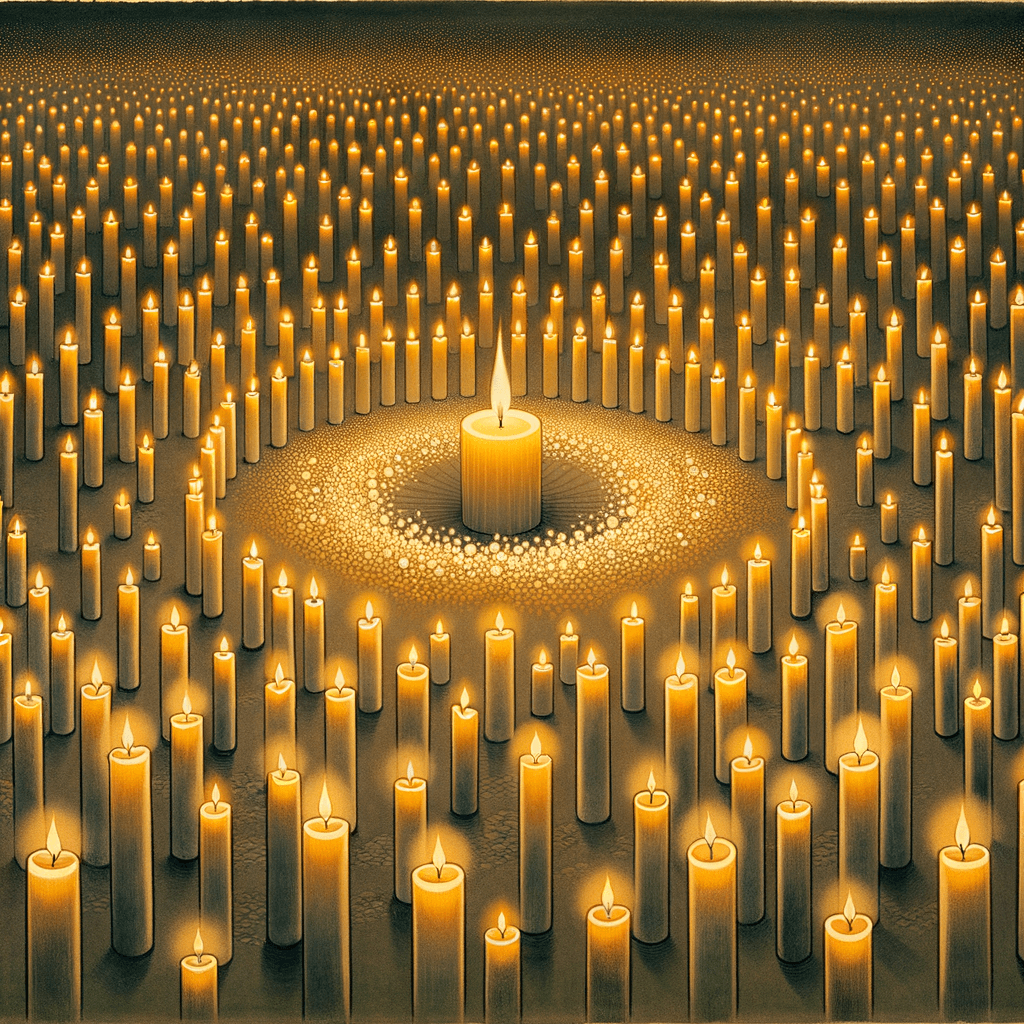
Thousands of candles can be lit from a single candle, and the life of the candle will not be shortened. Happiness never decreases by being shared. — Buddha
—What lingers after this line?
Endless Nature of Happiness
This quote illustrates that happiness, like the flame of a candle, is infinite and can be shared without being diminished. Sharing joy with others does not reduce our own happiness.
The Power of Generosity
It underscores the importance of generosity and kindness. By sharing happiness with others, we contribute to a more positive and compassionate world without losing anything ourselves.
Positive Impact on Others
The message reveals that by spreading happiness, we have the potential to light up the lives of countless people, just as one candle can light many others.
Philosophical Insight
It encapsulates a profound philosophical truth about the nature of positive emotions and the boundless capacity for human beings to promote well-being in others.
Historical Context
Attributed to Buddha, this quote reflects the teachings of Buddhism, which emphasize compassion, the interconnectedness of all beings, and the value of spreading happiness and reducing suffering.
One-minute reflection
What's one small action this suggests?
Related Quotes
6 selectedYou don't have to be a billionaire to believe you can make a difference. Give your time, give your love, or simply give a smile. — Steve Goodier
Steve Goodier
At its core, Steve Goodier’s quote challenges the idea that influence belongs only to the wealthy or powerful. By placing time, love, and even a smile alongside money, he broadens generosity into something almost anyone...
Read full interpretation →Takers must have no limits, because givers never do. — Iyanla Vanzant
Iyanla Vanzant
At first glance, Iyanla Vanzant’s line sounds almost humorous, yet its irony cuts deeply. If givers continue offering time, energy, money, or emotional labor without pause, then takers are effectively trained to expect a...
Read full interpretation →In the ordinary life, we hardly realize that we receive a great deal more than we give, and that it is only with gratitude that life becomes rich. — Dietrich Bonhoeffer
Dietrich Bonhoeffer
Bonhoeffer begins with a quiet but unsettling observation: most of us move through ordinary life without noticing how much we constantly receive. From language and education to food, care, and companionship, our days are...
Read full interpretation →The love we give away is the only love we keep. — Elbert Hubbard
Elbert Hubbard
At first glance, Elbert Hubbard’s line seems to contradict common sense: how can love that is given away be the only love we keep? Yet the paradox is precisely the point.
Read full interpretation →A generous heart is always open, always ready to receive our going and coming. — C. JoyBell C.
C. JoyBell C.
C. JoyBell C.’s line imagines generosity not merely as giving things away, but as creating inner space for others.
Read full interpretation →Peace is not something you wish for. It is something you make, something you do, something you are, and something you give away. — Robert Fulghum
Robert Fulghum
Robert Fulghum’s statement begins by overturning a comforting illusion: peace does not arrive through hope alone. By saying it is not merely something you wish for, he shifts the burden from passive desire to active resp...
Read full interpretation →More From Author
More from Buddha →To keep the body in good health is a duty, otherwise we shall not be able to keep our mind strong and clear. — Buddha
At its core, this saying presents physical care not as vanity or indulgence, but as a duty. The body is treated as the necessary ground on which mental clarity stands, so neglecting it becomes more than a personal lapse—...
Read full interpretation →However many holy words you read, however many you speak, what good will they do you if you do not act upon them? — Buddha
Buddha’s question cuts through spiritual comfort by shifting attention from what we consume—holy texts and pious speech—to what we embody. Reading and reciting can feel like progress because they are visible and repeatab...
Read full interpretation →Better than a thousand hollow words, is one word that brings peace. — Buddha
Buddha’s saying begins with a simple comparison: quantity versus consequence. A thousand words can impress, distract, or even manipulate, yet still remain “hollow” if they do not reduce suffering or clarify the mind.
Read full interpretation →The way is not in the sky. The way is in the heart. — Buddha
Buddha’s line redirects spiritual seeking away from distant, external places—“the sky”—and toward the intimate terrain of lived experience. Instead of imagining truth as something hidden in the heavens or guarded by spec...
Read full interpretation →