
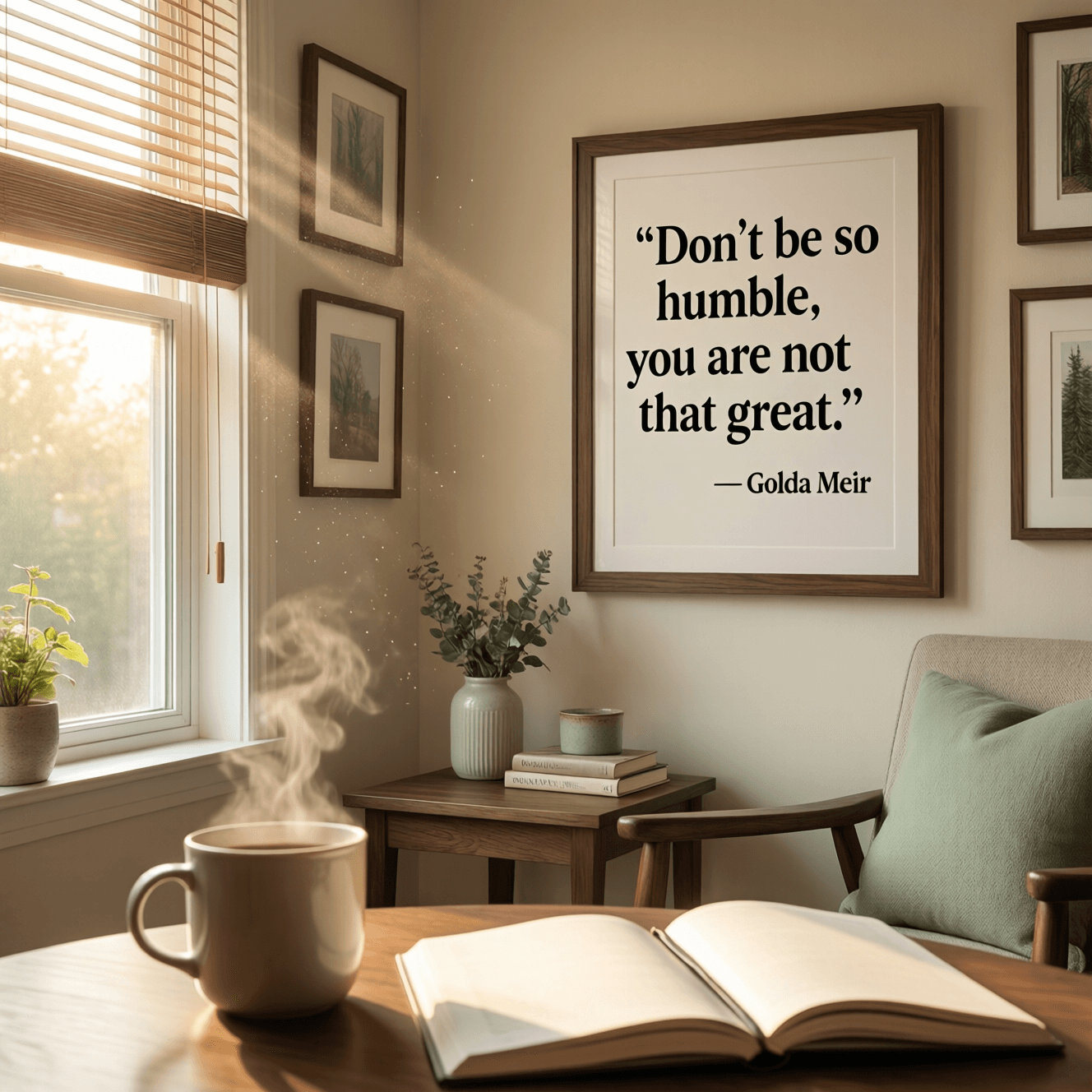
Don't be so humble—you are not that great. — Golda Meir
—What lingers after this line?
A Rebuke That Cuts Through Politeness
Golda Meir’s line—“Don’t be so humble—you are not that great.”—lands like a slap of honesty, refusing the social ritual of exaggerated modesty. Rather than praising confidence, she questions whether humility is being used as a costume to avoid scrutiny. In that sense, the remark is less about ego and more about accuracy: it calls for a truthful self-assessment instead of a performative lowering of oneself. From the outset, her phrasing also flips expectations. Humility is usually treated as a virtue, yet Meir suggests it can become a kind of indulgence—an easy refuge when a person would be better served by responsibility, competence, and results.
Humility as Evasion, Not Virtue
Moving from the sting to the lesson, Meir’s quote points to a subtle behavior: using modesty to dodge accountability. Someone who constantly downplays their ability may be trying to preempt criticism—if they fail, they can say they never claimed to be capable. Meir’s rebuke challenges that protective maneuver, implying that self-deprecation doesn’t automatically equal moral depth. In everyday workplaces, this shows up when a team member says, “I’m not the expert,” while still steering decisions—or when leaders hide behind “I’m just lucky” to avoid owning their impact. Meir’s line pressures the listener to drop the mask and engage reality directly.
The Difference Between Humility and Honesty
Still, the quote doesn’t have to be read as an attack on humility itself; it can be read as an insistence on intellectual honesty. Genuine humility recognizes limits while still naming strengths plainly. Meir’s jab targets false humility: the kind that exaggerates weakness to seem virtuous, or that invites reassurance from others. This distinction matters because accurate self-knowledge is a foundation for growth. If you pretend to be worse than you are, you may avoid opportunities that would develop you; if you pretend to be better, you become reckless. Meir’s sentence compresses that idea into a blunt correction: be neither inflated nor theatrically small.
A Leadership Style Built on Straight Talk
Seen in a broader light, the quote reflects a leadership posture that values candor over comfort. Leaders who must make high-stakes choices often develop impatience with affectation—whether it’s false confidence or false modesty—because both distort decision-making. Meir’s line signals a preference for people who can handle plain feedback and respond with improved performance rather than wounded pride. That bluntness also reveals a pragmatic ethic: character is proven by what you can do and what you will take responsibility for. By dismissing empty modesty, the quote nudges the listener toward a more solid virtue—competence paired with clarity.
The Social Function of Modesty—and Its Risks
At the same time, modesty often serves a social purpose: it smooths interaction, prevents envy, and keeps conversations cooperative. Meir’s critique, therefore, isn’t naïve about manners; it’s selective about when manners become manipulation. If modesty becomes a strategy to appear morally superior—or to fish for praise—it stops serving the group and starts serving the ego. This is why the line feels paradoxical: it sounds harsh, yet it’s aimed at reducing ego games. By puncturing self-flattering humility, Meir implicitly argues that there’s nothing noble about pretending to be small when the goal is to control how others see you.
A Practical Takeaway: Measure, Then Speak
Ultimately, the quote offers a practical discipline: replace self-performance with accurate measurement. Instead of reflexively diminishing yourself, state what you know, what you’ve done, and what you still need to learn. That approach is both humbler and stronger because it’s grounded in reality rather than in image. Meir’s closing implication is simple: you don’t earn respect by acting unimpressive—you earn it by being honest, capable, and accountable. If you are great, you don’t need the costume of humility; if you aren’t, humility won’t make you so. Either way, clarity beats posturing.
Recommended Reading
As an Amazon Associate, we earn from qualifying purchases.
One-minute reflection
Where does this idea show up in your life right now?
Related Quotes
6 selectedStarve the ego, feed the soul. — Mia Astral
Mia Astral
Mia Astral’s line frames personal growth as an act of selective nourishment: some parts of the self must be deprived so that others may thrive. In this contrast, the ego represents the restless hunger for validation, con...
Read full interpretation →To be truly free, one must be able to be free of oneself. — Jiddu Krishnamurti
Jiddu Krishnamurti
Krishnamurti’s line turns the usual idea of freedom inside out. Instead of blaming external rules alone—governments, traditions, or other people—he points to a subtler captivity: the constant pressure of “me,” with its p...
Read full interpretation →Saving money is the gap between your ego and your income. — Morgan Housel
Morgan Housel
Morgan Housel’s line reframes saving as a behavioral distance rather than a math problem. The “gap” is what remains when your self-image—what you feel you deserve, want to signal, or want to experience—doesn’t fully dict...
Read full interpretation →Trust yourself. Create the kind of self that you will be happy to live with all your life. — Golda Meir
Golda Meir
The quote encourages individuals to have faith in their own abilities and judgments.
Read full interpretation →Make the most of yourself by fanning the tiny, inner sparks of possibility into flames of achievement. — Golda Meir
Golda Meir
Golda Meir’s image reorients success away from grand gestures toward humble beginnings. A spark is fragile yet potent; it asks not for spectacle but for stewardship.
Read full interpretation →To reach the heights of greatness, one must begin at the depths of humility. — Anonymous
Unknown
This quote emphasizes that achieving greatness is a process that starts with understanding and acknowledging one’s limitations and the value of humility.
Read full interpretation →More From Author
More from Golda Meir →Trust yourself. Create the kind of self that you will be happy to live with all your life. — Golda Meir
The quote encourages individuals to have faith in their own abilities and judgments.
Read full interpretation →Make the most of yourself by fanning the tiny, inner sparks of possibility into flames of achievement. — Golda Meir
Golda Meir’s image reorients success away from grand gestures toward humble beginnings. A spark is fragile yet potent; it asks not for spectacle but for stewardship.
Read full interpretation →