
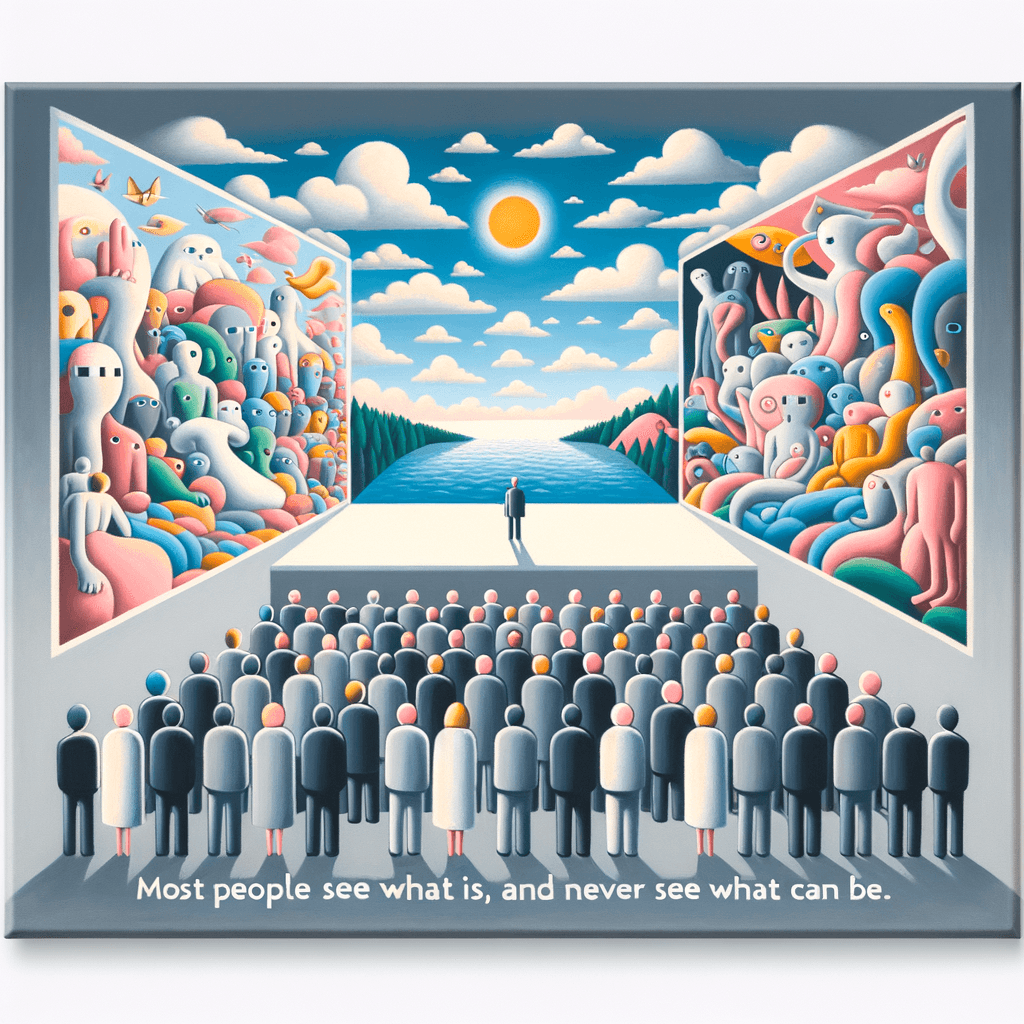
Most people see what is, and never see what can be. — Albert Einstein
—What lingers after this line?
Vision and Imagination
This quote emphasizes the difference between mere observation of the present reality and the ability to envision possibilities for the future. It highlights the importance of imagination in achieving innovation and progress.
Limitations of Conventional Thinking
Einstein points out that many individuals are constrained by conventional thinking, focusing only on what currently exists rather than considering what could potentially be created or achieved.
Encouragement for Change
The quote serves as a motivational call to challenge the status quo and encourages individuals to look beyond their current circumstances to identify opportunities for growth and transformation.
Creativity and Problem Solving
By urging people to see what can be, Einstein advocates for creativity and innovative problem-solving, which are essential skills for those seeking to make meaningful changes in their lives and in society.
Influence of Albert Einstein
As a renowned physicist, Einstein was not only concerned with scientific principles but also with broader philosophical implications. His insights often provoke deeper thinking about human potential and societal advancements.
One-minute reflection
Why might this line matter today, not tomorrow?
Related Quotes
6 selectedDreams are the seeds of possibility planted in the soil of the future. - Unknown
Unknown
This quote highlights the importance of dreams as the foundation for what can be achieved in the future. Dreams ignite the potential within us to create and accomplish great things.
Read full interpretation →Vision without execution is just hallucination. — Thomas Edison
Thomas Edison
This quote emphasizes that having a vision or idea is not enough. Implementation or execution is crucial to bring that vision into reality.
Read full interpretation →Hope is passion for the possible. — Søren Kierkegaard
Søren Kierkegaard
At first glance, Kierkegaard’s line transforms hope from a passive feeling into an active force. To call hope “passion for the possible” means that hope is not mere daydreaming; rather, it is an inward energy that leans...
Read full interpretation →Drawing is vision on paper. — Andrew Loomis
Andrew Loomis
At first glance, Andrew Loomis’s remark condenses the whole art of drawing into a single elegant idea: drawing is not merely the movement of a hand, but the translation of perception into form. In this sense, the page be...
Read full interpretation →A rock pile ceases to be a rock pile the moment a single man contemplates it, bearing within him the image of a cathedral. — Antoine de Saint-Exupéry
Exupéry
At first glance, Saint-Exupéry’s line seems to describe an ordinary heap of stones. Yet the moment someone looks at it while carrying the image of a cathedral within, the pile is transformed in meaning.
Read full interpretation →And now let us believe in a long year that is given to us, new, untouched, full of things that have never been. — Rainer Maria Rilke
Rainer Maria Rilke
Rilke opens by shifting the tone from planning to believing: the year is “given to us,” implying something received rather than conquered. This framing matters because it replaces the pressure of achievement with the hum...
Read full interpretation →More From Author
More from Albert Einstein →Be a loner. That gives you time to wonder, to search for the truth. Have holy curiosity. Make your life worth living. — Albert Einstein
At first glance, Einstein’s advice to “be a loner” may sound like a rejection of society, yet his deeper point is about protecting the inner space where thought can mature. Solitude gives a person room to hear their own...
Read full interpretation →The best of community does give one a deep sense of belonging and well-being; and in that sense, community takes away loneliness. — Albert Einstein
Einstein’s observation begins with a quiet but profound insight: loneliness is not solved merely by being around other people, but by feeling meaningfully connected to them. In his phrasing, the “best of community” offer...
Read full interpretation →It is entirely possible that behind the perception of our senses, worlds are hidden of which we are unaware. — Albert Einstein
At first glance, Einstein’s remark invites intellectual humility. He suggests that what we see, hear, and touch may represent only a thin surface of reality, not its full depth.
Read full interpretation →It is not that I'm so smart, it's just that I stay with problems longer. — Albert Einstein
At first glance, Einstein’s remark sounds like modesty, yet it does more than downplay genius. By saying he simply ‘stays with problems longer,’ he shifts attention from innate talent to sustained effort, suggesting that...
Read full interpretation →