
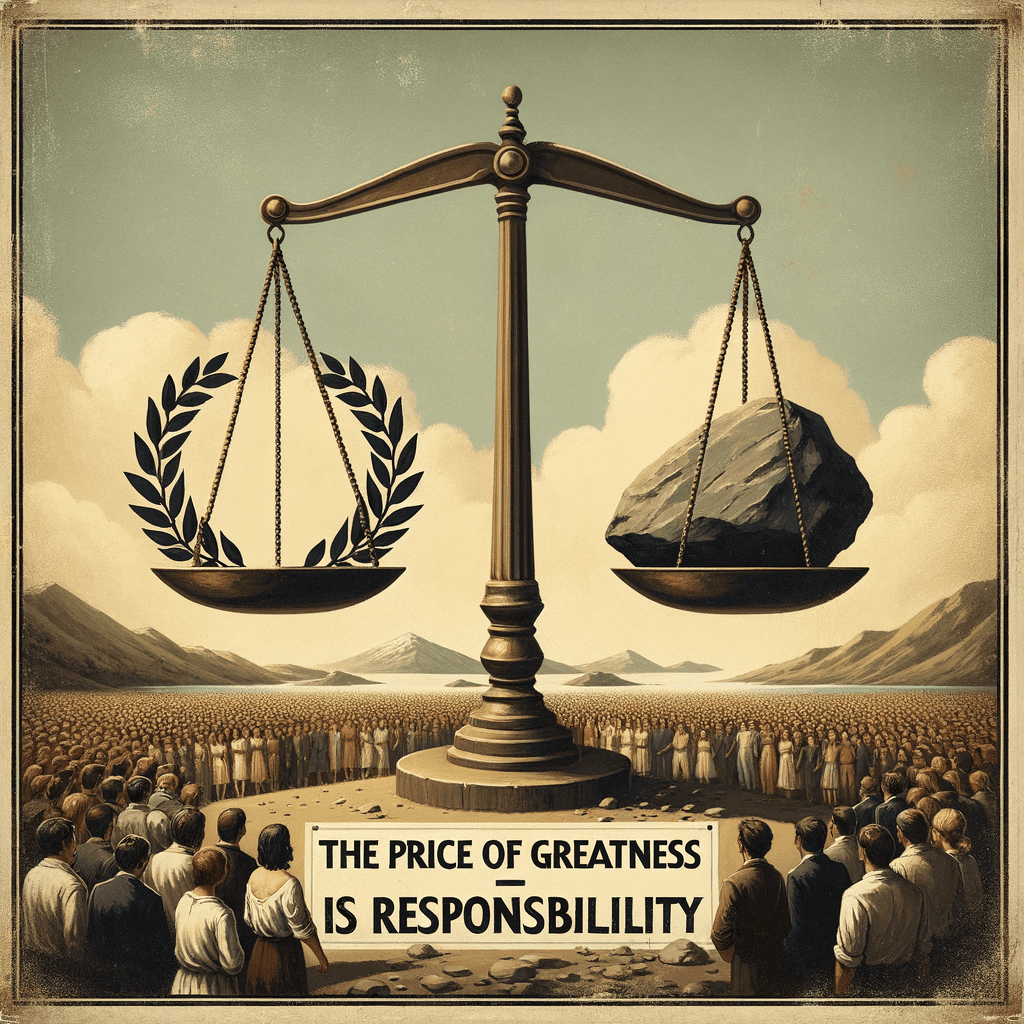
The price of greatness is responsibility. — Winston S. Churchill
—What lingers after this line?
Understanding Responsibility
This quote emphasizes that with achievement and success comes a greater level of responsibility. Greatness is not merely about accolades but involves accountability for one's actions and decisions.
Leadership and Accountability
Churchill highlights that true leaders must accept the weight of their responsibilities. Great leadership involves making tough decisions and being answerable for the outcomes that affect others.
Consequences of Success
Success often entails challenges and moral obligations. The quote suggests that aspiring for greatness requires confronting the consequences that arise from one's pursuits and ambitions.
Moral Duty
Greatness isn't just a position or title; it is accompanied by a moral duty to serve and uplift others. Those who achieve greatness are urged to act wisely and ethically for the betterment of society.
Historical Context
Winston S. Churchill, the British Prime Minister during World War II, understood the significant burdens of leadership amid crises. His insights on responsibility reflect the challenges he faced during his tenure and the importance of accountable governance.
One-minute reflection
Where does this idea show up in your life right now?
Related Quotes
6 selectedResponsibility is the price of freedom. — Elie Wiesel
Elie Wiesel
This quote highlights the idea that true freedom comes with the obligation to act responsibly. It suggests that being free entails making choices that consider the well-being of oneself and others.
Read full interpretation →If you want to be out front, then act as if you were behind. — Lao Tzu
Lao Tzu
Lao Tzu’s saying begins with a paradox: to move ahead of others, one must behave as though one is behind them. Rather than urging weakness or hesitation, the quote points to a subtler form of strength—leadership that doe...
Read full interpretation →You are not responsible for your first thought, but you are responsible for your second thought. — Viktor Frankl
Viktor Frankl
At its core, the quotation distinguishes between what arises automatically and what we deliberately endorse. A first thought may be reflexive, inherited, fearful, angry, or conditioned by habit; it appears before moral j...
Read full interpretation →If you wouldn't follow yourself, why should anyone else? — John C. Maxwell
John C. Maxwell
Maxwell’s line turns leadership inward before it points outward. In essence, he argues that credibility starts with a private standard: if your own behavior would not inspire your loyalty, your authority rests on appeara...
Read full interpretation →Let us not seek the Republican answer or the Democratic answer, but the right answer. Let us not seek to fix blame for the past. Let us accept our own responsibility for the future. — John F. Kennedy
John F. Kennedy
At its core, John F. Kennedy’s statement urges citizens to rise above partisan identity and focus on what is genuinely right.
Read full interpretation →Stop begging God to increase your territory when you can't even maintain the territory you already have. — Iyanla Vanzant
Iyanla Vanzant
At its core, Iyanla Vanzant’s statement confronts a common contradiction: people often ask for more influence, wealth, opportunity, or responsibility before proving they can care for what is already in their hands. In th...
Read full interpretation →More From Author
More from Winston S. Churchill →First, we shape our buildings; thereafter, they shape us. — Winston S. Churchill
This quote highlights the reciprocal relationship between humanity and the structures we create. Initially, we design buildings to serve our needs, but over time, these buildings begin to influence our behaviors, thought...
Read full interpretation →You create your own universe as you go along. — Winston S. Churchill
This quote emphasizes the power of individual agency in shaping one's reality. It suggests that one's thoughts, actions, and decisions actively contribute to the creation of their unique life experience.
Read full interpretation →You have enemies? Good. That means you've stood up for something, sometime in your life. — Winston S. Churchill
This quote suggests that having enemies is a sign of standing firm in one's beliefs and values. It implies that to have opposition means one has taken a strong stance on an issue.
Read full interpretation →The farther backward you can look, the farther forward you are likely to see. — Winston S. Churchill
Churchill emphasizes the importance of understanding history. By looking backward and analyzing the past, we can learn from previous successes and mistakes, which can guide us toward making informed decisions for the fut...
Read full interpretation →