
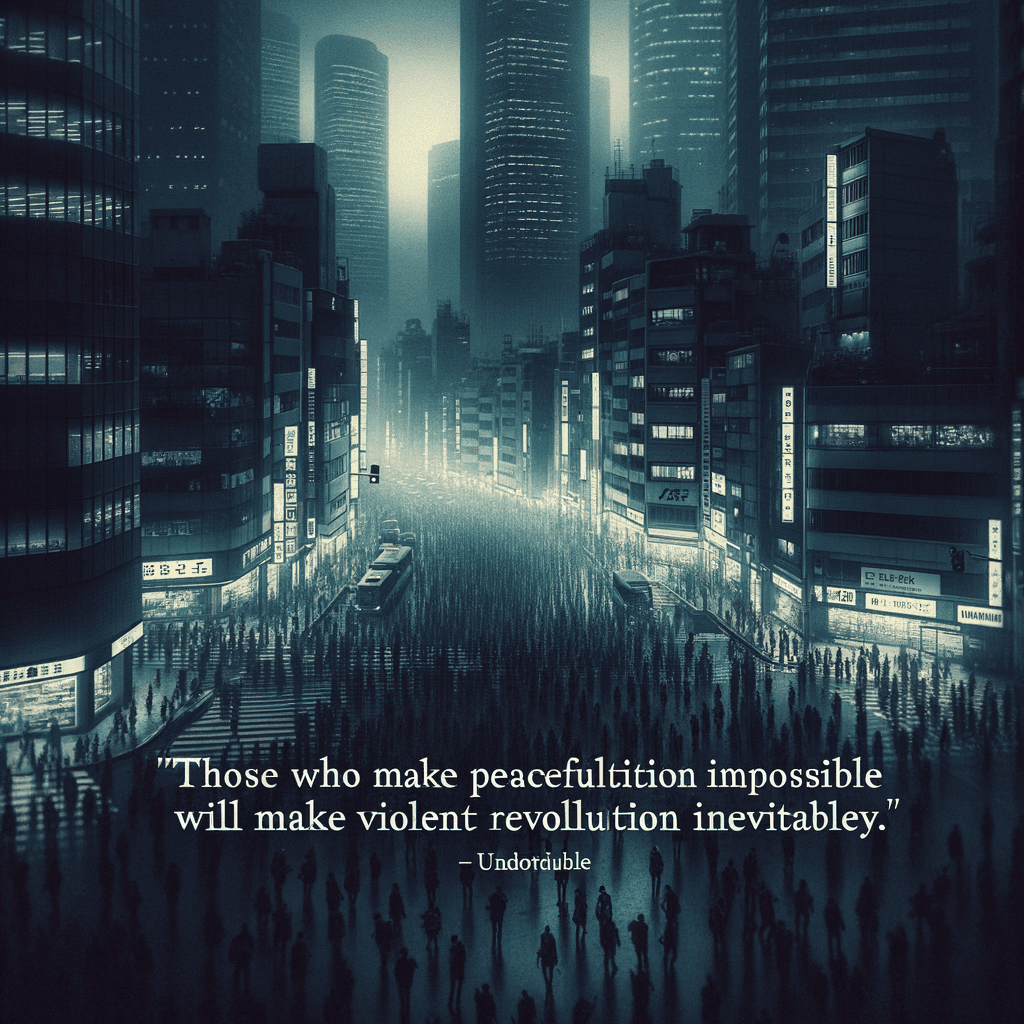
Those who make peaceful revolution impossible will make violent revolution inevitable. — John F. Kennedy, United States.
—What lingers after this line?
Consequences of Oppression
This quote highlights the idea that when a government or authority suppresses peaceful efforts for change, it leaves people with no choice but to resort to violence as a means of revolt.
The Importance of Dialogue
Kennedy emphasizes the need for open communication and negotiation in addressing grievances. When peaceful avenues are blocked, tensions escalate, ultimately leading to conflict.
Historical Context of Revolution
The statement can be understood in the context of various historical revolutions where the absence of peaceful options forced people to violently challenge the status quo, reflecting a broader pattern of societal response to injustice.
Role of Leadership
Leaders are tasked with creating environments conducive to peaceful change. Failing to do so can result in the loss of trust and legitimacy, making violence appear as the only option for the people.
Psychology of Protest
The quote also speaks to the psychological aspects of resistance, suggesting that when individuals feel unheard or oppressed, their frustration can lead to radical actions, indicating a breakdown in societal cohesion.
One-minute reflection
What's one small action this suggests?
Related Quotes
4 selectedDoing nothing gets us nothing. — John F. Kennedy, United States.
John F. Kennedy, United States.
This quote emphasizes the necessity of taking action to achieve goals. Without effort and initiative, one cannot expect to see progress or success.
Read full interpretation →Every advance in human freedom has been accompanied by the greater realization of the value of human life. — John F. Kennedy, United States.
John F. Kennedy, United States.
This quote suggests a direct correlation between the progress of human rights and the increasing appreciation for human life. As societies strive for greater freedom, they also tend to recognize and cherish the intrinsic...
Read full interpretation →Ask not what your country can do for you – ask what you can do for your country. — John F. Kennedy, United States.
John F. Kennedy, United States.
This quote emphasizes the idea of civic duty and the responsibility of individuals towards their community and nation. It encourages citizens to take an active role in contributing to the welfare of their country.
Read full interpretation →Things do not happen. Things are made to happen. — John F. Kennedy
John F. Kennedy
Kennedy’s line rejects the comfort of fatalism. By insisting that things are made to happen, he reframes outcomes as the product of intention, organization, and disciplined follow-through.
Read full interpretation →More From Author
More from John F. Kennedy, United States. →Ask not what your country can do for you – ask what you can do for your country. — John F. Kennedy, United States.
This quote emphasizes the idea of civic duty and the responsibility of individuals towards their community and nation. It encourages citizens to take an active role in contributing to the welfare of their country.
Read full interpretation →Doing nothing gets us nothing. — John F. Kennedy, United States.
This quote emphasizes the necessity of taking action to achieve goals. Without effort and initiative, one cannot expect to see progress or success.
Read full interpretation →Every advance in human freedom has been accompanied by the greater realization of the value of human life. — John F. Kennedy, United States.
This quote suggests a direct correlation between the progress of human rights and the increasing appreciation for human life. As societies strive for greater freedom, they also tend to recognize and cherish the intrinsic...
Read full interpretation →