
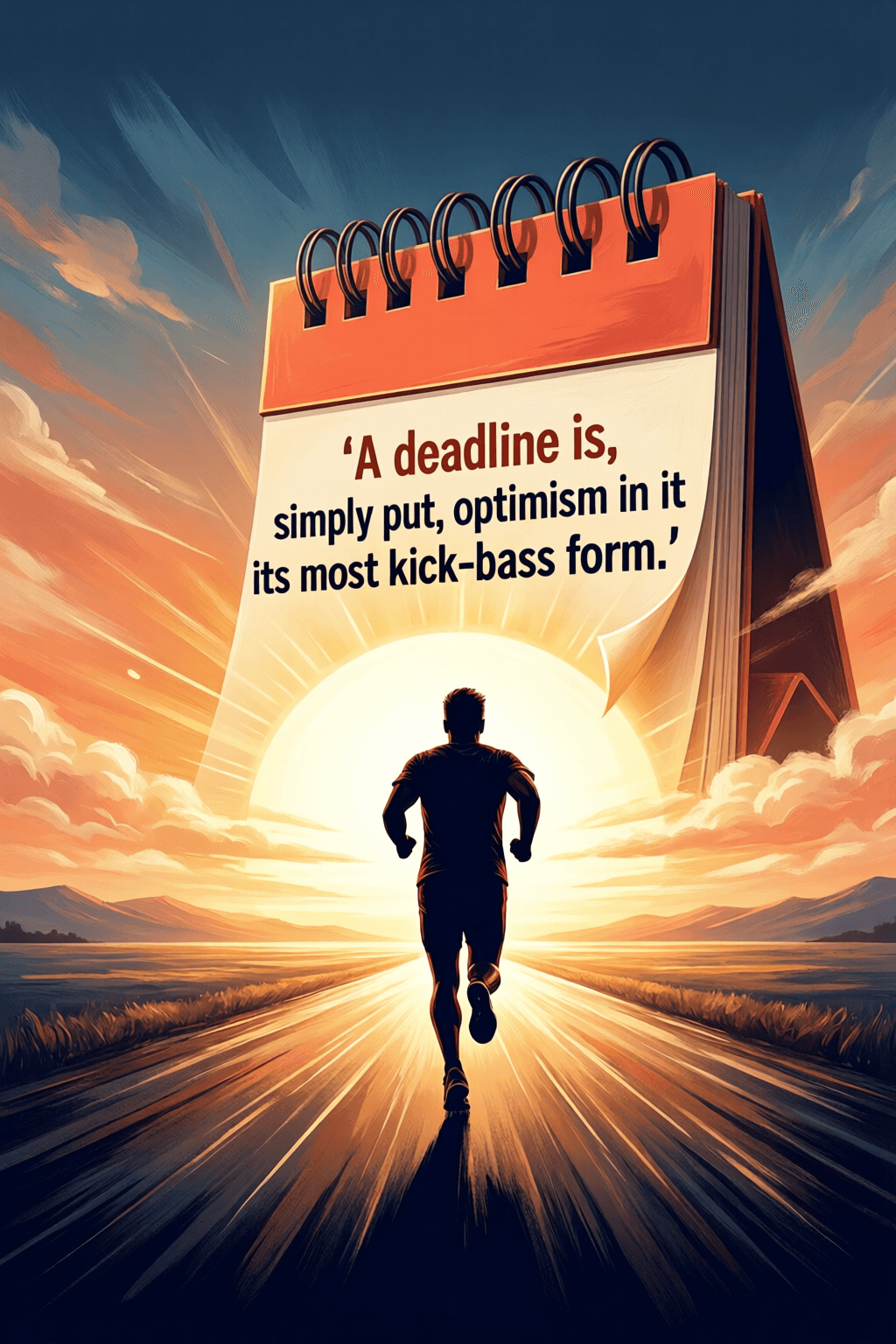
A deadline is, simply put, optimism in its most kick-ass form. — Chris Baty
—What lingers after this line?
A Surprising Definition of Pressure
At first glance, Chris Baty’s remark sounds like a joke about stress, yet it quickly turns into something sharper: a deadline is faith disguised as urgency. To set a date for finishing anything is to believe, perhaps stubbornly, that the work can be done at all. In that sense, the deadline is not merely a threat hanging over us; rather, it is an act of confidence with teeth. This framing matters because it shifts the emotional center of deadlines. Instead of seeing them only as instruments of control, we begin to see them as declarations of possibility. Even when they feel punishing, they carry an underlying message: the future can be shaped, and we are capable of shaping it within a fixed span of time.
Why Optimism Needs a Clock
From there, Baty’s use of the word “optimism” becomes especially revealing. Optimism alone can remain abstract—a pleasant belief that things will somehow work out. However, once attached to a deadline, that belief becomes active and accountable. The date on the calendar forces hope to leave the realm of fantasy and enter the world of schedules, drafts, revisions, and late nights. This is why deadlines often feel more honest than vague ambition. A person who says, “I’ll write a novel someday,” is entertaining a dream; a person who says, “I’ll finish by November 30,” is making a wager on effort. Baty, as the founder of National Novel Writing Month, built an entire movement on this principle: constraint can convert wishful thinking into momentum.
The Productive Energy of Urgency
Naturally, once optimism is given a hard edge, urgency enters the picture. Deadlines compress attention. They silence some distractions by making choices unavoidable, and in doing so they can unlock a level of productivity that open-ended time rarely produces. Parkinson’s Law, popularized by Cyril Northcote Parkinson in 1955, suggests that work expands to fill the time available for its completion; a deadline resists that expansion by setting a boundary. As a result, the looming finish line can become strangely energizing. Students, artists, and entrepreneurs alike often discover that they are capable of decisive action only when the clock becomes impossible to ignore. What seemed overwhelming in the abstract becomes manageable in sequence: first this task, then the next, then the final push.
Humor That Hides a Truth
Even so, Baty’s phrase “kick-ass form” keeps the quote from becoming solemn. The humor is important because it captures the emotional violence we often associate with deadlines while also admiring their effectiveness. In other words, the line acknowledges that deadlines are not gentle motivators; they are optimism toughened by consequence. That balance between comedy and truth explains why the quote resonates so widely. Most people know the absurd ritual of promising themselves they work best under pressure, only to discover that pressure really does produce results. The line laughs at that contradiction while preserving its wisdom: sometimes our boldest belief in ourselves arrives not as calm inspiration, but as a ticking clock.
When Constraint Creates Freedom
From this angle, deadlines begin to look less like cages and more like creative frameworks. Counterintuitive as it seems, limits often produce freedom by narrowing the field of hesitation. The poet W. H. Auden once remarked that art is born of constraint, and Baty’s philosophy follows a similar path: when time is finite, perfectionism loses some of its power, and progress becomes possible. Consequently, deadlines can liberate people from endless preparation. Instead of asking whether the work could be better in theory, they ask whether it can be completed in practice. That distinction is crucial, because many meaningful achievements—books, businesses, dissertations, even personal changes—exist only because someone accepted an imperfect finish over an infinite delay.
A More Useful Way to See Deadlines
Ultimately, Baty invites us to reinterpret a familiar source of dread. A deadline is certainly pressure, but it is also a bold statement that effort can be organized, that ambition can be measured, and that intention can become action. Seen this way, the deadline is optimism made muscular: not a passive wish for success, but a forceful commitment to arrive somewhere by a chosen hour. That is why the quote lingers. It turns a mundane feature of modern life into a small philosophy of achievement. Behind every deadline lies a simple but powerful belief: the future is not just something we await, but something we dare ourselves to meet.
Recommended Reading
As an Amazon Associate, we earn from qualifying purchases.
One-minute reflection
What's one small action this suggests?
Related Quotes
6 selectedOptimism is the faith that leads to achievement. Nothing can be done without hope and confidence. — Helen Keller
Helen Keller
This quote highlights the crucial role that optimism plays in achieving success. It suggests that a positive mindset is essential for driving efforts and overcoming challenges.
Read full interpretation →Optimism is the faith that leads to achievement. Nothing can be done without hope and confidence. — Helen Keller
Helen Keller
This quote highlights the crucial role optimism plays in achieving one's goals. It suggests that a positive outlook is the foundation upon which all achievements are built.
Read full interpretation →It is a new dawn, it is a new day, it is a new life for me, and I am feeling good. — Nina Simone
Nina Simone
At its core, Nina Simone’s line turns ordinary time—dawn, day, life—into a sequence of renewal. Each phrase builds on the last, moving from the external world to the speaker’s inner state, until the declaration “I am fee...
Read full interpretation →Stay positive does not mean that things will turn out okay. Rather it is knowing that you will be okay no matter how things turn out. — Garth Ennis
Garth Ennis
At first glance, positivity is often mistaken for optimism about outcomes, as if a hopeful person must believe everything will end well. Garth Ennis challenges that softer cliché by offering a sturdier definition: being...
Read full interpretation →If I can be optimistic when I'm nearly dead, surely the rest of you can handle a little inflation. — Charlie Munger
Charlie Munger
Charlie Munger’s line works by forcing a blunt comparison: if someone facing mortality can still choose optimism, then everyday economic discomforts look less like catastrophes and more like manageable hardships. The exa...
Read full interpretation →One of the things I learned the hard way was that it doesn't pay to get discouraged. — Lucille Ball
Lucille Ball
Lucille Ball’s line reframes discouragement as a bad investment: it “doesn’t pay.” Rather than a moral plea to be cheerful, it’s a pragmatic calculation about return on effort. When we stop after a setback, we halt compo...
Read full interpretation →More From Author
More from Chris Baty →