
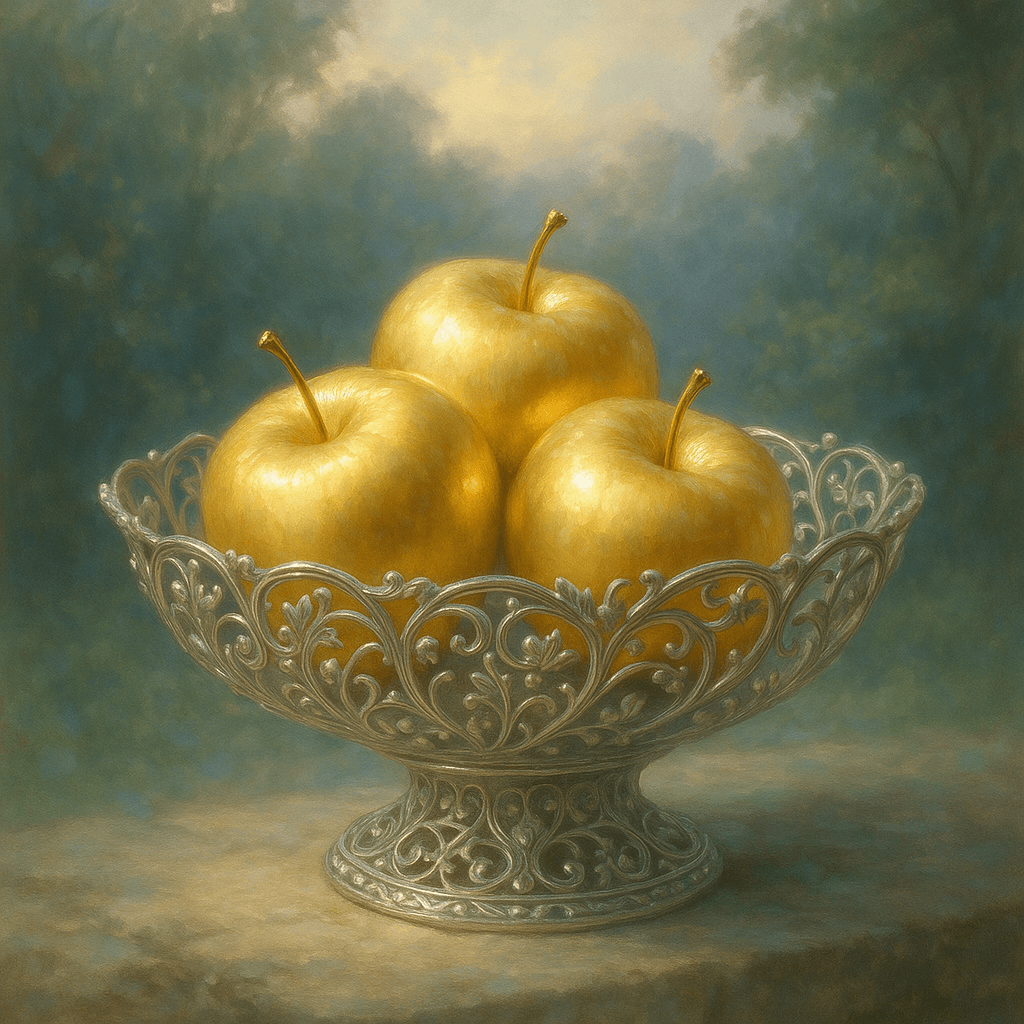
A word fitly spoken is like apples of gold in a setting of silver. — Proverbs (Biblical)
—What lingers after this line?
Power of Timely Speech
The proverb emphasizes the importance of saying the right thing at the right moment. Just as perfectly ripe fruit in a beautiful setting delights the eye, well-chosen words can comfort and inspire. In Abraham Lincoln’s famous 1862 address to Congress, he referenced this proverb to stress how crucial it was to address national issues with deliberate and timely words.
Value and Beauty of Wisdom
The imagery of 'apples of gold in a setting of silver' suggests both rarity and aesthetic perfection. Wisdom spoken fittingly is precious and beautiful, providing harmony in its surroundings. In *The Analects* (c. 475 BC), Confucius notes, 'Wisdom, compassion, and courage are the three universally recognized moral qualities of men.'
Impact on Relationships
Appropriate words can heal rifts and strengthen bonds. Like golden apples in silver, the effect of sensitive speech is both noticeable and lasting. In Jane Austen’s *Pride and Prejudice* (1813), Elizabeth Bennet’s sincere and timely remarks transform Darcy’s perception and pave the way for reconciliation.
Guidance in Communication
This verse encourages discernment and intentionality in speech. It reflects the biblical theme that words carry weight: Proverbs 18:21 asserts, 'Death and life are in the power of the tongue.' Thoughtful communication can uplift rather than discourage.
Cultural and Artistic Resonance
The phrase has inspired art, literature, and even jewelry design. For instance, 19th-century Victorian lockets engraved with this proverb were often given as gifts, symbolizing the enduring value of meaningful language in personal connections.
One-minute reflection
What's one small action this suggests?
Related Quotes
6 selectedWisdom is knowing when to have rest, when to have activity, and how much of each to have. — Etty Hillesum
Etty Hillesum
Etty Hillesum’s insight begins with a simple but demanding idea: wisdom is not merely knowing what is good, but knowing when it is good. Rest and activity are both necessary, yet either can become harmful when taken at t...
Read full interpretation →Wisdom comes only to the silent mind. — Krishnamurti
Krishnamurti
Krishnamurti’s statement begins with a simple but demanding insight: wisdom is not merely accumulated information, nor is it the reward for constant thinking. Instead, it arises when the mind becomes quiet enough to perc...
Read full interpretation →Never call yourself a philosopher; show it. — Epictetus
Epictetus
Epictetus compresses an entire ethical program into a sharp command: do not claim the title, demonstrate the life. In other words, wisdom is not a badge one pins on oneself but a pattern others can recognize in conduct.
Read full interpretation →You are not starting over. You're starting wiser. — Meredith Eastwood
Meredith Eastwood
At first glance, Meredith Eastwood’s line gently challenges the fear that often accompanies change. To say, “You are not starting over,” is to reject the idea that every setback erases what came before.
Read full interpretation →The wise do things slowly, because they love it. — David Fell
David Fell
At first glance, David Fell’s line seems to praise caution, yet it reaches further than mere hesitation. To do something slowly, in this view, is not to be indecisive but to be fully present.
Read full interpretation →To be old and wise you must first be young and stupid. — Terry Pratchett
Terry Pratchett
At first glance, Terry Pratchett’s line turns wisdom into a joke, yet its humor carries a serious truth: good judgment is rarely innate. Instead, it is usually built from errors, embarrassment, and misread situations tha...
Read full interpretation →More From Author
More from Proverbs (Biblical →