
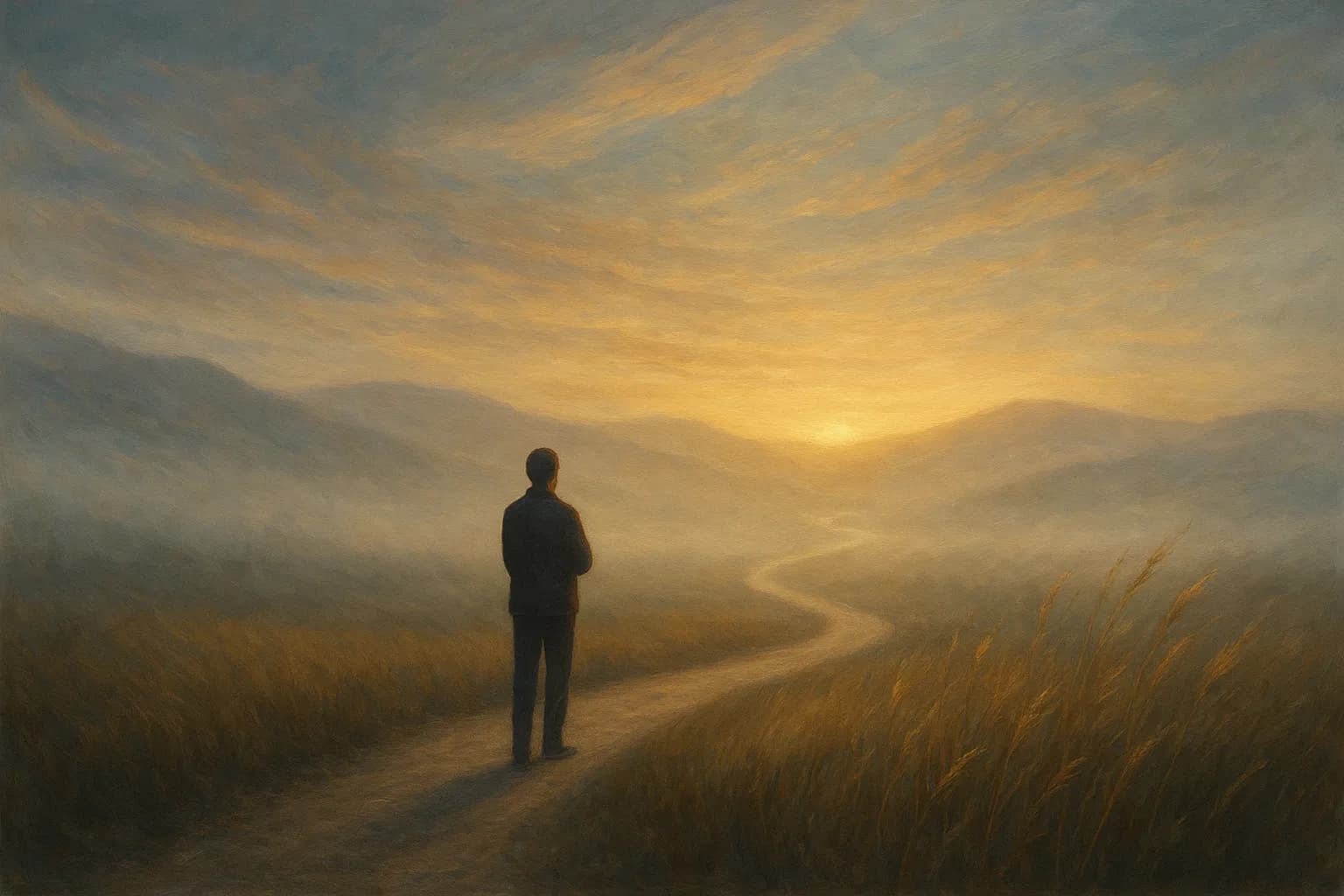
Act in faith about what you cannot foresee; meaning unfolds from motion. — Søren Kierkegaard
—What lingers after this line?
Trusting Beyond the Visible
Kierkegaard’s line, “Act in faith about what you cannot foresee,” captures his conviction that human life is lived on the edge of uncertainty. Rather than waiting for perfect clarity, he urges us to move while the path is still obscured. In works like *Fear and Trembling* (1843), he portrays biblical Abraham walking toward an unknown outcome, not because he understands everything, but because he dares to trust despite his confusion. Thus, faith here is not blind stubbornness; it is a courageous willingness to proceed without guarantees, accepting that risk is woven into existence itself.
Existence as a Journey, Not a Blueprint
From this starting point, Kierkegaard distinguishes between abstract knowledge and lived existence. You can plan, calculate, and imagine, yet life will still exceed your forecasts. He argues in *Either/Or* (1843) that no ethical system or rational blueprint can fully capture what it means to exist as a single individual with concrete choices. Therefore, action precedes full understanding: you step into a job, a relationship, or a vocation without knowing its final shape. It is only by journeying—rather than by drafting the perfect map—that your life acquires contour, depth, and direction.
Meaning Arising From Motion
The second half of the quote—“meaning unfolds from motion”—clarifies how understanding emerges. Kierkegaard insists that truths about yourself and your world cannot be grasped in detached stillness; they must be discovered in the very act of living. Just as a novel’s theme becomes clear only as the plot advances, your choices gradually reveal what matters to you. A student, for instance, may not grasp why a field of study is significant until months of practice, failure, and growth have passed. In this way, motion—concrete engagement with life—becomes the stage on which meaning slowly discloses itself.
The Leap of Faith and Its Risks
Naturally, this motion is never risk-free. Kierkegaard famously describes faith as a “leap,” emphasizing that one must jump without a full view of the landing. In *Concluding Unscientific Postscript* (1846), he criticizes the desire for absolute certainty before committing to anything, arguing that such a demand leads to paralysis. Instead, he suggests that risk is inseparable from authenticity: to love someone, to commit to a belief, or to pursue a calling always means stepping into the unforeseeable. Failure and disappointment remain possible, yet he contends that not leaping at all is the greater loss, for it leaves one stranded in empty possibility.
Freedom, Responsibility, and Becoming Oneself
This emphasis on acting in faith also heightens personal responsibility. Because meaning arises from your own motion, you cannot outsource your becoming to social norms or abstract theories. In *The Sickness Unto Death* (1849), Kierkegaard describes the self as a task—to become oneself is to continually choose how to relate to one’s possibilities. Acting in faith, therefore, is not reckless spontaneity but a disciplined, reflective engagement with your freedom. As you move, reflect, and move again, you gradually shape a life that is not merely accidental but owned, interpreted, and inhabited from within.
Living Forward, Understanding Backward
Finally, Kierkegaard’s insight resonates with his well-known remark that “life can only be understood backwards; but it must be lived forwards.” At the moment of decision, you cannot foresee all consequences; only later do patterns and meanings become visible. The quote therefore invites a specific posture toward time: live forward in faith, accepting opacity, and then interpret backward in patience. By holding these together—courage in moving ahead, humility in understanding later—you inhabit a more honest, dynamic view of meaning, one that is not discovered in advance but gradually revealed through the very fact that you dared to act.
One-minute reflection
Where does this idea show up in your life right now?
Related Quotes
6 selectedLeap with eyes open; faith begins where comfort ends. — Søren Kierkegaard
Søren Kierkegaard
The aphorism’s hinge is a threshold: where comfort ends, faith begins. For Kierkegaard, the crucial decisions of life are made precisely when certainty recedes and responsible risk emerges.
Read full interpretation →The task of a craftsman is not to generate meaning, but rather to cultivate in himself the skill of discerning the meanings that are already there. — Cal Newport
Cal Newport
At its core, Cal Newport’s quote overturns a popular modern assumption: that fulfillment is something we simply fabricate through self-expression alone. Instead, he argues that meaning already exists in the structure of...
Read full interpretation →The capacity to care is the thing which gives life its deepest significance. — Pablo Casals
Pablo Casals
Pablo Casals’ remark begins with a simple but profound claim: life does not gain depth merely from achievement, pleasure, or survival, but from the ability to care. In this view, significance is not something we possess...
Read full interpretation →Well-being cannot exist just in your own head. Well-being is a combination of feeling good as well as actually having meaning, good relationships and accomplishment. — Martin Seligman
Martin Seligman
At first glance, Martin Seligman’s statement challenges the common idea that well-being is simply a private feeling. Instead, he argues that flourishing includes both inner experience and outward reality: feeling good ma...
Read full interpretation →The meaning of life is to give life meaning. — Viktor E. Frankl
Viktor E. Frankl
At first glance, Frankl’s line turns a timeless question inside out. Instead of treating meaning as a hidden answer waiting to be discovered, he suggests that meaning emerges through our response to life itself.
Read full interpretation →Make a single real gesture and meaning will gather around it. — Fyodor Dostoevsky
Fyodor Dostoevsky
Dostoevsky’s line treats meaning not as something we merely discover, but as something that can accrete around an authentic act. A “real gesture” suggests sincerity—an action that is not performed for appearances, but ar...
Read full interpretation →More From Author
More from Søren Kierkegaard →Where you stand determines what you see and what you do not see; a change in where you stand changes everything. — Søren Kierkegaard
Kierkegaard’s insight begins with a simple but unsettling claim: vision is never neutral. Where we stand—socially, emotionally, spiritually, or intellectually—determines not only what comes into view but also what remain...
Read full interpretation →Hope is passion for the possible. — Søren Kierkegaard
At first glance, Kierkegaard’s line transforms hope from a passive feeling into an active force. To call hope “passion for the possible” means that hope is not mere daydreaming; rather, it is an inward energy that leans...
Read full interpretation →To know what you want to do and to do it is the same courage. — Søren Kierkegaard
At first glance, Kierkegaard’s line seems to separate thought from action, yet it quickly reunites them under a single demand: courage. To know what one truly wants is not a passive discovery, because genuine self-knowle...
Read full interpretation →The most common form of despair is not being who you are. — Søren Kierkegaard
Kierkegaard’s line reframes despair as something subtler than grief or temporary unhappiness. Rather than treating it as a passing mood, he points to a spiritual and existential condition: the suffering that arises when...
Read full interpretation →