
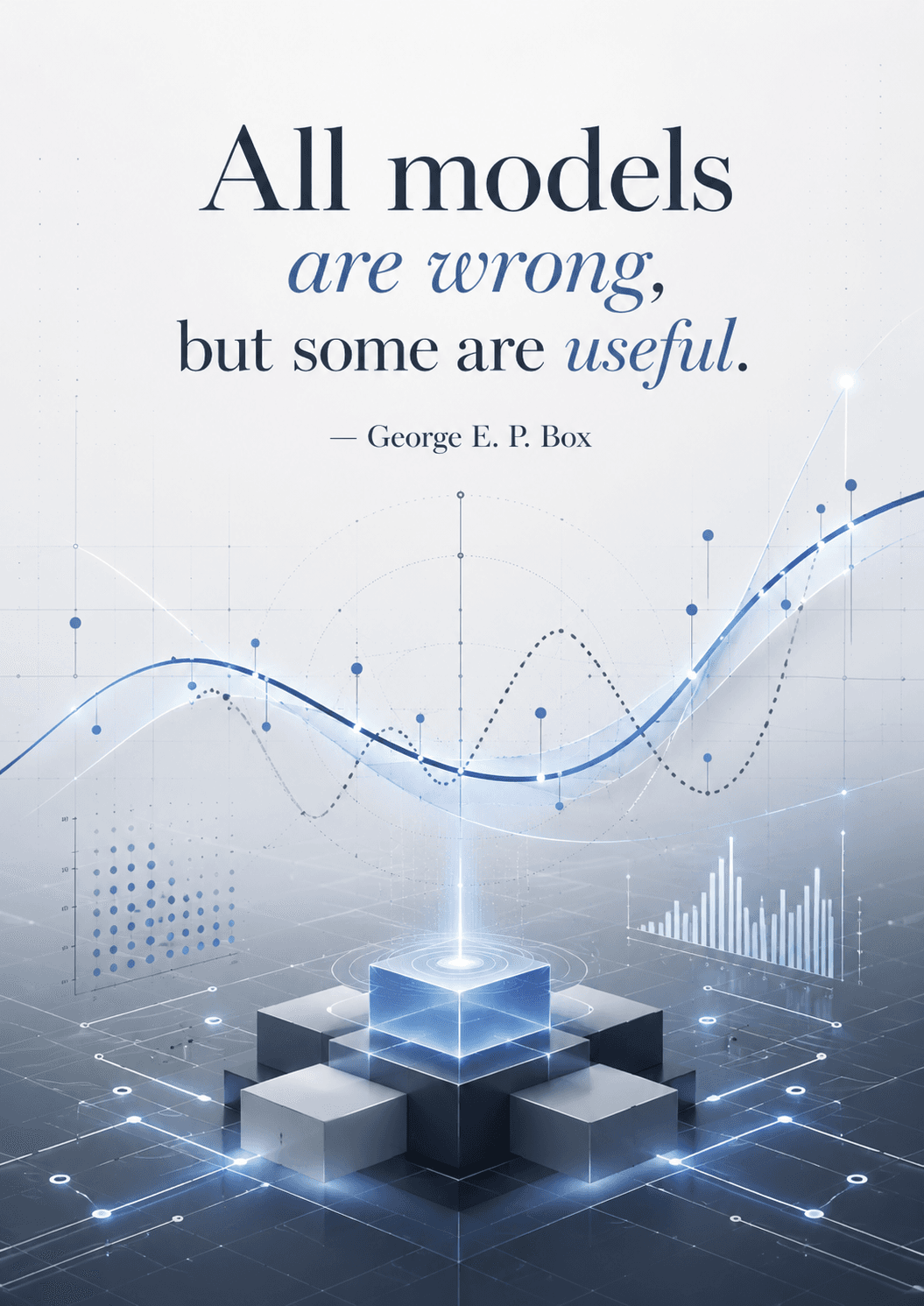
All models are wrong, but some are useful. — George E. P. Box
—What lingers after this line?
The Humility Behind the Quote
At first glance, George E. P. Box’s famous line sounds like a criticism of science and prediction. In fact, it is a statement of intellectual humility. A model—whether a statistical formula, a map, or an economic theory—is never reality itself. It simplifies, trims, and highlights only certain features, which means it must always leave something out. Even so, this limitation is precisely what makes a model workable. Box, writing in “Robustness in the Strategy of Scientific Model Building” (1979), argued that usefulness matters more than perfection. In other words, a model earns its value not by being flawless, but by helping us think clearly, test ideas, and make better decisions.
Why Simplification Is Necessary
From there, the quote points to a practical truth: without simplification, understanding would become nearly impossible. A weather forecast cannot include every molecule in the atmosphere, just as a subway map cannot reproduce every building in a city. By stripping away detail, models make patterns visible. Consequently, being “wrong” in a literal sense is unavoidable. The London Underground map designed by Harry Beck in 1933 is geographically distorted, yet it remains useful because it helps travelers navigate. In much the same way, scientific and social models succeed when they clarify the essential structure of a problem, even while ignoring its full complexity.
Usefulness Over Literal Truth
This leads naturally to Box’s central distinction between truth and utility. Many people assume that a good model must mirror reality exactly, but Box suggests a different standard: does it help us act, explain, or predict? If it does, then its imperfections do not cancel its worth. Economics offers a familiar example. Supply-and-demand diagrams rarely capture the full messiness of human behavior, culture, or politics. Nevertheless, they remain valuable teaching and analytical tools because they reveal broad tendencies. Thus, usefulness is not a consolation prize for being wrong; it is often the real purpose of modeling in the first place.
A Warning Against Blind Faith
At the same time, the quote carries a warning. Because models are useful, people are often tempted to trust them too much. Financial risk models before the 2008 crisis, for instance, gave many institutions a false sense of security by underestimating rare but devastating events. Their elegance masked their blind spots. Therefore, Box’s insight encourages skepticism alongside appreciation. A model should guide judgment, not replace it. Once users forget that a model is only a selective representation, they begin treating an instrument as reality itself—a mistake that can turn a helpful abstraction into a dangerous illusion.
Testing, Revising, and Learning
For that reason, the real strength of a model often lies in its revisability. Science advances not by discovering perfect descriptions all at once, but by comparing models with evidence and improving them over time. Karl Popper’s philosophy of falsification in The Logic of Scientific Discovery (1934) echoes this spirit: progress comes from exposing ideas to possible failure. Seen this way, a wrong model is not a defeat but a starting point. When predictions fail, researchers learn where the simplification breaks down. Each revision sharpens understanding, so the model becomes more useful even if it never becomes fully true in an absolute sense.
A Principle for Everyday Thinking
Ultimately, Box’s remark extends far beyond statistics. People use informal models every day when they form habits, plan careers, or judge relationships. These mental shortcuts are also incomplete, yet they help organize experience and reduce confusion. Life would be unmanageable without such provisional frameworks. In the end, the quote teaches a balanced habit of mind: rely on models, but hold them lightly. Their value lies not in perfection, but in service. When we remember that all models are partial, we become better thinkers—more practical, more cautious, and more open to revision.
One-minute reflection
What feeling does this quote bring up for you?
Related Quotes
5 selectedAn ounce of action is worth a ton of theory. — Ralph Waldo Emerson, United States.
Ralph Waldo Emerson, United States.
This quote emphasizes that taking action is far more valuable than merely discussing or theorizing about a concept. Real-world application leads to tangible results.
Read full interpretation →One learns to itch where one can scratch. — Robert Frost
Robert Frost
This quote suggests that people adapt to what is available or attainable in life. Just as one learns to itch in places they can easily scratch, individuals tend to direct their desires and efforts toward goals that are w...
Read full interpretation →You cannot plough a field simply by turning it over in your mind. — Unknown, but cited by Kwame Nkrumah
Unknown, but cited by Kwame Nkrumah
This quote emphasizes that mere planning or thinking is not enough to achieve results—real progress requires concrete action.
Read full interpretation →The pessimist complains about the wind; the optimist expects it to change; the realist adjusts the sails. — William Arthur Ward
William Arthur Ward
The quote explores how people with different mindsets—pessimists, optimists, and realists—respond to challenges.
Read full interpretation →Whosoever desires constant success must change his conduct with the times. — Niccolò Machiavelli
Niccolò Machiavelli
Machiavelli’s maxim distills a core principle of his political thought: fortune shifts like a river, and prudence lies in reshaping one’s banks. In The Prince (1532), chapter 25, he argues that fortune governs half of hu...
Read full interpretation →More From Author
More from George E. P. Box →