
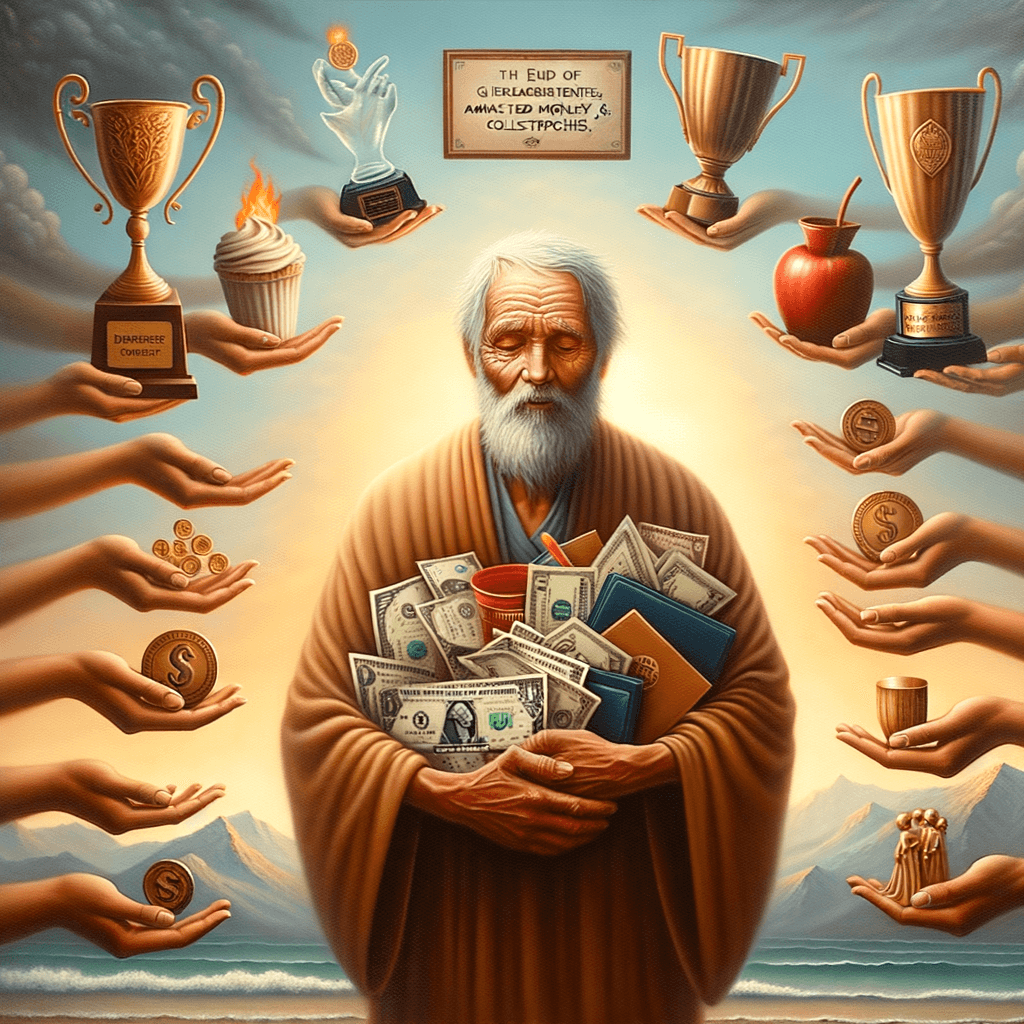
At the end of our lives, we will not be judged by how many diplomas we receive, how much money we amass, or how many trophies we collect. We will be judged by the extent to which we have given of ourselves to others. — Wayne Dyer
—What lingers after this line?
Value of Contribution
This quote emphasizes that the worth of a life is not determined by material success or accolades but by the impact one has made on others through acts of kindness and selflessness.
Legacy of Generosity
It suggests that the most significant legacy we can leave behind is not our possessions or achievements, but the love and generosity we extend to those around us.
Priorities in Life
Dyer's words challenge societal norms that often prioritize career and wealth over meaningful relationships and altruism, urging individuals to reflect on what truly matters in life.
Judgment Beyond Materialism
The idea presented in this quote points to a deeper evaluation of our lives that goes beyond superficial measures, highlighting the importance of emotional and social contributions.
Philosophical Perspective
Wayne Dyer, a well-known self-help author and motivational speaker, often focused on personal growth and spirituality, advocating for a life driven by purpose and connection to others.
One-minute reflection
Where does this idea show up in your life right now?
Related Quotes
6 selectedThe beauty of a life well-lived is measured by the depth of the roots you grow into the lives of those standing right beside you. — Wendell Berry
Wendell Berry
At first glance, Wendell Berry shifts our idea of a successful life away from personal achievement and toward human closeness. The beauty of living well, he suggests, is not counted in status, wealth, or visibility, but...
Read full interpretation →The things that you do for yourself are gone when you are gone, but the things that you do for others remain as your legacy. — Kalu K. Ndukwe Kalu
Kalu K. Ndukwe Kalu
At its heart, Kalu K. Ndukwe Kalu’s quote redirects attention from personal gain to shared impact.
Read full interpretation →Mastery is more than technique. It's legacy, it's tradition, and it's worth preserving. — Art of Mastery
Art of Mastery
At first glance, mastery may seem like the highest refinement of technique, the polished result of repetition and control. Yet this quote insists that technical ability, while essential, is only the visible surface of so...
Read full interpretation →You don't have to be a billionaire to believe you can make a difference. Give your time, give your love, or simply give a smile. — Steve Goodier
Steve Goodier
At its core, Steve Goodier’s quote challenges the idea that influence belongs only to the wealthy or powerful. By placing time, love, and even a smile alongside money, he broadens generosity into something almost anyone...
Read full interpretation →Takers must have no limits, because givers never do. — Iyanla Vanzant
Iyanla Vanzant
At first glance, Iyanla Vanzant’s line sounds almost humorous, yet its irony cuts deeply. If givers continue offering time, energy, money, or emotional labor without pause, then takers are effectively trained to expect a...
Read full interpretation →In the ordinary life, we hardly realize that we receive a great deal more than we give, and that it is only with gratitude that life becomes rich. — Dietrich Bonhoeffer
Dietrich Bonhoeffer
Bonhoeffer begins with a quiet but unsettling observation: most of us move through ordinary life without noticing how much we constantly receive. From language and education to food, care, and companionship, our days are...
Read full interpretation →More From Author
More from Wayne Dyer →Peace is the result of retraining your mind to process life as it is, rather than as you think it should be. — Wayne Dyer
Wayne Dyer’s quote begins with a simple but demanding insight: peace does not arrive when life finally matches our preferences, but when the mind loosens its grip on those preferences. In other words, inner calm grows fr...
Read full interpretation →Be miserable. Or motivate yourself. Whatever has to be done, it’s always your choice. — Wayne Dyer
Wayne Dyer’s statement cuts directly to personal agency: while circumstances may press in from the outside, our inner stance remains, at least in part, our own decision. By placing misery and motivation side by side, he...
Read full interpretation →If you want to change your life, you must first be willing to change your mind. The ego is a cage, but you hold the key. — Wayne Dyer
Wayne Dyer’s quote begins with a direct challenge: lasting transformation does not start in circumstances, but in perception. In other words, before a person can alter habits, relationships, or direction, they must first...
Read full interpretation →Everything that's created comes out of silence. Your thoughts emerge from the nothingness of silence. — Wayne Dyer
Wayne Dyer’s reflection begins with an apparent paradox: what we call creation arises not from noise, but from silence. At first glance, silence seems empty, even passive; however, Dyer recasts it as a fertile void, a hi...
Read full interpretation →