
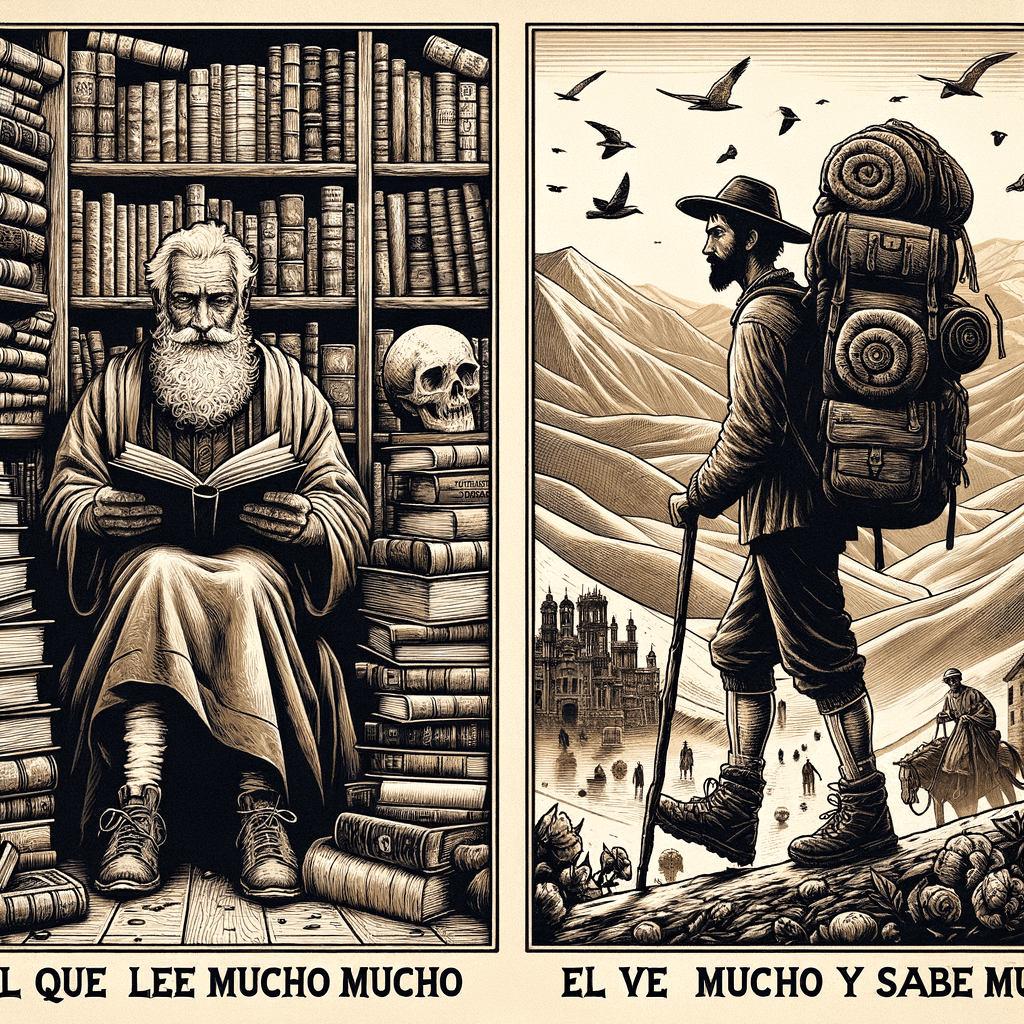
He who reads a lot and travels a lot, sees a lot and knows a lot. - Miguel de Cervantes
—What lingers after this line?
The Value of Reading
This quote emphasizes the importance of reading as a way to gain knowledge and wisdom. It suggests that through reading, individuals can learn about different cultures, ideas, and perspectives, broadening their understanding of the world.
The Benefits of Traveling
Traveling is highlighted as another crucial means of gaining insight and experience. By traveling, one encounters diverse cultures, places, and people, which contributes to a deeper and more comprehensive understanding of the world.
Holistic Learning
Miguel de Cervantes points to the interconnectedness of reading and traveling as complementary activities that together enrich the mind. Both activities expand one's horizons and enhance one's knowledge.
Experiential Learning
The quote underscores the concept that direct experiences gained through traveling can provide practical learning that complements theoretical knowledge acquired from books.
Historical Context
Miguel de Cervantes, a prominent Spanish writer of the 16th and 17th centuries, is best known for his classic novel 'Don Quixote'. His life and works reflect a deep engagement with literature and an appreciation for the broader world, which is encapsulated in this quote.
One-minute reflection
Why might this line matter today, not tomorrow?
Related Quotes
6 selectedHe who reads a lot and travels a lot, sees a lot and knows a lot. - Miguel de Cervantes
Miguel de Cervantes
This quote highlights that through reading and traveling, individuals gain a vast amount of knowledge and perspectives. Books offer theoretical knowledge, while travel presents practical experiences.
Read full interpretation →The world is a book and those who do not travel read only one page. - Saint Augustine
Saint Augustine
This quote highlights the importance of travel in expanding one's horizons and understanding. By traveling, individuals can experience new cultures, ideas, and perspectives that they wouldn't encounter in their usual env...
Read full interpretation →The world is a book, and those who do not travel read only one page. - St. Augustine
St. Augustine
This quote emphasizes the importance of travel in gaining a broader understanding of the world. Just like a book with many pages, the world has much to offer, and traveling allows us to experience its diverse aspects.
Read full interpretation →Knowledge is not power. It is only potential. Power is knowledge acted upon. — Tony Robbins
Tony Robbins
At its core, Tony Robbins’s statement draws a sharp line between what we know and what we actually do with it. Knowledge, by itself, remains dormant—a reserve of possibility rather than a force that changes circumstances...
Read full interpretation →Art is the act of navigating without a map. — Seth Godin
Seth Godin
At its core, Seth Godin’s line defines art not as technical polish but as a willingness to move forward without guaranteed direction. To create without a map is to accept uncertainty as part of the process, trusting intu...
Read full interpretation →Science is organized knowledge. Wisdom is organized life. — Immanuel Kant
Immanuel Kant
Kant’s line draws a sharp but complementary distinction: science arranges what we know, while wisdom arranges how we live. In other words, science is not merely a pile of facts; it becomes science when those facts are st...
Read full interpretation →More From Author
More from Miguel de Cervantes →A bird is known by its song and a man by his deeds. — Miguel de Cervantes
Cervantes condenses a large moral idea into a vivid comparison: just as a bird announces itself through its song, a person reveals his true nature through action. In other words, identity is not established by claims, ap...
Read full interpretation →From time to time it is good to be a little crazy; it makes life interesting. - Miguel de Cervantes
This quote highlights the importance of spontaneity in life. Embracing moments of craziness can bring excitement and prevent life from becoming monotonous.
Read full interpretation →He who does not expect to win is already defeated. - Miguel de Cervantes
This quote underscores the importance of having a positive mindset and belief in oneself. Without the expectation of success, one can lack the motivation and confidence needed to actually achieve goals.
Read full interpretation →In some place of a book, there is a phrase waiting for us to give meaning to existence. - Miguel de Cervantes
This quote highlights the profound impact that literature can have on an individual. It suggests that somewhere within the pages of a book, one might find words that resonate deeply and impart significant meaning to life...
Read full interpretation →