
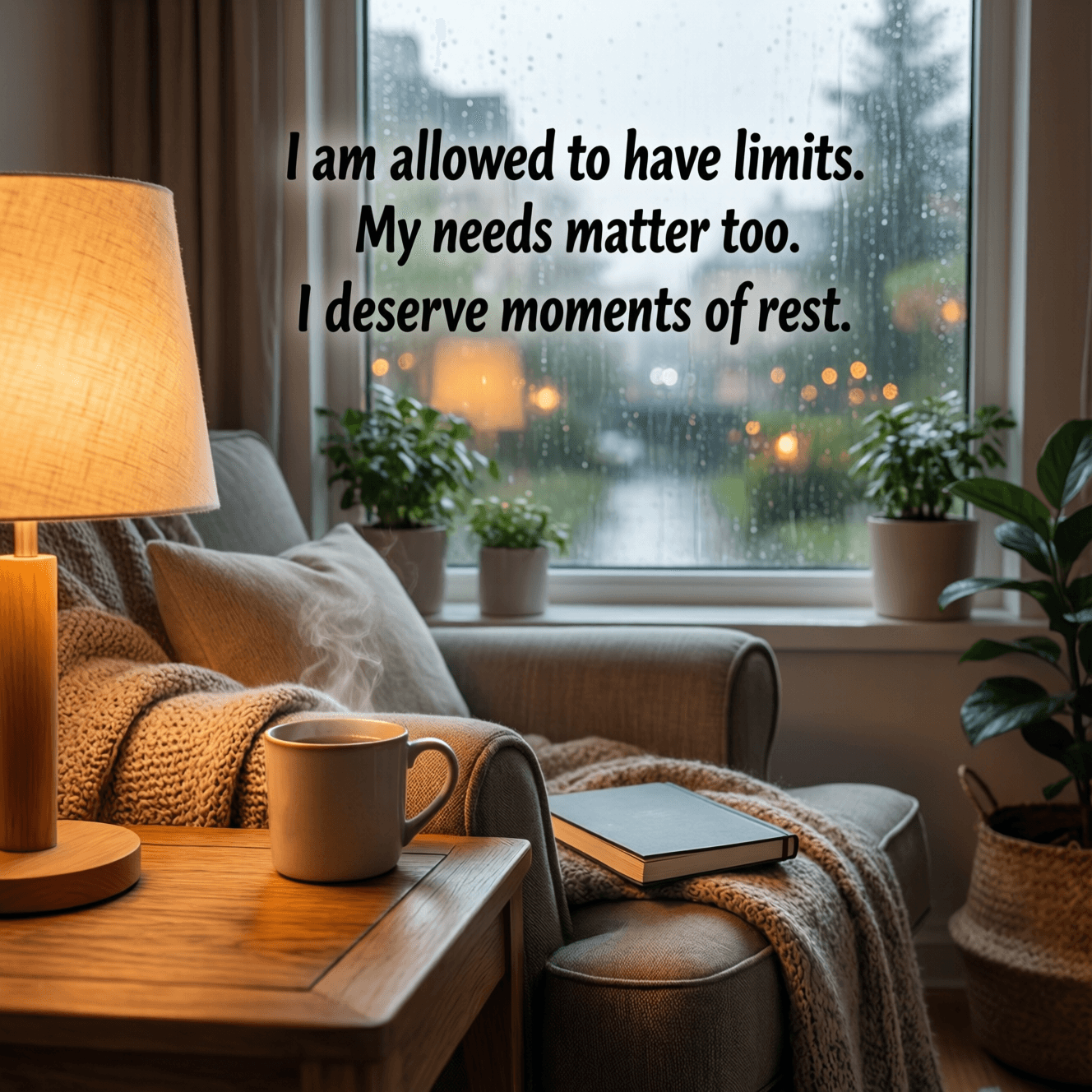
I am allowed to have limits. My needs matter too. I deserve moments of rest. — Proverb
—What lingers after this line?
Permission to Have Limits
The proverb begins with a simple but radical permission: you are allowed to have limits. In many families, workplaces, or cultures, saying “no” can be treated as selfishness, yet limits are often the very structure that makes care sustainable. By framing boundaries as something you’re “allowed” to have, the line counters the quiet fear that self-protection requires justification. From there, the message invites a shift in self-talk—from proving your worth through constant availability to recognizing that your time and energy are finite resources. Limits do not necessarily reduce generosity; instead, they define where responsibility ends and where self-respect begins.
Needs as Legitimate, Not Optional
Moving from boundaries to inner reality, the proverb insists that your needs matter too. That small word “too” is doing important work: it implies that other people’s needs may be real and urgent, but they do not erase yours. This is a corrective to roles like caretaker, peacekeeper, or high performer, where personal needs are often postponed indefinitely. In psychological terms, Abraham Maslow’s “A Theory of Human Motivation” (1943) describes basic needs—sleep, safety, belonging—as foundations rather than luxuries. When these needs are ignored, even good intentions become brittle. Acknowledging needs is not a demand for perfection; it’s a commitment to staying human.
Rest as a Form of Dignity
The proverb then widens the frame: you deserve moments of rest. Rest is presented not as a reward you earn after “enough” productivity, but as something tied to dignity—something deserved. This reframing matters because many people only permit rest when sick, overwhelmed, or forced to stop, which turns recovery into crisis management. Philosophically, the idea echoes ancient practices of protected downtime, such as Sabbath traditions described in Exodus 20:8–11, where rest is treated as a moral rhythm rather than a weakness. In that light, rest becomes a way of honoring life’s limits, not resisting them.
The Hidden Cost of Constant Yes
Once rest is recognized as deserved, the proverb also exposes what happens when limits are denied: burnout, resentment, and emotional numbness. Chronic overextension may look like devotion, but it often comes with a growing sense of being used or unseen. Over time, “helpfulness” can become a mask for fear—fear of disappointing others, losing belonging, or being judged. The World Health Organization’s ICD-11 (2019) describes burnout as a syndrome related to chronic workplace stress not successfully managed, highlighting exhaustion and reduced efficacy. Although not every strain is job-related, the pattern is familiar: without boundaries and rest, even meaningful work and love can start to feel depleting.
Boundaries That Strengthen Relationships
Importantly, the proverb isn’t an argument for withdrawal; it’s an argument for healthier connection. When you state limits and needs, you give others clear information about how to treat you, and you reduce the likelihood of silent resentment. In practice, a boundary can be as small as, “I can talk for ten minutes, then I need to sleep,” which keeps care honest and sustainable. Clinician Anne Katherine’s Boundaries (1991) emphasizes that boundaries clarify responsibility and protect relationships from enmeshment. Seen this way, limits and rest are not barriers to intimacy; they’re the conditions that allow intimacy to remain freely chosen rather than coerced.
A Daily Practice of Self-Respect
Finally, the proverb reads like a short daily vow: I can choose my limits, I can name my needs, and I can take small rests. The emphasis on “moments” makes the goal achievable—rest doesn’t have to be a vacation; it can be a pause, a quiet meal, a short walk, or ten minutes without demands. Small moments accumulate into stability. Over time, this practice becomes identity-building: you stop treating care for yourself as a detour from your responsibilities and start treating it as part of them. In that closing movement, the proverb offers not only comfort but a standard—one that measures a life by sustainability, not self-erasure.
One-minute reflection
Why might this line matter today, not tomorrow?
Related Quotes
6 selectedYour nervous system is a landscape, not a machine; it requires the soft rain of rest, not the constant lightning of urgency. — Proverb
Proverb
The proverb begins by rejecting the idea that the nervous system is a simple machine with replaceable parts and predictable outputs. Instead, it frames the body as a landscape—complex, interconnected, and shaped over tim...
Read full interpretation →Rest is not a luxury; it is a necessity for the soul to regain its light. — Proverb
Proverb
The proverb opens by rejecting a common misconception: that rest is a bonus reserved for when all work is finished. By calling rest a “necessity,” it places recovery on the same level as food or shelter—something require...
Read full interpretation →Rest and self-care are so important. When you take time to replenish your spirit, it allows you to serve others from the overflow. You cannot serve from an empty vessel. — Eleanor Brownn
Eleanor Brownn
Eleanor Brownn’s quotation begins with a simple but powerful claim: rest is not a luxury but a condition for meaningful giving. By linking self-care with service, she reframes replenishment as something outward-looking r...
Read full interpretation →Rest is not a reward for work. It is the fuel for life. — Proverb
Proverb
The proverb challenges a common moral ledger in which rest is earned only after sufficient effort. By rejecting rest-as-reward, it shifts the focus from deservingness to necessity, implying that waiting to “merit” rest m...
Read full interpretation →Boundaries are a part of self-care. They are healthy, normal, and necessary. — Doreen Virtue
Doreen Virtue
At first glance, Doreen Virtue’s quote reframes self-care as something deeper than rest, indulgence, or temporary relief. By calling boundaries a part of self-care, she emphasizes that caring for oneself also means prote...
Read full interpretation →Nervous system regulation is the new mental fitness. You cannot pour from an empty cup, nor can you build a sanctuary while the world is still burning. — April Koh
April Koh
April Koh’s quote reframes wellness by suggesting that mental fitness is no longer just about discipline, productivity, or positive thinking. Instead, it begins with the body’s capacity to return to steadiness after stre...
Read full interpretation →More From Author
More from Proverb →Your nervous system is a landscape, not a machine; it requires the soft rain of rest, not the constant lightning of urgency. — Proverb
The proverb begins by rejecting the idea that the nervous system is a simple machine with replaceable parts and predictable outputs. Instead, it frames the body as a landscape—complex, interconnected, and shaped over tim...
Read full interpretation →If you bring forth what is within you, what you bring forth will save you. If you do not, it will destroy you. — Proverb
The proverb frames self-expression as a decisive fork in the road: what lies within us is not neutral, and it will shape our fate one way or another. In this view, inner fears, desires, convictions, and gifts resemble a...
Read full interpretation →The world will provide you with a label if you are too lazy to define yourself. Pick your own name before someone else names you their tool. — Proverb
The proverb begins with a blunt warning: if you don’t articulate who you are, other people will do it for you. In everyday life, that labeling can be subtle—“quiet,” “difficult,” “gifted,” “unreliable”—but once applied,...
Read full interpretation →The algorithm can show you where you have been, but it cannot show you where you are going. Magic happens in the moments you haven't optimized yet. — Proverb
The proverb begins by granting the algorithm its real power: it can reconstruct your past with remarkable precision. Recommendation engines, dashboards, and performance metrics thrive on historical data—clicks, purchases...
Read full interpretation →