
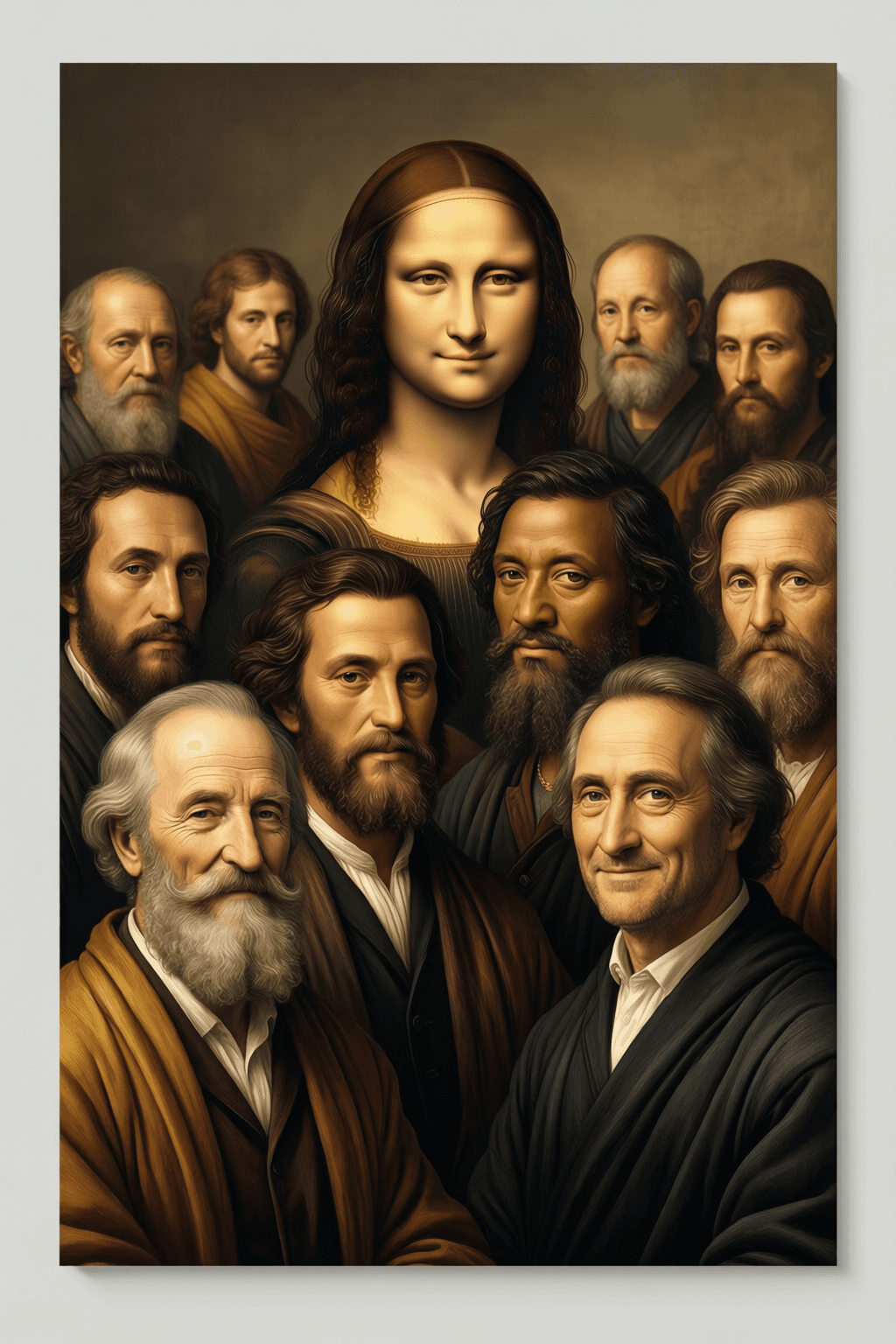
I hold that the perfection of form and beauty is contained in the sum of all men. — Albrecht Dürer
—What lingers after this line?
A Collective Vision of Beauty
At first glance, Dürer’s statement challenges the idea that perfection belongs to any single body or face. Instead, he proposes that ideal form is gathered from the full range of human beings, as though beauty is distributed across humanity rather than concentrated in one flawless example. In this view, perfection is not discovered; it is assembled. This idea immediately broadens the meaning of beauty. Rather than treating difference as deviation, Dürer suggests that variation itself is the source of the ideal. As a result, his remark feels surprisingly modern, inviting us to see human diversity not as a problem to correct but as the very material from which higher standards of art and understanding are made.
The Renaissance Search for Ideal Form
Placed in its historical setting, the quote reflects a central Renaissance ambition: to unite observation and idealization. Dürer, who wrote extensively on proportion in works such as Four Books on Human Proportion (1528), studied the body with mathematical seriousness, yet he did not believe one person alone could embody absolute perfection. Therefore, the artist’s task was to observe many individuals and extract harmonious relations from them. In this way, Dürer bridges science and imagination. He measures, compares, and studies real bodies, but then moves beyond mere imitation. The ideal form becomes a thoughtful synthesis, showing how Renaissance art often sought truth not in isolated appearances but in patterns distilled from lived reality.
Beauty Beyond the Individual Model
From this follows an important artistic principle: no single model is sufficient. A painter or sculptor may admire one person’s posture, another’s hands, and another’s facial balance, combining them into a more complete vision. Classical precedents support this approach; Pliny the Elder’s Natural History (1st century AD) recounts how the painter Zeuxis selected features from several women to create an ideal Helen. Dürer’s remark carries that tradition forward, but with a humanist nuance. He is not merely collecting attractive parts; he is acknowledging that the human whole exceeds every individual instance. Consequently, art becomes an act of careful selection shaped by respect for the richness of the species itself.
A Humanist Respect for Diversity
Seen from another angle, the quote also expresses a deeply humanist belief in shared human worth. If beauty lies in the sum of all men, then each person contributes something meaningful to the larger picture. Even traits overlooked by conventional standards may hold proportion, strength, or character that enriches the collective ideal. This perspective softens rigid hierarchies of appearance. Rather than ranking bodies against a narrow template, Dürer’s thought implies an inclusive aesthetic, one built from multiplicity. Thus the statement can be read not only as an artistic theory but also as a philosophical reminder that humanity is most fully understood when viewed in its breadth, not in its exceptions.
From Artistic Theory to Modern Relevance
Finally, Dürer’s insight speaks clearly to modern debates about beauty and representation. Contemporary culture often promotes singular, standardized ideals, yet his words point in the opposite direction: beauty becomes more complete as more human variation is recognized. In that sense, his Renaissance observation anticipates current efforts to value different bodies, faces, and identities within art and media. What begins as a theory of form ends as an ethic of perception. By suggesting that perfection is composed from the many, Dürer encourages us to look outward with humility and attention. Beauty, then, is not a fixed idol but a composite truth, formed through the shared presence of humanity itself.
One-minute reflection
Why might this line matter today, not tomorrow?
Related Quotes
1 selectedMore From Author
More from Albrecht Dürer →