
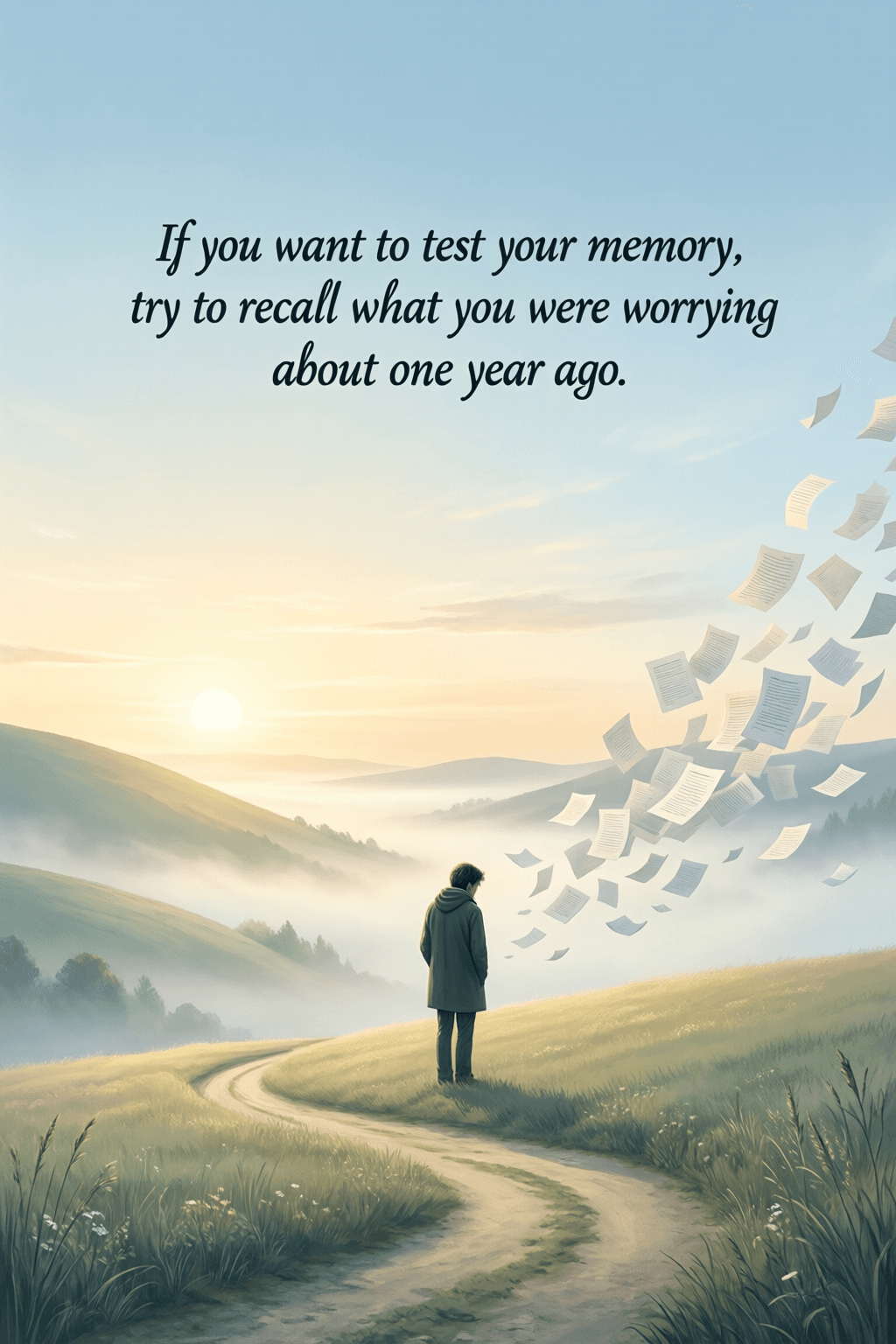
If you want to test your memory, try to recall what you were worrying about one year ago. — E. Joseph Cossman
—What lingers after this line?
A Simple Test of Perspective
E. Joseph Cossman’s remark begins with an almost playful challenge: if you want to test your memory, try recalling what troubled you a year ago. At first, the exercise seems easy, yet most people quickly discover how many once-urgent anxieties have faded into obscurity. In that way, the quote gently exposes a truth about human life: much of what consumes us in the moment does not retain its importance over time. From there, the insight deepens. Worry often feels permanent while we are inside it, but memory reveals its temporary nature. By asking us to look backward, Cossman turns hindsight into a corrective lens, helping us see that many fears were not only survivable but also forgettable.
Why Worry Feels Larger Than Life
Naturally, this leads to the question of why worries seem so overwhelming in the first place. The mind is built to scan for danger, and as psychologists have long observed, perceived threats receive disproportionate attention. Daniel Kahneman’s work in Thinking, Fast and Slow (2011) describes how immediate concerns can dominate judgment, making small uncertainties feel enormous simply because they are present and unresolved. As a result, worry magnifies the near and minimizes the distant. A tense email, a financial concern, or an awkward conversation can appear central to our whole existence, even when it later proves minor. Cossman’s quote cuts through that distortion by reminding us that emotional intensity is not the same as lasting significance.
Memory as a Quiet Teacher
Seen this way, memory becomes more than storage; it becomes instruction. When we struggle to remember last year’s fears, we learn not that life is trivial, but that distress is often fleeting. The very act of forgetting serves as evidence that many burdens lost their power long before we noticed. In this sense, memory teaches perspective by omission. Moreover, philosophers have long treated reflection as a path to wisdom. Marcus Aurelius, in his Meditations (c. AD 180), repeatedly urges himself to view events against the broader sweep of time. Cossman’s advice works similarly: by stretching our attention across a year, we discover that many private storms were smaller than they felt while raging.
The Gap Between Fear and Reality
Once that perspective appears, another implication follows: worry frequently predicts outcomes that never arrive. Many fears are rehearsals for imagined futures rather than responses to actual catastrophe. Dale Carnegie’s How to Stop Worrying and Start Living (1948) collected countless examples of people tormented by scenarios that either never happened or proved manageable when they did. This does not mean all concerns are foolish, of course. Some worries signal real responsibilities and deserve action. Yet Cossman distinguishes productive concern from repetitive mental spinning. If a problem mattered enough to consume us a year ago but leaves barely a trace today, then perhaps much of our suffering came not from events themselves but from anticipation.
A Healthier Way to Meet the Present
Consequently, the quote offers more than comfort; it suggests a practical discipline. When a current worry begins to expand beyond proportion, we can ask a simple question: will this matter to me a year from now? That small pause can interrupt panic and replace it with scale. Even if the answer is yes, the question often clarifies whether the situation calls for action, patience, or release. In everyday life, people discover this in ordinary ways: the presentation that ruined a week is forgotten by next season, the social embarrassment that felt fatal becomes a private joke, and the delayed plan that seemed disastrous opens an unexpected door. By inviting this habit of comparison, Cossman teaches emotional economy—save deep distress for what truly endures.
The Humility Hidden in Forgetting
Finally, there is something humbling and liberating in the fact that we cannot easily summon yesterday’s anxieties. Forgetting reminds us that our minds are poor judges of importance when under pressure. What feels all-consuming now may soon become a footnote, and that realization can soften both fear and self-importance. Thus the quote closes on an almost compassionate lesson: life moves, we recover, and many troubles dissolve without demanding a permanent place in our identity. Remembering that can make us gentler with ourselves in the present. After all, if last year’s worry has already vanished into the blur of time, today’s may be far less powerful than it appears.
One-minute reflection
Why might this line matter today, not tomorrow?
Related Quotes
6 selectedThe present changes the past. Looking back you do not find what you left behind. — Kiran Desai
Kiran Desai
At first glance, Desai’s line seems paradoxical, yet it captures a basic truth about human memory: the past is not stored inside us like a sealed archive. Instead, each act of remembering rebuilds events through the lens...
Read full interpretation →Whatever is going to happen will happen, whether we worry or not. — J.K. Rowling
J.K. Rowling
At its core, Rowling’s line reminds us that worry often mistakes itself for control. We rehearse disasters in our minds as if anticipation could alter reality, yet events unfold according to forces far larger than our pr...
Read full interpretation →The most important milestones are the ones that come to the door of memory unannounced, stray dogs that amble in, sniff around a bit and simply never leave. — Susan B. Anthony
Susan B. Anthony
Susan B. Anthony reframes the idea of a milestone by shifting attention away from public achievements and toward the private moments that linger unexpectedly.
Read full interpretation →There is only one way to happiness and that is to cease worrying about things which are beyond the power of our will. — Seneca
Seneca
At the heart of Seneca’s statement is a clean and demanding distinction: some things belong to our will, while many others do not. Happiness, he argues, depends less on controlling the world than on recognizing this boun...
Read full interpretation →Gratitude is the memory of the heart. — Jean Baptiste Massieu
Jean Baptiste Massieu
Jean Baptiste Massieu’s line transforms gratitude from a simple polite response into something deeper and more enduring. At once, he suggests that the heart keeps its own kind of record, preserving moments of kindness lo...
Read full interpretation →I have survived many things, and most of them never happened. — Mark Twain
Mark Twain
Mark Twain’s line compresses a lifetime of anxiety into a single, mischievous confession: we often feel as though we’ve “survived” disasters that never actually occurred. The humor works because it’s recognizable—our min...
Read full interpretation →More From Author
More from E. Joseph Cossman →The best bridge between despair and hope is a good night's sleep. — E. Joseph Cossman
At first glance, E. Joseph Cossman’s line sounds almost too simple, yet that simplicity is precisely its power.
Read full interpretation →Doing nothing is a great peace maker. — E. Joseph Cossman
This quote highlights the importance of taking time to be still and avoid unnecessary activity. In a world filled with chaos, doing nothing can create a sense of calm and tranquility.
Read full interpretation →The richest wealth is not in the bank, but in the heart. — E. Joseph Cossman
This quote suggests that real wealth is not measured by financial assets but by the richness of emotions, love, and kindness within a person's heart.
Read full interpretation →