
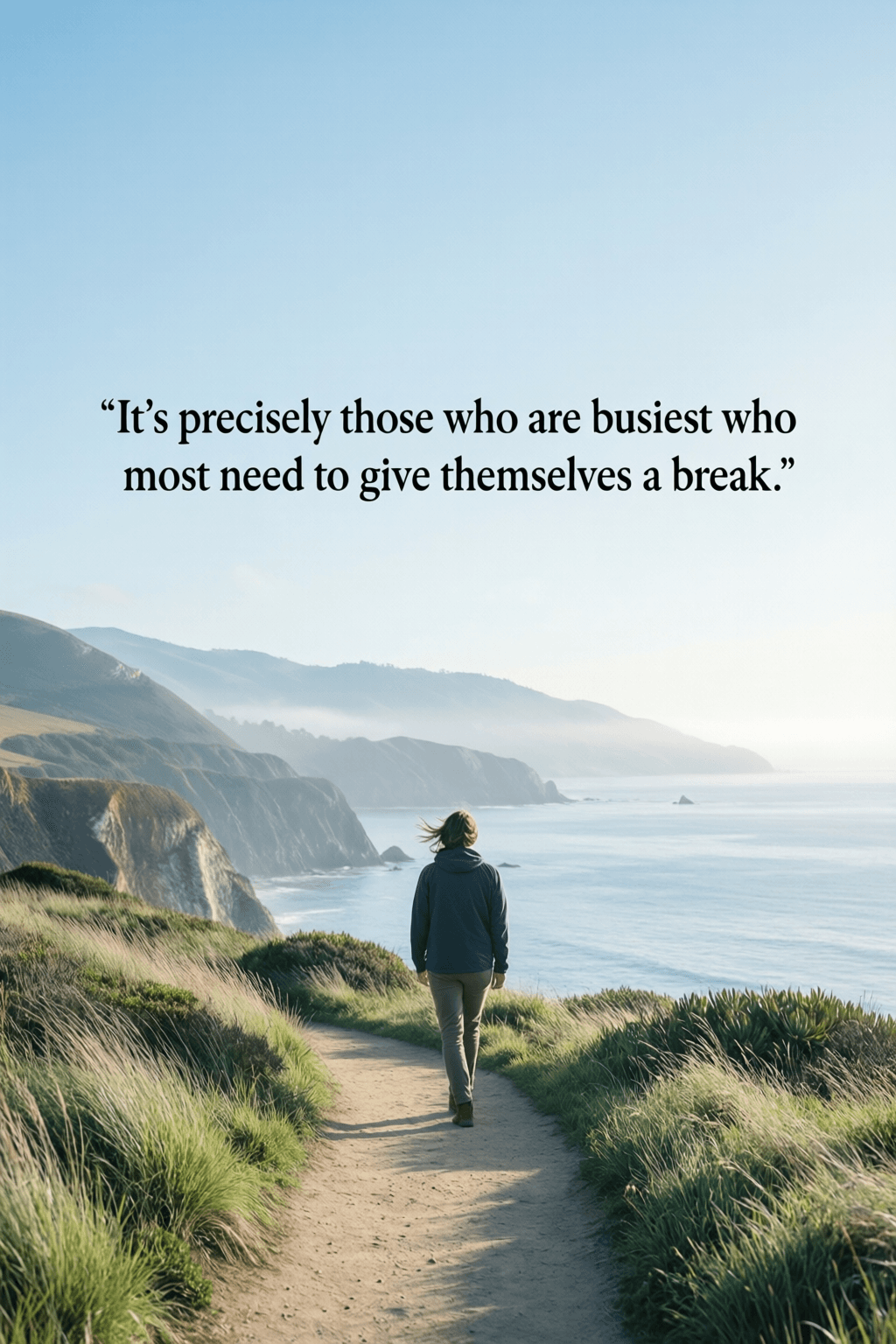
It's precisely those who are busiest who most need to give themselves a break. — Pico Iyer
—What lingers after this line?
The Hidden Irony of Busyness
Pico Iyer’s remark turns a common assumption upside down: the people who seem least able to pause are often the ones most endangered by never doing so. Busyness can look like competence, ambition, or usefulness, yet it also masks depletion. In that sense, the quote exposes a quiet irony—constant activity may signal not strength alone, but a growing need for recovery. This insight feels especially modern because many cultures reward exhaustion as proof of commitment. However, the more tightly a person’s schedule is packed, the easier it becomes to ignore fatigue until it hardens into burnout. Iyer’s line therefore reads not as indulgent advice, but as a practical warning.
Rest as a Condition for Clarity
From that irony, a deeper truth emerges: rest is not merely the absence of work, but a condition for seeing clearly. When the mind is overrun with deadlines and obligations, judgment narrows; everything feels urgent, and perspective disappears. By contrast, even a brief pause can restore proportion, allowing a person to distinguish what truly matters from what merely shouts loudest. This idea appears in Iyer’s own reflections in The Art of Stillness (2014), where he argues that stepping back is not retreat from life but a way of meeting it more fully. In other words, a break is valuable not because it interrupts productivity, but because it renews intelligence, attention, and choice.
What Burnout Looks Like in Real Life
Seen this way, the quote also speaks to ordinary experience. Consider the manager who answers emails through dinner, the parent who organizes everyone else’s day while neglecting sleep, or the student who mistakes perpetual strain for discipline. At first, such effort may seem admirable; gradually, though, irritability, forgetfulness, and emotional numbness begin to appear. Psychologists have long described burnout in similar terms. Christina Maslach’s research on occupational burnout, developed from the 1970s onward, identifies exhaustion, cynicism, and reduced effectiveness as recurring markers. Thus, Iyer’s observation lands with force: the busiest person may be the one standing closest to collapse, even if outwardly they seem most in control.
Why People Resist Taking a Break
Even so, many people resist rest precisely when they need it most. Part of the reason is emotional: pausing can provoke guilt, as if stepping away means failing others or losing momentum. Another part is cultural, since modern professional life often treats availability as virtue. Under those pressures, rest begins to seem selfish, and overwork starts to masquerade as moral seriousness. Yet this resistance reveals the problem rather than solving it. If a person cannot permit themselves a short walk, an unhurried meal, or an afternoon off, their schedule is no longer serving them—they are serving it. Iyer’s quote gently challenges that imbalance by reframing breaks as responsible acts of self-preservation.
The Productive Power of Stepping Back
Once that reframing takes hold, the quote becomes less a consolation than a strategy. Some of the most effective workers know that sustained performance depends on intervals of recovery. As Alex Soojung-Kim Pang argues in Rest (2016), many accomplished creators and thinkers built deliberate cycles of focused work and genuine downtime into their routines, recognizing that endurance requires rhythm rather than nonstop exertion. Therefore, taking a break is not opposed to meaningful achievement; it protects it. A rested mind returns with sharper concentration, greater patience, and more creative flexibility. What looks like lost time from the outside often becomes regained capacity from within.
A More Humane Measure of Success
Ultimately, Iyer’s sentence invites a broader redefinition of success. If a life is filled with tasks but emptied of presence, then busyness has become a poor bargain. Rest restores more than energy: it returns a person to themselves, to relationships, and to the larger texture of living that frantic schedules often erase. For that reason, the quote carries both compassion and critique. It tells overburdened people that their need for pause is not a weakness to hide, and it questions systems that glorify relentless motion. In the end, giving oneself a break is not abandoning responsibility; it is what makes a responsible, sustainable, and fully human life possible.
Recommended Reading
As an Amazon Associate, we earn from qualifying purchases.
One-minute reflection
What does this quote ask you to notice today?
Related Quotes
6 selectedRest is a fine medicine. Let your brain rest, you wearied and worried men of business. — Thomas Carlyle
Thomas Carlyle’s remark frames rest not as laziness, but as treatment. By calling it “a fine medicine,” he shifts the discussion from moral judgment to human necessity, especially for those worn down by constant demands.
Read full interpretation →Rest is not a retreat; it is a reset. It is the necessary pause that allows us to show up grounded rather than reactive. — Sophia A. Nelson
Sophia A. Nelson
At first glance, Sophia A. Nelson’s statement challenges a common assumption: that rest is somehow equivalent to stepping back, giving up, or retreating from responsibility.
Read full interpretation →Rest is not laziness; it is the essential fuel that allows your creativity to ignite once more. — Arianna Huffington
Arianna Huffington
At first glance, Arianna Huffington’s statement challenges a deep cultural bias: the tendency to equate nonstop activity with virtue and rest with weakness. By insisting that rest is not laziness, she reframes it as a ne...
Read full interpretation →It is not a sign that you are doing something wrong to need a break; it is a sign that you are human. — Nedra Glover Tawwab
Nedra Glover Tawwab
At its core, Nedra Glover Tawwab’s quote rejects the harsh belief that constant productivity is the measure of worth. Instead, it reframes the need for a break as evidence of our basic humanity: bodies tire, minds overlo...
Read full interpretation →Anything that is living must have a rest. If it does not rest, it will lose its strength. — Lao Tzu
Lao Tzu
Lao Tzu’s insight begins with a simple observation: all living things move in cycles, not in endless exertion. By saying that anything alive must rest, he frames rest not as laziness but as a biological and spiritual nec...
Read full interpretation →Rest is not the opposite of productivity. It is a vital part of it. Sustainable well-being requires cycles of effort and restoration. — Michelle Pearce
Michelle Pearce
At first glance, Michelle Pearce’s statement challenges a deeply ingrained modern assumption: that productivity and rest are enemies competing for the same limited time. Instead, she reframes rest as a functional partner...
Read full interpretation →More From Author
More from Pico Iyer →Connection is not found in the scrolling, but in the pausing. Look up, breathe, and find the person standing right in front of you. — Pico Iyer
Pico Iyer’s reflection begins with a quiet reversal of modern habit: instead of searching for connection through constant motion, he locates it in stillness. The phrase “not found in the scrolling, but in the pausing” su...
Read full interpretation →The mind needs solitude in the same way a forest needs quiet after a storm. It is not because nothing is happening; it is because that is when everything begins to grow. — Pico Iyer
Pico Iyer compares the mind to a forest recovering after a storm, and the image immediately shifts our understanding of solitude. Rather than treating aloneness as emptiness, he presents it as a necessary period of renew...
Read full interpretation →To do one thing well is the only way to endure a world that demands we do everything at once. — Pico Iyer
At its core, Pico Iyer’s line argues that endurance now depends less on speed than on concentration. In a culture that praises multitasking, constant updates, and endless availability, he reframes survival as an act of d...
Read full interpretation →Inner calm is not a state you wait for, but a space you build within the daily noise. — Pico Iyer
At its core, Pico Iyer’s line shifts calm from something passive to something made. Rather than imagining peace as a rare mood that descends when life finally becomes quiet, he presents it as an inner architecture built...
Read full interpretation →