
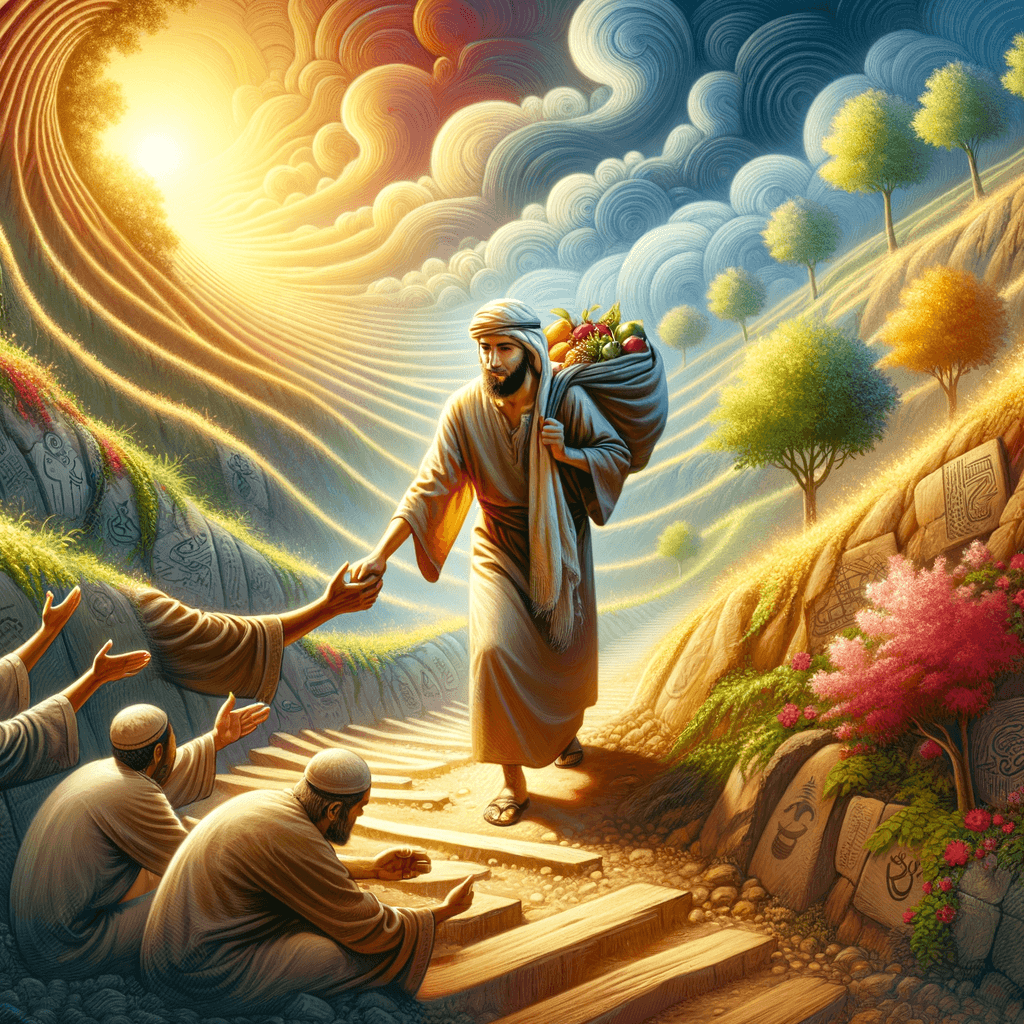
Life becomes harder for us when we live for others, but it also becomes richer and happier. — Albert Camus
—What lingers after this line?
The Sacrifice of Living for Others
This quote highlights that when we dedicate our lives to helping and supporting others, it can lead to more challenges and difficulties. Selflessness requires effort and sometimes personal suffering.
The Reward of Enriching Relationships
Despite the sacrifices involved, the act of living for others also brings deeper emotional rewards. It implies that fulfillment, belonging, and purpose come from fostering meaningful connections with others rather than focusing solely on oneself.
Happiness Through Altruism
Living for others often brings a sense of happiness that material possessions or selfish pursuits can't provide. The emotional satisfaction of altruism leads to a richer and more fulfilling life.
Philosophical Perspective on Shared Existence
Camus, known for his philosophical ideas on absurdism and existentialism, here signals the duality of living for others: while it may seem to make life harder on the surface, it creates a deeper shared existence that imbues life with greater happiness and meaning.
Balancing Hardship with Joy
This quote suggests that true richness and happiness in life come not from avoiding hardship but from embracing the challenges that come with caring for others. Such a life may come at a greater personal cost but cultivates inner growth and fulfillment.
Recommended Reading
As an Amazon Associate, we earn from qualifying purchases.
One-minute reflection
What's one small action this suggests?
Related Quotes
6 selectedLove is the only way to rescue any life from the insignificance of its own self-absorption. — Iris Murdoch
Iris Murdoch
At the heart of Iris Murdoch’s line is a moral claim: love is not merely a feeling, but a way of turning outward. A life trapped in its own self-importance becomes small, repetitive, and ultimately insignificant because...
Read full interpretation →There is no true joy in a life lived closed up in the little shell of the self. — The Dalai Lama
The Dalai Lama
At its core, the Dalai Lama’s statement argues that a life centered only on personal comfort, status, or protection becomes emotionally cramped. The image of a ‘little shell’ suggests not strength but confinement: when p...
Read full interpretation →To study the self is to forget the self. To forget the self is to be enlightened by all things. — Dōgen
Dōgen
Dōgen frames awakening as an apparent contradiction: you begin by studying the self, yet that very study culminates in forgetting the self. The first clause points to honest examination—watching thoughts, motives, and ha...
Read full interpretation →Objective judgment, unselfish action, and willing acceptance are all the soul requires. — Marcus Aurelius
Marcus Aurelius
Marcus Aurelius frames the soul’s needs in strikingly spare terms: clear judgment, unselfish action, and willing acceptance. In doing so, he argues that the essentials of a good life are not external—status, comfort, app...
Read full interpretation →The only ones among you who will be really happy are those who will have sought and found how to serve. — Albert Schweitzer
Albert Schweitzer
Albert Schweitzer’s claim reframes happiness as an outcome rather than a possession: it arrives not by chasing pleasure directly, but by orienting life toward service. By saying “the only ones,” he draws a sharp boundary...
Read full interpretation →Harmony follows those who practice kindness without waiting for applause — Confucius
Confucius
Confucius’ observation highlights a subtle but powerful truth: the most transformative kindness is often the kind no one sees. Rather than treating goodness as a performance awaiting compliments, he points toward actions...
Read full interpretation →More From Author
More from Albert Camus →Peace is the only battle worth waging. — Albert Camus
At first glance, Camus frames peace through an apparent contradiction: a battle fought not for conquest, but to end the need for conquest itself. By calling peace the only struggle worth pursuing, he redirects human cour...
Read full interpretation →Sometimes carrying on, just carrying on, is the superhuman achievement. — Albert Camus
At first glance, Camus shifts the meaning of heroism away from grand victories and toward something far more ordinary: persistence. By saying that “just carrying on” can be a superhuman achievement, he honors the invisib...
Read full interpretation →In order to understand the world, one has to turn away from it on occasion. — Albert Camus
Camus’ line sounds contradictory at first: how can you understand the world by turning away from it? Yet the paradox points to a familiar truth—immersion can blur perception, while distance can sharpen it.
Read full interpretation →Face the stretch of life as an open road for discovery, not a wall to avoid. — Albert Camus
Camus’ image hinges on a simple choice of metaphor: an “open road for discovery” versus a “wall to avoid.” The road suggests motion, curiosity, and an invitation to keep going even when the destination is unclear, while...
Read full interpretation →