
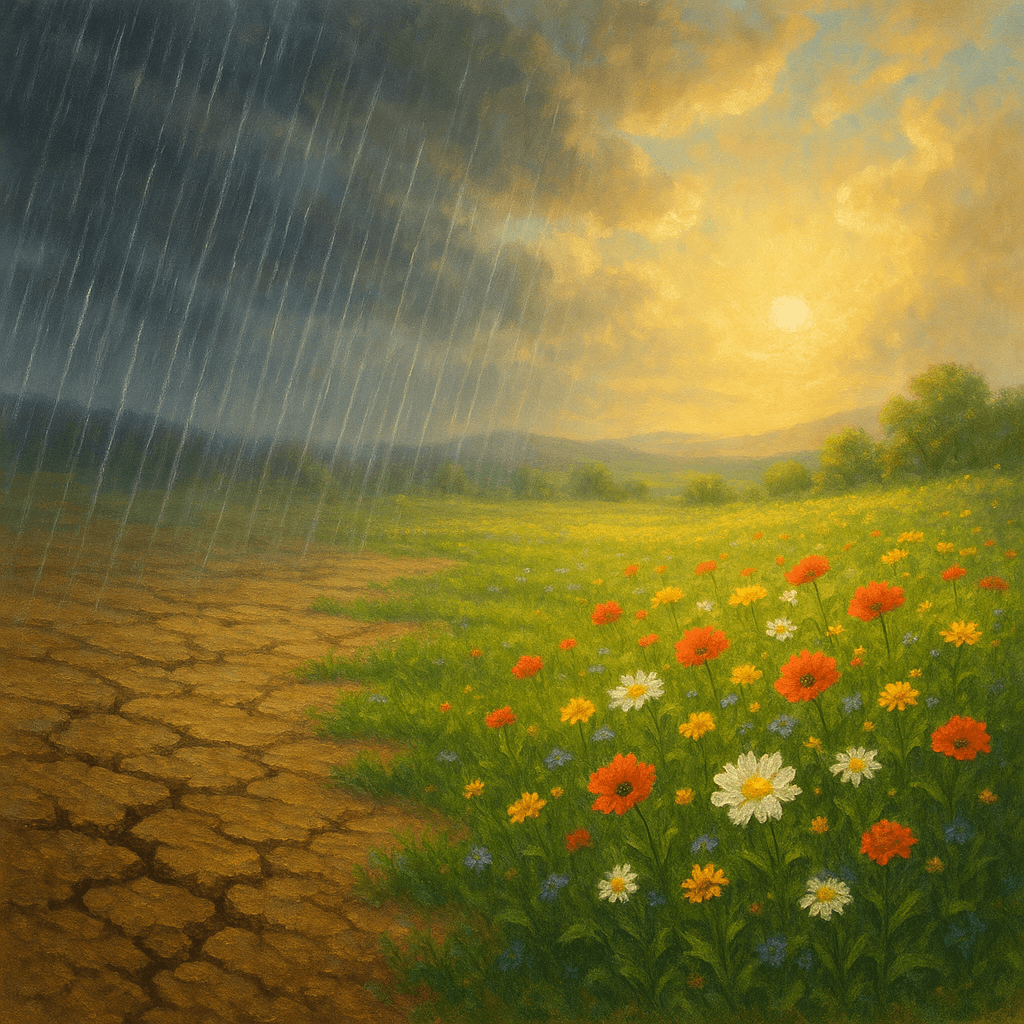
Life blooms fully only when watered by action. — Rumi
—What lingers after this line?
Rumi’s Metaphor of Growth
Rumi’s words liken life to a flourishing plant that depends on more than mere existence; it requires the nurturing force of action. This metaphor sets the stage for understanding how possibilities alone are not enough—just as seeds will not sprout without water, dreams and ambitions cannot materialize without effort. The poet’s imagery offers a vivid reminder: potential thrives only when consciously cultivated.
Philosophical Traditions of Doing
Building on Rumi’s insight, Western philosophers such as Aristotle emphasized ‘praxis’—the practice of enacting virtue—as the ultimate good. In his Nicomachean Ethics, Aristotle argued that true happiness, or eudaimonia, arises from purposeful activity rather than idle contemplation. Both Eastern and Western wisdoms converge here, reinforcing the idea that passivity leads to stagnation, while action breathes life into intention.
The Perils of Inaction
Continuing this exploration, the dangers of inertia become evident. History is replete with examples—whether in missed social reforms or personal ambitions—that show the costs of inaction. Psychologist William James famously observed that inaction breeds doubt and fear, while action breeds confidence and courage. Thus, the absence of purposeful movement causes possibilities to wither, denying life its fullness.
Action as Spiritual Practice
Furthermore, Rumi’s Sufi tradition frames action not only as practical necessity but as a spiritual journey. In works like the Masnavi, Rumi illustrates how each intentional act becomes both a means of worldly progress and a step toward self-discovery. Here, movement is not merely external—each act waters the inner garden of the soul, deepening meaning and connection.
Transforming Inspiration Into Reality
Ultimately, the unity of inspiration and action completes this cycle. While dreams provide direction, it is only through daily effort—whether writing a poem, starting a venture, or lending a hand—that we realize life’s latent beauty. Rumi’s teaching thus challenges us to respond to inspiration by acting, ensuring that our brief time blooms into abundant fulfillment, much like a garden lovingly attended.
One-minute reflection
Why might this line matter today, not tomorrow?
Related Quotes
6 selectedPlant courage in your daily choices and watch a life grow. — Rumi
Rumi
Rumi’s image of planting courage in daily choices suggests that bravery is less a grand gesture and more a repeated act, like sowing seeds in a garden. Instead of waiting for a dramatic moment to be heroic, he invites us...
Read full interpretation →Yesterday I was clever, so I wanted to change the world. Today I am wise, so I am changing myself. — Rumi
Rumi
This quote illustrates the personal growth from trying to change external factors to focusing on internal self-improvement. It signifies a journey from youthful ambition to mature wisdom.
Read full interpretation →Consistency is a superpower. — Ryan Holiday
Ryan Holiday
Ryan Holiday’s line begins with a deceptively simple idea: greatness is rarely built through dramatic gestures. More often, it emerges from repeated actions that seem ordinary in isolation but become extraordinary over t...
Read full interpretation →Confidence is silent. Insecurities are loud. — Unknown (Wait—skip/replace with: True nobility is being superior to your former self. — Ernest Hemingway)
Ernest Hemingway
At its core, Hemingway’s line redefines nobility as an inward achievement rather than a social rank. Instead of measuring worth by wealth, pedigree, or dominance over others, it points to a quieter standard: becoming bet...
Read full interpretation →You are under no obligation to be consistent with the person you were yesterday. — James McCrae
James McCrae
At its core, James McCrae’s line challenges the quiet pressure to remain legible to others. Many people feel bound to opinions, habits, or identities simply because they once claimed them, as though consistency were a mo...
Read full interpretation →Growth often looks like slowing down, reassessing, and rebuilding with intention. — Erin Gregory
Erin Gregory
At first glance, growth is often imagined as constant acceleration—more output, faster decisions, visible momentum. Erin Gregory’s quote gently overturns that assumption by suggesting that real development may appear qui...
Read full interpretation →More From Author
More from Rumi →Everything that happens is a form of instruction if you choose to listen. — Rumi
At its core, Rumi’s line reframes ordinary experience as a living classroom. Nothing is merely random noise if one approaches it with attention; instead, each success, disappointment, encounter, or delay carries the poss...
Read full interpretation →Do not mistake movement for progress; a spinning top stays in one place, while a seed grows by staying rooted in the dark. — Rumi
Rumi’s image draws an immediate contrast between busyness and true development. A spinning top dazzles with speed and motion, yet it remains fixed in essentially the same place.
Read full interpretation →You don't need to escape the chaos to find peace—it's already inside you, waiting to be remembered. — Rumi
At first glance, Rumi’s line overturns a common assumption: that peace must be found by fleeing noise, conflict, or uncertainty. Instead, he suggests that peace is not an external destination but an inner condition alrea...
Read full interpretation →Confidence is silent. Insecurities are loud. Do not feel the need to broadcast your worth to a world that doesn't understand your path. — Rumi
At its core, this saying contrasts two very different emotional states: confidence, which rests quietly within, and insecurity, which seeks constant outward expression. The point is not that confident people never speak,...
Read full interpretation →