
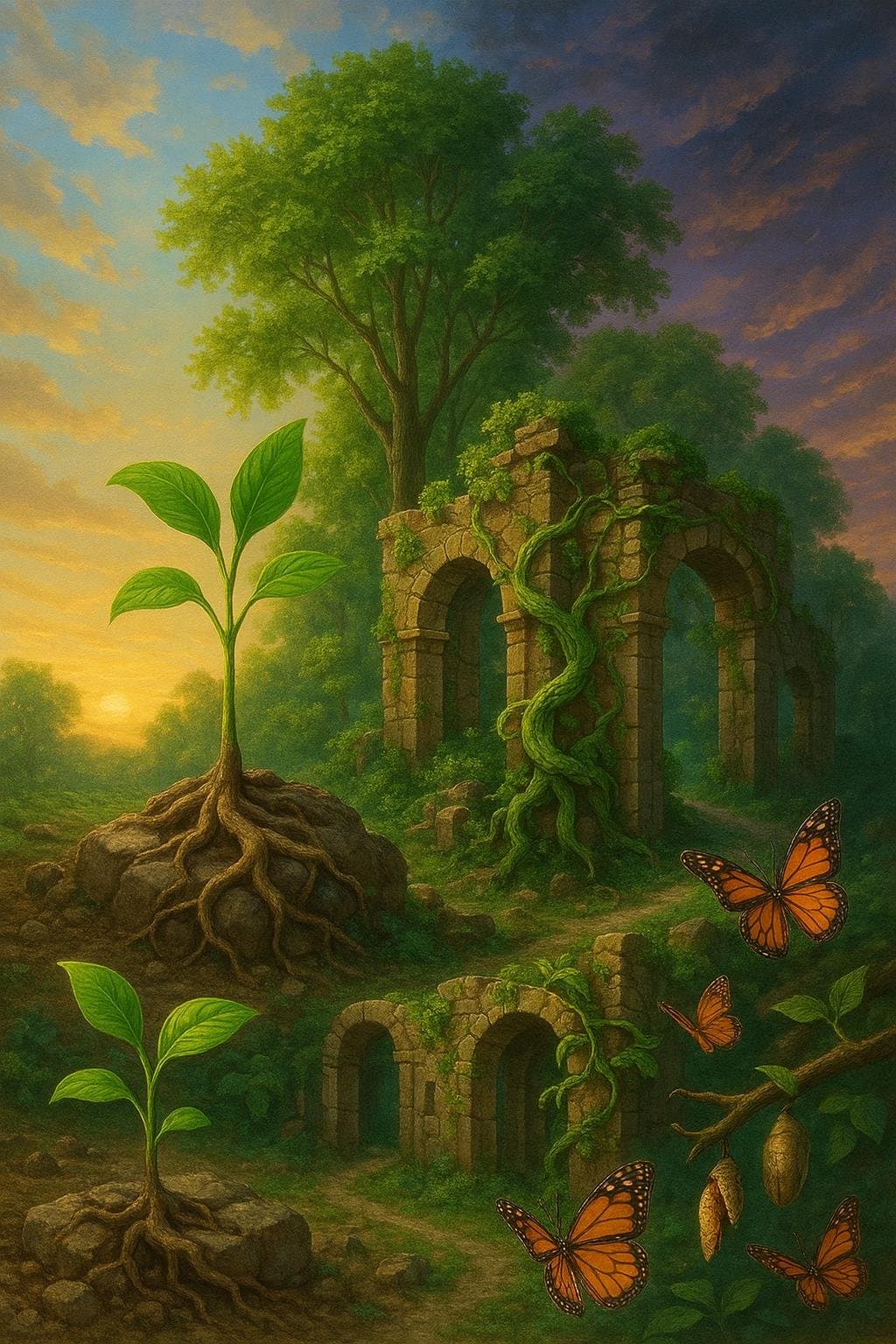
Life insists on being something more than an event. — Samuel Butler
—What lingers after this line?
Distinguishing Events from Essence
Samuel Butler’s reflection challenges us to look beyond the surface of our experiences. While events undoubtedly mark the passage of time, Butler encourages us to perceive life as more than a string of isolated incidents. This perspective nudges us to search for meaning—something richer and more enduring than the fleeting moments that comprise our daily existence.
Seeking Continuity and Coherence
Building on Butler’s idea, humans have an innate drive to weave coherence from the chaos of events. Psychologists like Jerome Bruner have argued that narrative gives shape to life, transforming random occurrences into a personal story. In this way, life becomes a tapestry of meaning, where each event fits into a broader context and purpose.
Philosophical Roots of Life’s Depth
Turning to philosophy, thinkers such as Søren Kierkegaard highlighted the difference between simply existing and living with purpose. In works like ‘Either/Or’ (1843), he distinguishes between life as a ‘succession of moments’ and life as an ethical or spiritual journey. Butler’s assertion echoes this tradition, encouraging us to see our lives as more than temporal activities.
Artistic Perspectives on Living Fully
Artists and writers have long explored life’s intangible qualities. For instance, in Virginia Woolf’s ‘To the Lighthouse’ (1927), the day-to-day happenings are often secondary to the inner lives and consciousness of her characters. This focus suggests that life’s true substance resides in personal growth, relationships, and the pursuit of meaning rather than in isolated events alone.
Embracing Life as an Evolving Journey
Ultimately, Butler’s words urge us to treat life as a continuously evolving process. By recognizing that we are not defined solely by what happens to us, but also by how we interpret and respond to those events, we foster resilience and self-understanding. Thus, life insists on being something greater—a creative endeavor where meaning unfolds beyond the mere sequence of events.
One-minute reflection
What's one small action this suggests?
Related Quotes
6 selectedThe meaning of life differs from man to man, from day to day and from hour to hour. — Viktor Frankl
Viktor Frankl
Frankl’s sentence immediately resists the idea that life has one universal, static answer. Instead, he frames meaning as something that changes with the individual and even with the passing of time—so what matters most t...
Read full interpretation →When we learn how to become resilient, we learn how to embrace the beautifully broad spectrum of the human experience. — Steve Maraboli
Steve Maraboli
At first glance, Steve Maraboli’s statement frames resilience not merely as endurance, but as a deeper way of perceiving life. To become resilient is not simply to survive hardship; it is to widen our capacity for joy, g...
Read full interpretation →Here is the test to find whether your mission on Earth is complete. If you're alive, it isn't. — Richard Bach
Richard Bach
The quote implies that as long as one is alive, their purpose or mission is ongoing. Life is seen as a continuous journey with always something more to achieve or experience.
Read full interpretation →We are not human beings having a spiritual experience; we are spiritual beings having a human experience. — Pierre Teilhard de Chardin
Pierre Teilhard de Chardin
This quote suggests that our essence is inherently spiritual, and our human existence is a temporary journey. It shifts the focus from viewing life as purely physical to considering a deeper, spiritual dimension.
Read full interpretation →The quest for meaning is the greatest adventure of all. — Victor Frankl
Victor Frankl
This quote highlights that finding meaning in life is the most profound journey one can undertake. It suggests that personal fulfillment comes from understanding our purpose.
Read full interpretation →Life then is the art of drawing sufficient conclusions from insufficient premises. — Samuel Butler
Samuel Butler
Samuel Butler’s quote suggests that life is fundamentally about managing uncertainty. In reality, we rarely have all the facts we wish for when making choices, whether in relationships, careers, or daily routines.
Read full interpretation →More From Author
More from Samuel Butler →Life then is the art of drawing sufficient conclusions from insufficient premises. — Samuel Butler
Samuel Butler’s quote suggests that life is fundamentally about managing uncertainty. In reality, we rarely have all the facts we wish for when making choices, whether in relationships, careers, or daily routines.
Read full interpretation →We do not learn to walk by following rules. We learn by doing, and by falling over. — Samuel Butler
Samuel Butler’s line distinguishes maps from terrain. Rules can point us toward competence, yet they rarely confer it; only contact with the world does.
Read full interpretation →