
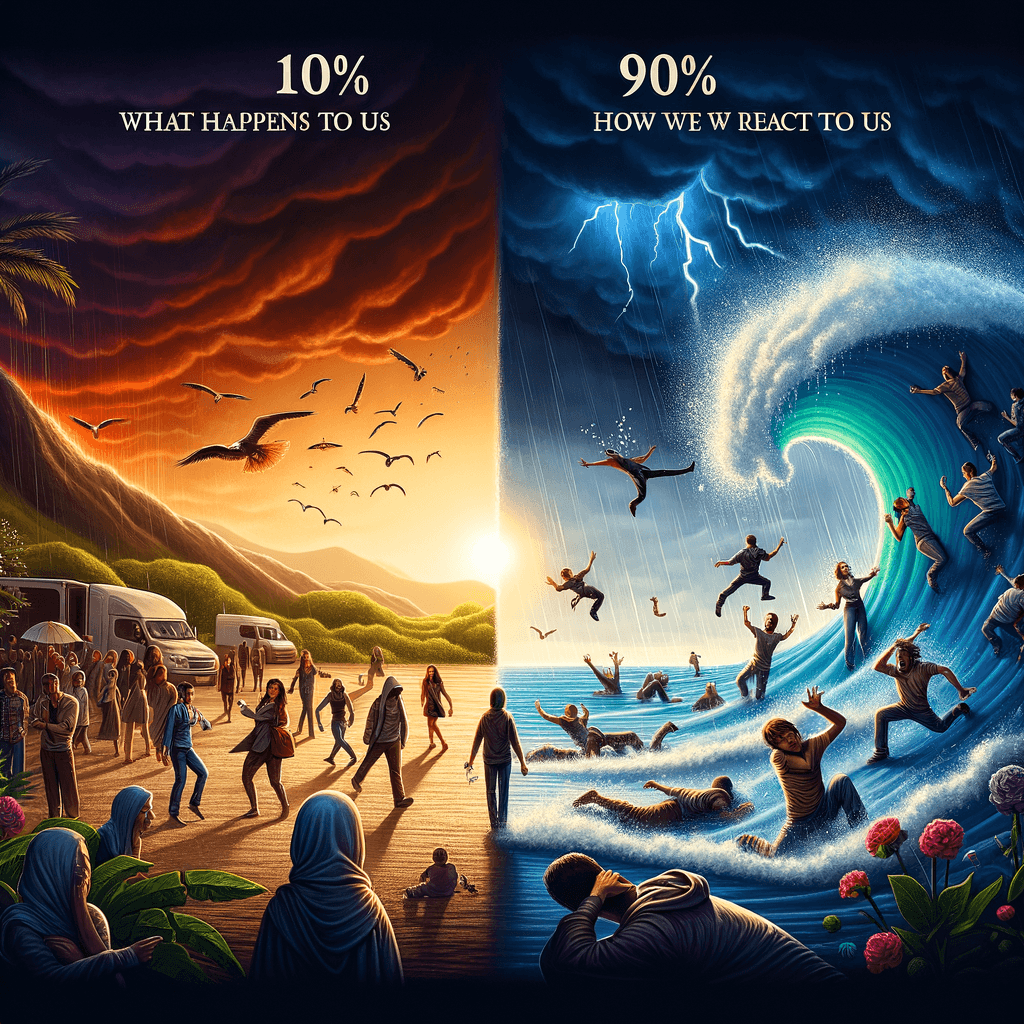
Life is 10% what happens to us and 90% how we react to it. – Charles R. Swindoll
—What lingers after this line?
Perspective and Attitude
This quote emphasizes the importance of maintaining a positive and proactive attitude towards life's events. It suggests that while we cannot control everything that happens, we have significant control over our responses to those events.
Resilience and Adaptability
It highlights the value of resilience, meaning the ability to bounce back from setbacks, and adaptability, which is adjusting to new conditions. These qualities are critical in navigating life's challenges and achieving personal growth.
Personal Responsibility
The quote underscores the concept of personal responsibility. By emphasizing our reactions over external events, it suggests that we are accountable for our feelings and behaviors, encouraging self-awareness and mindfulness.
Mental and Emotional Strength
Reacting effectively to life's circumstances often requires mental and emotional strength. This quote inspires individuals to cultivate inner fortitude, helping them manage stress, conflict, and adversity with grace.
Influence of Mindset
The quote speaks to the power of mindset. A positive outlook can profoundly affect our experiences and outcomes in life, demonstrating that our mental approach can transform difficulties into opportunities.
Charles R. Swindoll's Background
Charles R. Swindoll is an influential American pastor, author, and educator known for his inspirational messages on faith and personal development. His teachings often center on practical wisdom and encouraging a positive, resilient attitude.
One-minute reflection
Where does this idea show up in your life right now?
Related Quotes
6 selectedIf you have a different mindset, you will have a different outcome. — Jack Ma
Jack Ma
Jack Ma’s quote begins with a simple but powerful premise: outcomes rarely change before thinking changes. A different mindset alters what we notice, how we interpret obstacles, and which actions feel possible.
Read full interpretation →We are not victims of our impulses or emotions; we have the power to control them. It is time to relinquish the excuses. — Allie Brosh
Allie Brosh
At its core, Allie Brosh’s quote rejects the comforting idea that emotions and impulses are irresistible forces. Instead, it insists that human beings possess agency: the ability to pause, choose, and act deliberately ev...
Read full interpretation →My will shall shape my future. Whether I fail or succeed shall be no man's doing but my own. — Elaine Maxwell
Elaine Maxwell
At its core, Elaine Maxwell’s statement is a declaration of personal agency. By saying that her will shall shape her future, she rejects the idea that destiny is merely handed down by circumstance, luck, or the judgments...
Read full interpretation →You cannot build a life of meaning on a foundation of excuses. Your circumstances are the starting point, not the excuse for staying still. — David Goggins
David Goggins
At its core, David Goggins’s statement redraws the map between hardship and identity. He does not deny that circumstances can be painful, unfair, or limiting; instead, he insists they are only the opening conditions of a...
Read full interpretation →If it is to be, it is up to me. — William H. Johnsen
William H. Johnsen
At first glance, William H. Johnsen’s line compresses an entire philosophy into a few plain words: desired outcomes do not arrive by wish alone, but through personal action.
Read full interpretation →If you want to be successful, you must take 100% responsibility for everything that you experience in your life. — Jack Canfield
Jack Canfield
At its heart, Jack Canfield’s statement argues that success starts when a person stops treating life as something that merely happens to them. To take “100% responsibility” does not mean blaming oneself for every event i...
Read full interpretation →More From Author
More from Charles R. Swindoll →The family is a place where principles are hammered and honed on the anvil of everyday living. — Charles R. Swindoll
Charles R. Swindoll’s image of the family as an anvil immediately turns abstract morality into something tangible.
Read full interpretation →We cannot change our past. We can not change the fact that people act in a certain way. We can not change the inevitable. The only thing we can do is play on the one string we have, and that is our attitude. — Charles R. Swindoll
The quote emphasizes that some aspects of life, such as the past and other people's actions, are beyond our control.
Read full interpretation →