
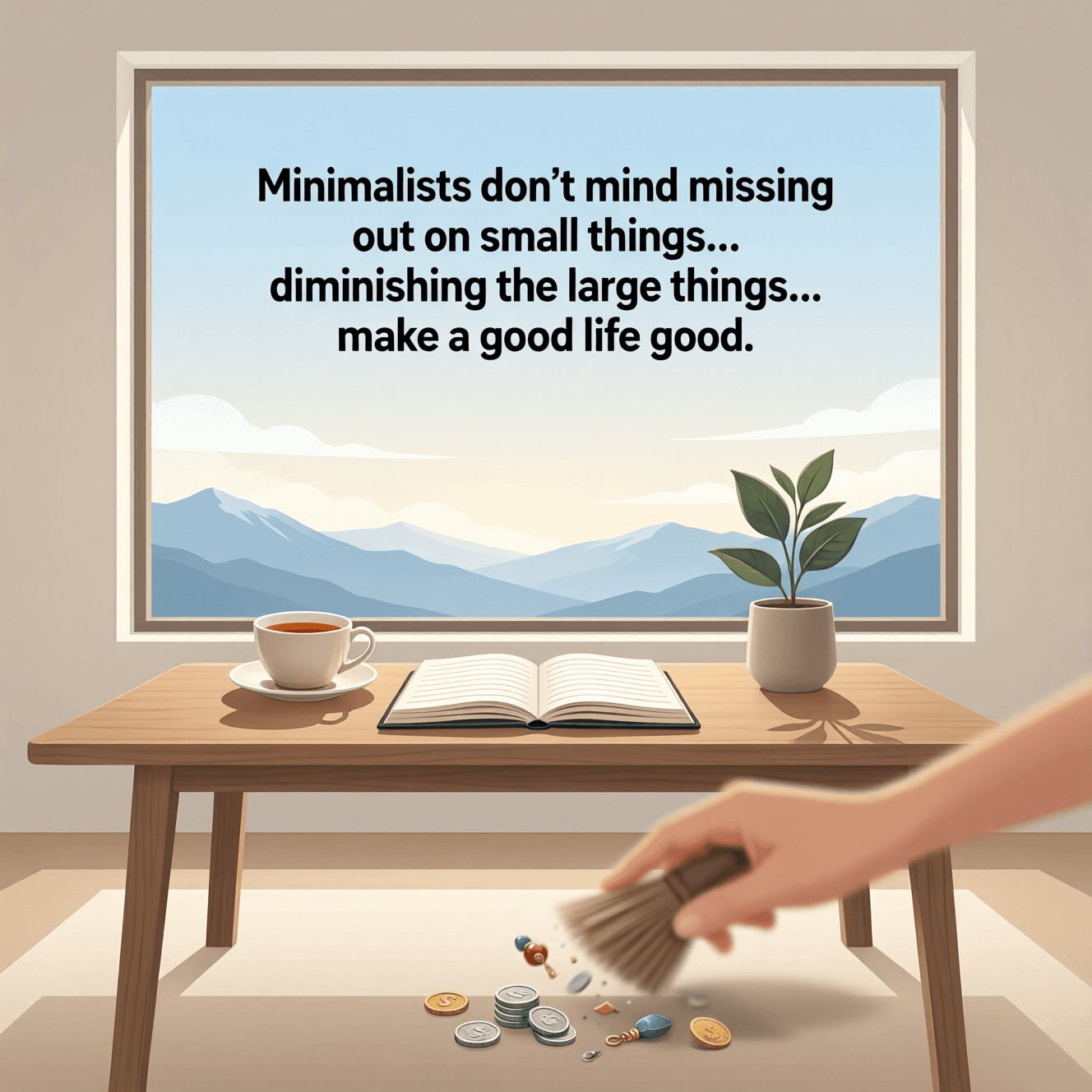
Minimalists don't mind missing out on small things; what worries them more is diminishing the large things they know make a good life good. — Cal Newport
—What lingers after this line?
Reframing Minimalism Beyond Deprivation
Cal Newport’s line begins by correcting a common misunderstanding: minimalism isn’t mainly a heroic refusal of pleasures. Instead, it’s a practical stance toward attention and desire, where the absence of certain “small things” doesn’t feel like loss. In this framing, the minimalist isn’t constantly gritting their teeth through temptation. Rather, the mindset pivots from what is being removed to what is being protected. That shift matters because it turns minimalism into a positive project—less about self-denial and more about creating room for the experiences that actually register as meaningful.
Small Losses vs. Big Erosion
From there, Newport draws a sharper contrast: the real fear isn’t missing a minor convenience, but slowly shrinking the major pillars of a good life. The “small things” might be an extra purchase, another app, one more commitment, or an evening lost to scrolling—each individually trivial. Yet the danger is cumulative. As these minor choices multiply, they quietly erode larger goods like deep relationships, sustained health, craft mastery, or a sense of purpose. What looks like harmless sampling can become a long-term trade: a little more noise in exchange for a little less life.
Defining the “Large Things” That Matter
To understand the quote fully, it helps to name what Newport calls “the large things.” These are often slow-growing, high-yield investments: unbroken time with family, close friendships that require presence, meaningful work that requires focus, and bodily well-being that depends on consistency. In Nicomachean Ethics (4th century BC), Aristotle links a good life to activities that cultivate virtue over time, not quick hits of satisfaction. In the same spirit, Newport implies that the large things are those whose value compounds—precisely the kinds of goods most vulnerable to fragmentation.
Attention as the Hidden Currency
Next, the quote suggests an underlying mechanism: minimalism guards attention. Many “small things” compete less for money than for mental bandwidth, leaving people tired, distracted, and perpetually behind. When attention is scattered, even leisure stops feeling restorative and work stops feeling meaningful. Newport’s broader body of work, including Deep Work (2016), argues that focus is a prerequisite for both professional excellence and personal satisfaction. Minimalism, in this sense, becomes a strategy for preserving the conditions in which the large things can flourish.
Choosing Principles Over Constant Decisions
Another implication follows naturally: minimalists don’t want to re-litigate every tiny choice. By setting clear standards—what they allow in, what they keep out—they reduce decision fatigue and avoid the slow creep of clutter. This can look like declining most optional obligations or limiting tools that invite compulsive checking. The benefit isn’t mere tidiness; it’s stability. When principles replace constant micro-decisions, the big commitments get consistent support. Over time, a life organized this way tends to feel more coherent because it is built around fewer, better priorities.
Minimalism as a Form of Care
Finally, Newport’s worry about “diminishing” the large things gives minimalism an ethical tone: it is a way of caring for what you already know is precious. The minimalist’s restraint is not rooted in contempt for small pleasures, but in respect for fragile, irreplaceable goods that require protection. Seen this way, minimalism is less a lifestyle aesthetic than a maintenance practice. It asks a simple question—what am I defending?—and then treats time, focus, and energy as resources to be spent primarily on the people and pursuits that make life genuinely good.
One-minute reflection
Where does this idea show up in your life right now?
Related Quotes
6 selectedClutter is not just the stuff on your floor; it's anything that stands between you and the life you want to be living. — Peter Walsh
Peter Walsh
At first glance, Peter Walsh’s quote seems to address physical mess, yet it quickly expands into something much broader. Clutter, in his view, is not merely a pile of objects on the floor; rather, it is any obstacle—mate...
Read full interpretation →Clutter is not just physical; it is the visual noise that prevents us from seeing what truly matters. — Fumio Sasaki
Fumio Sasaki
At first glance, Fumio Sasaki’s remark appears to be about untidy rooms, yet it quickly reaches further. He reframes clutter not merely as an excess of objects but as a form of visual interference that competes for our a...
Read full interpretation →Do the work of naming the highest, eulogy-worthy priorities in your life. Then do the work of putting them at the center of your life, every day. — Brooke McAlary
Brooke McAlary
Brooke McAlary’s quote begins with a difficult but clarifying task: identifying the priorities so important they would belong in your eulogy. In other words, she asks us to look beyond errands, ambitions, and social nois...
Read full interpretation →Instead of hustling to build a life that looks good, what if you slowed down and cultivated a life that feels good. — Erica Layne
Erica Layne
Erica Layne’s quote begins by challenging a familiar modern reflex: the urge to “hustle” toward a life that looks impressive from the outside. In doing so, she contrasts external validation with internal well-being, sugg...
Read full interpretation →Doing less doesn't make you less. — Tessa L. G. (Talk2Tessa)
Tessa L. G. (Talk2Tessa
At its core, Tessa L. G.’s line rejects a modern habit of confusing human value with constant activity.
Read full interpretation →Intentional living is the art of making our own choices before others' choices make us. — Richie Norton
Richie Norton
Richie Norton’s quote frames intentional living as an active rather than passive way of being. At its core, it argues that a meaningful life is shaped by deliberate decisions made in advance, not by drifting along with e...
Read full interpretation →More From Author
More from Cal Newport →The greatest luxury in a modern world is not things, but the ability to disconnect and reclaim your own attention. — Cal Newport
At first glance, Newport’s statement overturns the traditional idea of luxury as something material. Instead of wealth being measured by rare objects, he suggests it is now measured by the freedom to step away from noise...
Read full interpretation →Technology should empower us, not overwhelm us. Digital wellness is about reclaiming control over our attention and time. — Cal Newport
At its core, Cal Newport’s statement draws a clear boundary between empowerment and domination. Technology, he suggests, fulfills its promise only when it serves human aims rather than dictating them.
Read full interpretation →We are not defined by the speed of our output, but by the depth of our attention. — Cal Newport
At first glance, Cal Newport’s line challenges one of modern life’s favorite assumptions: that worth is proven through visible speed. In many workplaces and social spaces, quick replies, rapid delivery, and constant acti...
Read full interpretation →The task of a craftsman is not to generate meaning, but rather to cultivate in himself the skill of discerning the meanings that are already there. — Cal Newport
At its core, Cal Newport’s quote overturns a popular modern assumption: that fulfillment is something we simply fabricate through self-expression alone. Instead, he argues that meaning already exists in the structure of...
Read full interpretation →