
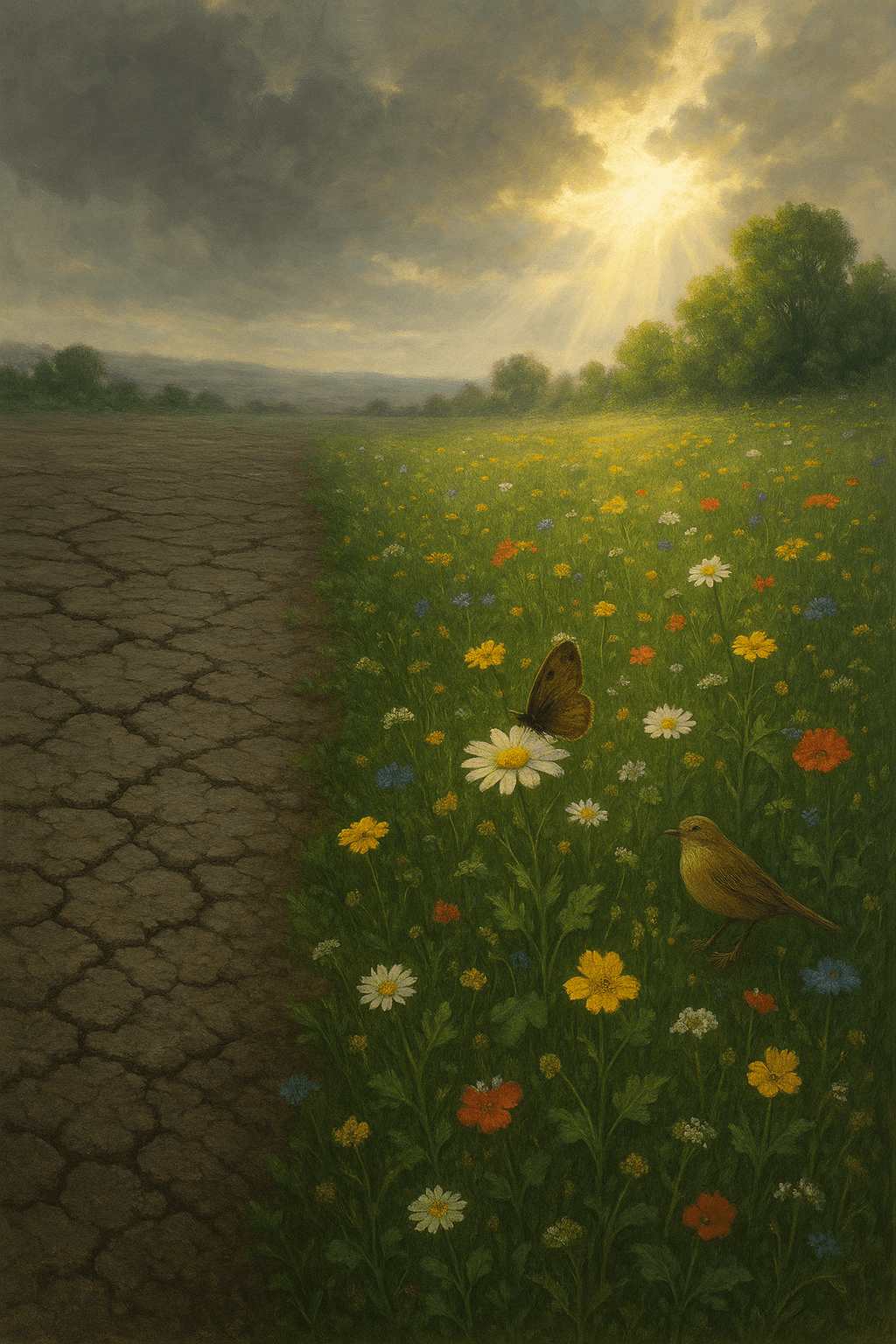
Not to have been born is best. But since we are born, let us do something. — Rabindranath Tagore
—What lingers after this line?
The Existential Weight of Birth
Tagore’s statement begins with a striking assertion: ‘Not to have been born is best.’ Here, he echoes an ancient sentiment, reminiscent of Sophocles’ words in ‘Oedipus at Colonus’ (c. 406 BC), where the chorus proclaims that never to have been born is the greatest good. This reflects profound existential anxiety—the notion that life, by mere virtue of existence, entails suffering and burden. For Tagore, the very act of being born thrusts us into a world of uncertainty and inevitable hardship.
Moving from Lament to Action
Yet, rather than resigning himself to despair, Tagore seamlessly pivots: ‘But since we are born, let us do something.’ This transition marks a crucial shift from passive lamentation to active engagement. By acknowledging our unavoidable presence in the world, Tagore suggests that meaning is not found in the avoidance of life’s difficulties, but in what we choose to do despite them. This echoes Viktor Frankl’s existential imperative in ‘Man’s Search for Meaning’ (1946), where agency and purpose are offered as antidotes to suffering.
The Role of Responsibility and Creativity
Taking action, in Tagore’s view, is more than mere distraction—it is a responsibility. As a poet, educator, and reformer, Tagore’s own life exemplified this ethos. Despite grappling with loss and the tragedies of his era, he committed himself to artistic creation and social change. This reflects a broader philosophical tradition, as seen in Albert Camus’ ‘The Myth of Sisyphus’, where persistent effort in the face of absurdity becomes an act of defiance and meaning.
Meaning in Human Connection and Contribution
Continuing this journey, Tagore’s call to ‘do something’ also highlights the value of contribution—whether through art, service, or simple acts of kindness. In Indian philosophy, the concept of ‘karma’ underscores the necessity of action (Bhagavad Gita, Chapter 2), suggesting our deeds form the fabric of our existence. Tagore’s words gently remind us that, since we cannot escape life, our best recourse is to improve it for ourselves and others.
From Acceptance to Authentic Living
Ultimately, Tagore’s message is one of acceptance transformed into authenticity. Rather than succumbing to nihilism, he advocates embracing reality and shaping it through purposeful action. In doing so, he invites us to honor both our existential doubts and our capacity for meaningful endeavor, forging a life that balances sorrow with hope and passivity with creative engagement.
Recommended Reading
As an Amazon Associate, we earn from qualifying purchases.
One-minute reflection
What feeling does this quote bring up for you?
Related Quotes
6 selectedAct, and God will act. — Meister Eckhart
Meister Eckhart
“Act, and God will act” distills Meister Eckhart’s mystical theology into a compact challenge. Rather than picturing a passive believer waiting for a distant deity to intervene, Eckhart reverses the sequence: human initi...
Read full interpretation →The strongest principle of growth lies in the human choice. — George Eliot
George Eliot
This quote highlights the power of human agency. It suggests that growth—personal, intellectual, or emotional—stems from the deliberate decisions we make in our lives.
Read full interpretation →Man is not the creature of circumstances, circumstances are the creatures of man. — Benjamin Disraeli
Benjamin Disraeli
This quote emphasizes that individuals are not merely passive victims of their environment. Instead, they have the power to shape and influence their circumstances through their decisions and actions.
Read full interpretation →In action, be it for good or ill, there is no such thing as neutrality. — William S. Burroughs
William S. Burroughs
William S. Burroughs’s statement directly challenges the comforting belief that our actions can be entirely neutral.
Read full interpretation →Culture does not make people. People make culture. — Chimamanda Ngozi Adichie
Chimamanda Ngozi Adichie
Chimamanda Ngozi Adichie’s declaration flips the traditional understanding of culture on its head, emphasizing human agency over structural determinism. By stating, 'Culture does not make people.
Read full interpretation →Beauty awakens the soul to act. — Dante Alighieri
Dante Alighieri
Dante Alighieri’s assertion positions beauty as more than visual appeal—it is a call to action, stirring the deepest parts of our being. In his own masterpiece, the 'Divine Comedy' (c.
Read full interpretation →More From Author
More from Rabindranath Tagore →When I stand before thee at the day's end, thou shalt see my scars and know that I had my wounds and also my healing. — Rabindranath Tagore
At its heart, Tagore imagines an ultimate moment of reckoning in which nothing essential can be hidden. To stand before another “at the day’s end” suggests the close of life, a spiritual homecoming, or simply the end of...
Read full interpretation →A home is not a mere transient shelter of brick and stone, but a place where hearts dwell and souls are nurtured. — Rabindranath Tagore
At its core, Tagore’s statement rejects the idea that a home can be defined by architecture alone. Walls, roofs, and doors may provide protection, yet they do not automatically create belonging.
Read full interpretation →Whatever you do with determination and grace, you do for the soul of the world. — Rabindranath Tagore
At its heart, Tagore’s line suggests that no sincere act is isolated. When a person works with determination, effort gains direction; when that same effort is carried out with grace, it acquires moral beauty.
Read full interpretation →Opinions are nothing; better is the self-contained calm of true realization. — Rabindranath Tagore
Tagore’s line draws a sharp contrast between what people say and what a person is. “Opinions” are portrayed as weightless—changeable, socially contagious, and often untethered from lived truth—while “true realization” im...
Read full interpretation →