
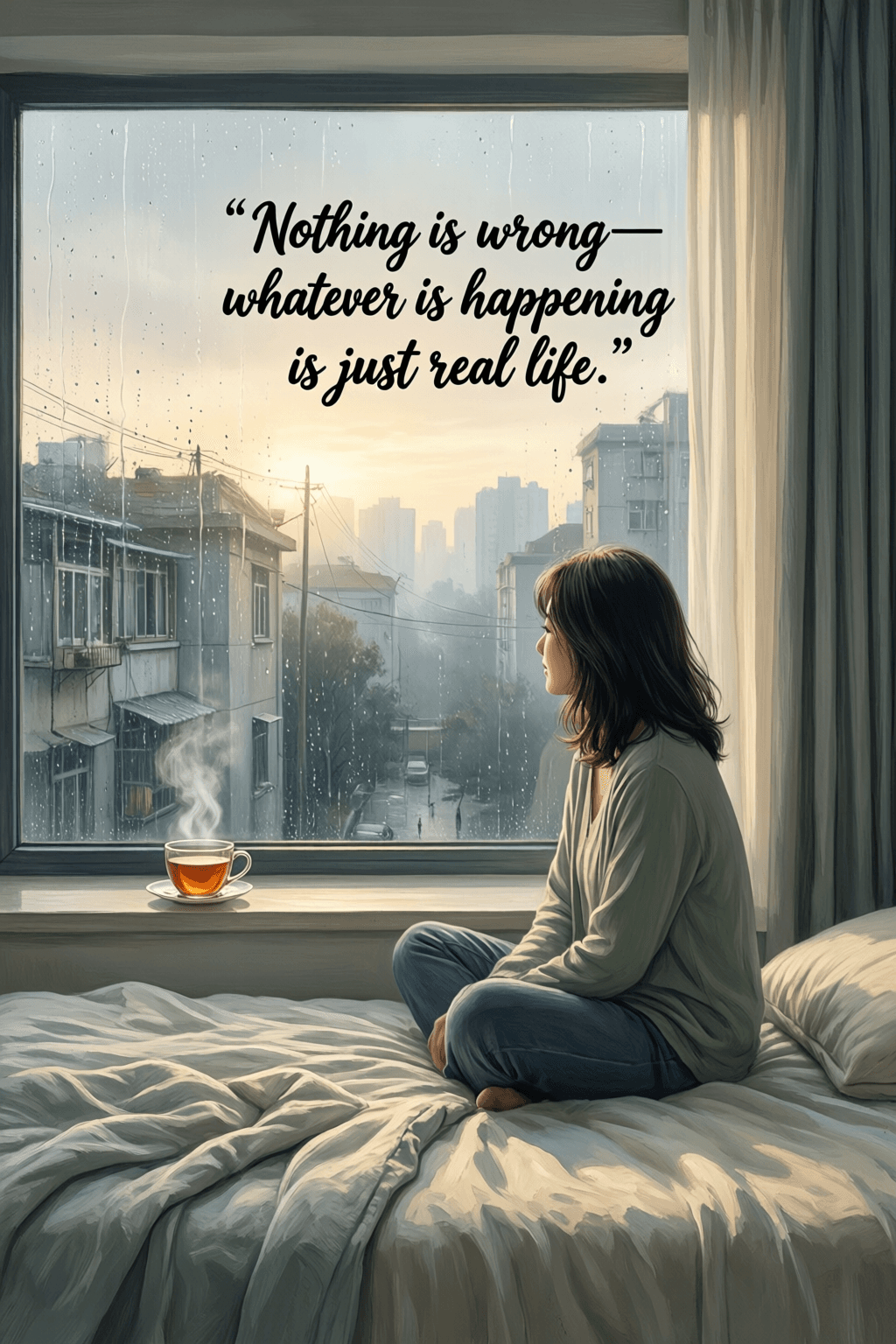
Nothing is wrong—whatever is happening is just real life. — Tara Brach
—What lingers after this line?
Reframing the Sense of Wrongness
At first glance, Tara Brach’s line gently interrupts a habit many people carry: the reflex to label discomfort as evidence that something has gone wrong. Instead, she proposes a quieter interpretation—what is happening is simply life as it is. In that shift, suffering is not denied, but the added layer of resistance begins to loosen. This perspective echoes Brach’s broader teaching in Radical Acceptance (2003), where she argues that pain deepens when we fight reality before we understand it. By replacing the inner verdict of “this should not be happening” with “this is what is here,” the mind moves from panic toward presence.
The Difference Between Pain and Resistance
From there, the quote opens an important distinction: pain is often unavoidable, but the conviction that pain signals failure can make it harder to bear. Illness, disappointment, conflict, and grief belong to the ordinary texture of human existence. When we call these experiences “wrong,” we often create a second wound made of shame, fear, or self-blame. In this way, Brach’s insight aligns with Buddhist teachings on dukkha, often translated as suffering or unsatisfactoriness. The First Noble Truth does not dramatize pain; rather, it normalizes it as part of embodied life. Consequently, acceptance becomes not resignation, but clarity.
Mindfulness as a Return to What Is
Once that clarity appears, mindfulness becomes possible. Rather than escaping experience or immediately fixing it, we begin by noticing sensations, thoughts, and emotions without declaring them mistakes. Jon Kabat-Zinn’s Full Catastrophe Living (1990) similarly describes mindfulness as paying attention on purpose, in the present moment, and without judgment. As a result, Brach’s statement can function almost like a breathing instruction during distress: pause, feel, and recognize that this moment—however messy—is still part of life. The goal is not passivity, but an honest starting point from which wise action can emerge.
Compassion in Ordinary Struggle
Just as mindfulness steadies attention, compassion softens the heart that must live through reality. If nothing is “wrong” in the moralized sense, then our struggles do not make us defective. A parent overwhelmed by caregiving, a student lost in uncertainty, or someone grieving a breakup may still be hurting deeply, yet none of them has failed at being human. Kristin Neff’s work on self-compassion, especially Self-Compassion (2011), emphasizes this recognition of common humanity. Therefore, Brach’s quote can be heard as a compassionate permission slip: your difficulty is not proof of personal inadequacy; it is evidence that you are alive and participating in real life.
Acceptance That Leads to Action
Importantly, accepting reality does not mean approving of injustice, avoiding change, or surrendering to harmful conditions. Rather, it means seeing clearly what is true before deciding what to do next. A doctor facing a difficult diagnosis, for example, cannot help a patient by pretending the illness is not there; effective care begins with accurate recognition. Likewise, Brach’s point suggests that wise response grows from reality-based awareness, not denial. Because of that, acceptance becomes an active foundation: once we stop arguing with the fact of the moment, we can meet it with courage, discernment, and practical care.
Living Without the Extra Battle
Ultimately, the power of the quote lies in its simplicity. Real life includes beauty and confusion, intimacy and loss, beginnings and endings. When we stop insisting that difficult moments are cosmic errors, we free up energy that was being spent on inner battle. What remains is a more spacious way of living, one that can hold joy and sorrow at once. In the end, Brach offers not a slogan of indifference, but a discipline of tenderness. Nothing is wrong does not mean nothing hurts; it means the hurt belongs to the human story. And once that is understood, life becomes easier to meet with honesty and grace.
Recommended Reading
As an Amazon Associate, we earn from qualifying purchases.
One-minute reflection
What does this quote ask you to notice today?
Related Quotes
6 selectedEverything in our life keeps changing—our inner moods, our bodies, our work. We can't hold on to anything. — Tara Brach
Tara Brach
At its heart, Tara Brach’s reflection points to impermanence as the basic condition of human life. Our feelings rise and fall, our bodies age and heal, and even the work that structures our days shifts in ways we cannot...
Read full interpretation →The only way to live is by accepting each minute as an unrepeatable miracle. — Tara Brach
Tara Brach
Tara Brach’s words echo a universal wisdom: every moment is unique and irretrievable. By urging us to accept each minute as an ‘unrepeatable miracle’, she highlights the transformative power of present-moment awareness.
Read full interpretation →The boundary to what we can accept is the boundary to our freedom. — Tara Brach
Tara Brach
At first glance, Tara Brach’s statement suggests that freedom is not only shaped by external circumstances but also by our inner willingness to face reality. What we cannot accept—whether grief, uncertainty, fear, or imp...
Read full interpretation →Flow with whatever may happen and let your mind be free. Stay centered by accepting whatever you are doing. This is the ultimate. — Zhuangzi
Zhuangzi
This quote emphasizes the importance of accepting and adapting to life's circumstances. By flowing with whatever happens, one can maintain a sense of peace and equilibrium.
Read full interpretation →There are times in our lives when we have to realize our past is precisely what it is, and we cannot change it. — Nicholas Sparks
Nicholas Sparks
Nicholas Sparks frames a difficult but necessary truth: some moments in life demand that we stop struggling against what has already happened. At first, this realization can feel like surrender, because people often revi...
Read full interpretation →Intimacy is the capacity to be rather weird with someone – and finding that that's okay with them. — Alain de Botton
Alain de Botton
At first glance, Alain de Botton’s remark shifts intimacy away from grand declarations and toward something quieter: the freedom to reveal one’s oddities without fear. In this view, closeness is not built on flawless com...
Read full interpretation →More From Author
More from Tara Brach →Everything in our life keeps changing—our inner moods, our bodies, our work. We can't hold on to anything. — Tara Brach
At its heart, Tara Brach’s reflection points to impermanence as the basic condition of human life. Our feelings rise and fall, our bodies age and heal, and even the work that structures our days shifts in ways we cannot...
Read full interpretation →The boundary to what we can accept is the boundary to our freedom. — Tara Brach
At first glance, Tara Brach’s statement suggests that freedom is not only shaped by external circumstances but also by our inner willingness to face reality. What we cannot accept—whether grief, uncertainty, fear, or imp...
Read full interpretation →If we are holding back from any part of our experience, if our heart shuts out any part of who we are, we are fueling the trance of unworthiness. — Tara Brach
Tara Brach’s statement begins with a subtle but powerful observation: whenever we withhold parts of our experience, we do not merely avoid discomfort—we strengthen a painful inner story. In this view, unworthiness is not...
Read full interpretation →The real fault line in our lives is not between those who are awake and those who are asleep, but between those who can stay present with discomfort and those who must immediately explain it away. — Tara Brach
Tara Brach shifts attention away from the familiar contrast between the ‘aware’ and the ‘unaware’ and toward something more intimate: how we respond when life becomes uncomfortable. In this view, the deepest dividing lin...
Read full interpretation →