
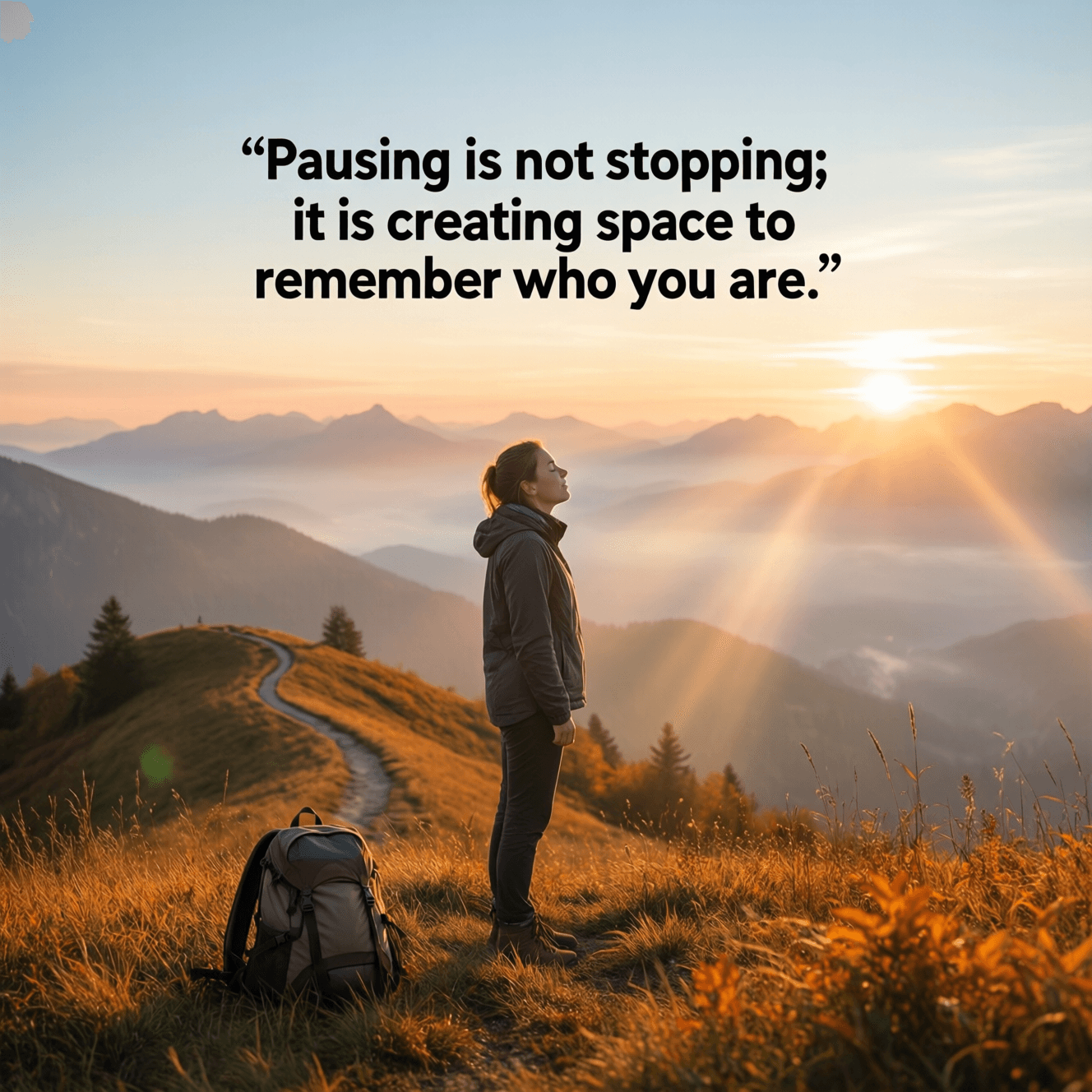
Pausing is not stopping; it is creating space to remember who you are. — Gary Burnison
—What lingers after this line?
Reframing the Meaning of a Pause
Gary Burnison’s line begins by correcting a common fear: that slowing down equals falling behind. By insisting that “pausing is not stopping,” he separates rest from resignation and reflection from retreat. A pause can be an intentional act, chosen precisely because life is moving quickly. This reframing matters because many people only allow themselves to stop when they are forced—by burnout, illness, or circumstance. Burnison instead points to a deliberate, proactive pause, one that preserves momentum while preventing the self from being flattened into pure productivity.
Space as a Tool for Self-Recognition
Once pause is understood as purposeful, the second clause—“creating space”—reveals how identity is recovered. Space is not emptiness; it is a clearing where the noise of obligations, roles, and expectations quiets enough for an inner voice to be heard. In that silence, you can notice what you actually value, not merely what you are responding to. This idea echoes ancient practices of stepping back to see oneself more clearly; Marcus Aurelius’ Meditations (c. 170–180 AD) repeatedly urges retreat into the mind’s “inner citadel” to regain perspective amid external demands. Burnison modernizes the same mechanism: space restores the signal of self.
Interrupting Autopilot and Social Scripts
In daily life, people often run on autopilot—checking boxes, meeting deadlines, and performing competence. Over time, the “who you are” can be replaced by “what you do,” and identity becomes a bundle of tasks. Pausing breaks that trance by inserting a moment where you can ask, “Is this still aligned with me?” From there, a pause becomes a hinge between reaction and choice. Even small interruptions—turning off notifications for an hour, walking without a destination—can expose how much of your behavior is driven by social scripts rather than authentic intention.
Why Memory Matters to Identity
Burnison’s use of “remember” is precise: identity is not always discovered; often it is recovered. Remembering implies you once knew your priorities, boundaries, and aspirations, but they were buried under urgency. A pause gives you room to reconnect with that earlier clarity, the version of you that existed before constant acceleration. This resonates with psychological accounts of narrative identity, where people maintain a sense of self by continually revisiting and editing the story they tell about their lives. When the story is never revisited—because there is no space—the self becomes fragmented, and choices feel strangely disconnected from personal meaning.
Pauses as Micro-Practices, Not Grand Escapes
Importantly, the quote does not demand dramatic withdrawal; it suggests creating space, which can be modest and repeatable. A five-minute pause before a meeting to name what you’re feeling, a weekly review of what energized you, or a brief journal entry after a hard conversation can all function as identity checkpoints. These small pauses work because they are sustainable. Rather than waiting for a vacation or a crisis to prompt reflection, you build a rhythm where self-recognition is ongoing—like regularly recalibrating a compass so your direction stays true even as terrain changes.
Returning to Action with More Integrity
Finally, a pause earns its value when it changes how you re-enter motion. After creating space and remembering who you are, action becomes less frantic and more coherent—guided by priorities instead of pressure. In this sense, pausing is not the opposite of progress; it is the condition for progress that still belongs to you. Burnison’s message ultimately defends a humane form of ambition: keep moving, but not at the cost of self-erasure. The pause becomes a quiet declaration that your identity is not a luxury—it is the foundation that makes your effort meaningful.
One-minute reflection
What's one small action this suggests?
Related Quotes
6 selectedWe cannot be more connected to others than we are to ourselves. — Brené Brown
Brené Brown
Brené Brown’s statement begins with a simple but demanding truth: our relationships with others are limited by the relationship we have with ourselves. If we are estranged from our own feelings, needs, and fears, then ou...
Read full interpretation →We must look at the lens through which we see the world, as well as the world we see. — Sarah Ban Breathnach
Sarah Ban Breathnach
Sarah Ban Breathnach’s line reminds us that perception is never a simple act of receiving reality; it is also an act of interpretation. We do not merely look outward at events, people, and circumstances—we also look thro...
Read full interpretation →The most important form of incremental change is the decision by the individual to become more conscious in their own life. — Carol J. Adams
Carol J. Adams
Carol J. Adams frames incremental change not as a distant political event, but as a personal awakening.
Read full interpretation →You cannot change what you refuse to confront. Growth begins when you stop hiding from your own truth. — Marc Chernoff
Marc Chernoff
Marc Chernoff’s quote turns growth into an act of courage rather than comfort. At its heart, the message is simple: real change cannot begin while we avoid the facts of our own lives.
Read full interpretation →Quiet confidence is the result of realizing who you are at the deepest level, not rearranging your circumstances. — Eckhart Tolle
Eckhart Tolle
At its core, Eckhart Tolle’s statement reframes confidence as an act of recognition rather than acquisition. Instead of treating self-assurance as something earned through status, approval, or control, he suggests it ari...
Read full interpretation →One's own self is well worth knowing. — Sappho
Sappho
At first glance, Sappho’s brief statement seems simple, yet its force lies in its directness: the self is not a trivial subject but a worthy one. In a world that often rewards attention to status, duty, or appearance, he...
Read full interpretation →More From Author
More from Gary Burnison →