
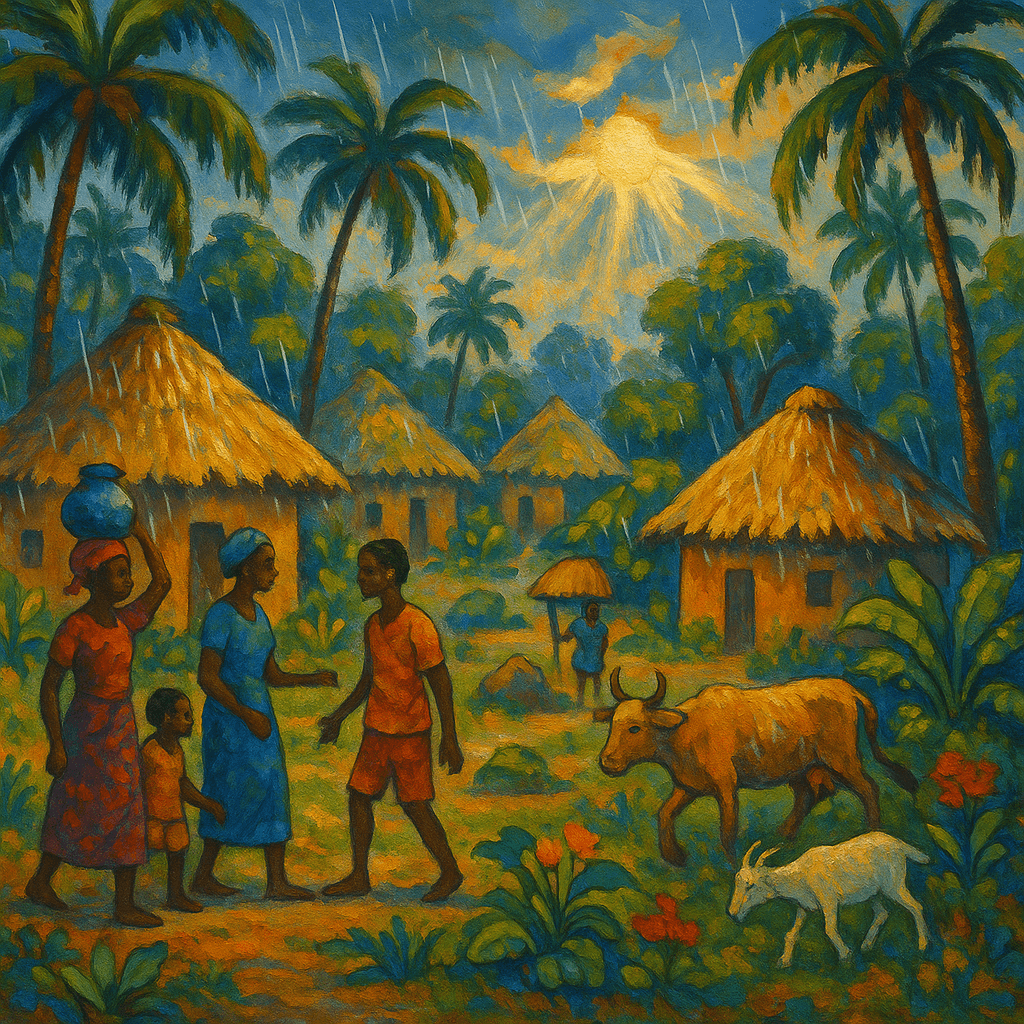
Rain does not fall on one roof alone. — Cameroon Proverb
—What lingers after this line?
The Proverb’s Core Message
The Cameroon proverb, 'Rain does not fall on one roof alone,' eloquently conveys that hardship and difficulty are universal experiences. Rather than singling out any one individual, circumstance, or community, the metaphorical 'rain' falls broadly, touching many lives. This wisdom urges listeners to recognize their troubles as part of a broader human experience, fostering resilience through a sense of solidarity.
Historical Perspectives on Collective Suffering
Throughout history, periods of turmoil—from plagues to wars—have echoed the sentiment of this proverb. During the Black Death, for instance, entire towns and nations were afflicted, erasing boundaries between social status and geography. Chronicles from that era show how shared adversity sometimes drew communities together, catalyzing both grief and unity in the face of widespread misfortune.
Social Cohesion in Times of Trial
Beyond historical examples, modern societies also reveal the power of this proverb. When natural disasters or economic recessions hit, their impacts seldom discriminate. Sociologist Emile Durkheim observed in his studies (1893) that communal challenges, while stressful, often lead to stronger social bonds. People instinctively reach out to neighbors and strangers alike, finding comfort in shared vulnerability and mutual support.
Learning Empathy Through Shared Experience
Importantly, recognizing that no one is exempt from life’s 'rain' cultivates empathy. Literature often explores these shared burdens—John Steinbeck’s 'The Grapes of Wrath' (1939), for instance, illustrates how families displaced by the Dust Bowl formed tight-knit migrant communities, leaning on one another for survival. Such narratives remind us that witnessing struggle can move us toward deeper compassion and solidarity.
From Acceptance to Action
Ultimately, the proverb guides us from passive acceptance to active engagement. While adversity is a common lot, acknowledging its ubiquity can inspire collective action rather than resignation. Grassroots movements, charitable initiatives, and international aid efforts all spring from this recognition—that when the rain pours, we must not simply shield our own roofs, but join together to weather the storm.
One-minute reflection
What does this quote ask you to notice today?
Related Quotes
6 selectedI can never be what I ought to be until you are what you ought to be. This is the interrelated structure of reality. — Martin Luther King, Jr.
Martin Luther King Jr.
At the heart of Martin Luther King, Jr.’s statement is a simple but demanding truth: no person develops in isolation. Our moral growth, dignity, and freedom are bound up with the condition of others.
Read full interpretation →You are not Atlas carrying the world on your shoulder. It is good to remember that the planet is carrying you. — Vandana Shiva
Vandana Shiva
Vandana Shiva’s words begin by overturning a familiar heroic image: the individual as Atlas, straining beneath the weight of the world. Instead, she gently corrects that illusion, reminding us that we are not supporting...
Read full interpretation →To love is to recognize that we are not alone in the universe; we are threads woven into a shared tapestry of existence. — Iris Murdoch
Iris Murdoch
At its heart, Iris Murdoch’s reflection presents love not merely as emotion but as recognition. To love someone is to awaken to the fact that life is never fully solitary; instead, our identities are shaped through conta...
Read full interpretation →The only way we're going to make it is in the company of others. We need each other. In all ways. — Mia Birdsong
Mia Birdsong
Mia Birdsong’s statement begins with a simple but far-reaching truth: human life is not built for isolation. By saying “the only way we’re going to make it” is with others, she reframes survival as a collective act rathe...
Read full interpretation →No man is an island, entire of itself; every man is a piece of the continent, a part of the main. — John Donne
John Donne
John Donne begins by dismantling the fantasy of complete self-sufficiency. To say that no man is an island is to argue that human beings cannot exist in any meaningful sense apart from others; our identities, duties, and...
Read full interpretation →We don't accomplish anything in this world alone… and whatever happens is the result of the whole tapestry of one's life and all the weavings of individual threads from one to another that creates something. — Sandra Day O'Connor
Sandra Day O'Connor
Sandra Day O’Connor’s reflection begins by rejecting the myth of the self-made individual. At its heart, the quote suggests that no achievement emerges in isolation; instead, every success, failure, and turning point is...
Read full interpretation →More From Author
More from Cameroon Proverb →