
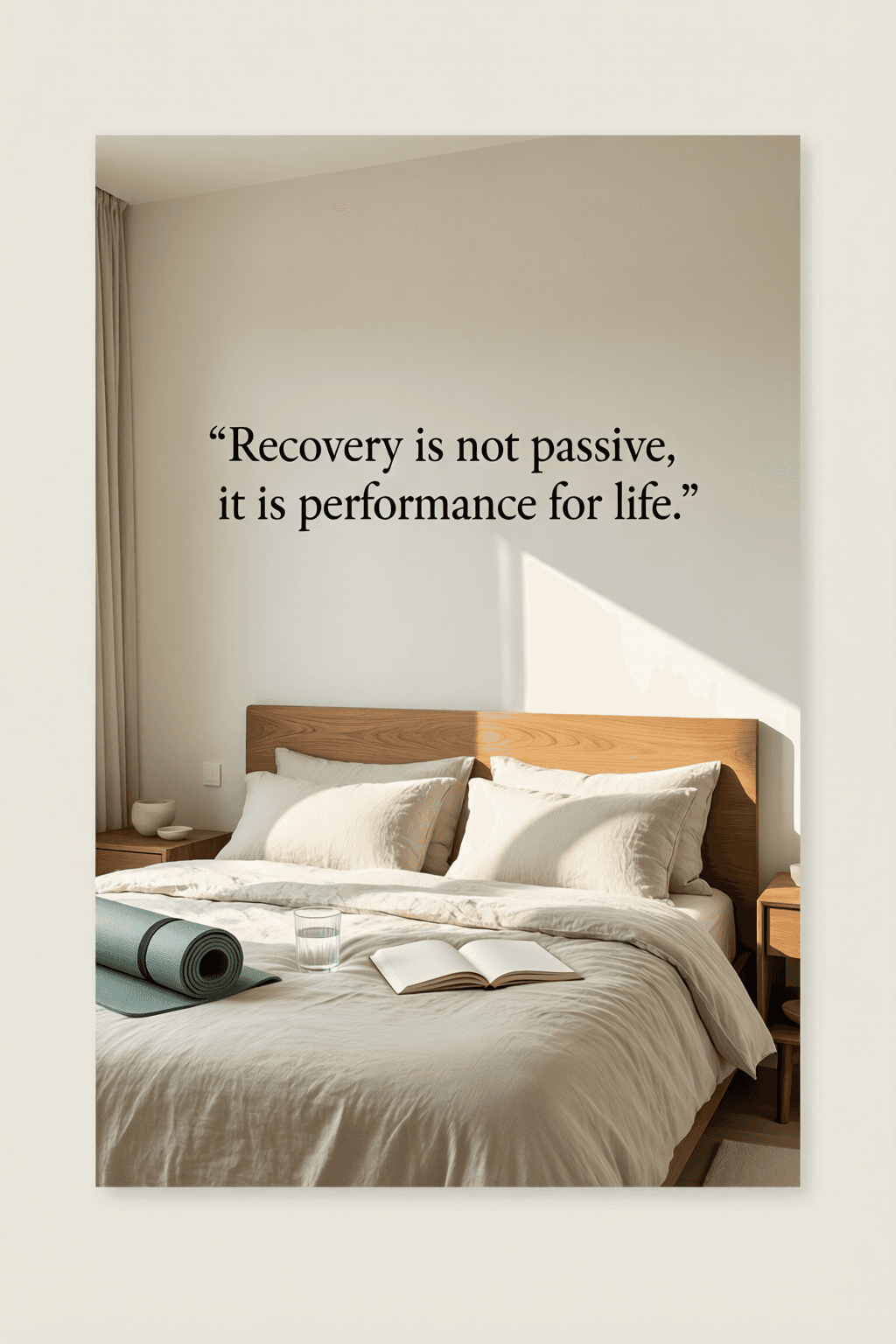
Recovery is not passive, it is performance for life. — Erica Diamond
—What lingers after this line?
Redefining Recovery as Action
At first glance, Erica Diamond’s statement overturns a common misconception: recovery is not simply rest, waiting, or the passive passage of time. Instead, it is an intentional process, something lived and enacted through choices, routines, and effort. By calling it “performance for life,” she frames recovery as a discipline that prepares a person to meet daily demands with renewed strength. This shift in perspective matters because it transforms recovery from a backstage activity into part of life’s main stage. Rather than being separate from productivity, healing becomes the very condition that makes meaningful action possible. In that sense, recovery is not the opposite of living well; it is one of its most essential forms.
The Meaning of Performance
From there, the word “performance” adds an intriguing layer. It does not merely suggest public display or athletic output, but the capacity to function, respond, and endure in the ongoing drama of ordinary existence. Much as a musician must rehearse and reset between concerts, human beings require deliberate restoration to sustain their best work over time. This idea appears in performance psychology and sports science, where recovery is treated as an active component of excellence rather than a break from it. Studies in athletic training, such as those discussed by Tudor Bompa’s periodization research, repeatedly show that adaptation happens not only during exertion but also through structured recovery. Diamond’s phrasing extends that principle beyond sports into the wider arena of life.
Recovery in Body and Mind
Seen this way, recovery includes far more than physical rest. Sleep, nutrition, movement, emotional processing, and mental quiet all become forms of preparation for living well. As a result, recovery becomes holistic: the body repairs tissue, the mind consolidates memory, and the emotions regain balance after strain. Modern neuroscience supports this broader view. Sleep research by Matthew Walker in Why We Sleep (2017) emphasizes that rest is an active biological event, crucial for cognition, mood regulation, and immune function. Likewise, stress research shows that recovery periods help regulate cortisol and restore resilience. Diamond’s quote therefore captures a scientific truth in compact language: restoration is not inactivity, but a vital form of internal work.
A Counterpoint to Hustle Culture
Moreover, the quote pushes back against modern hustle culture, which often glorifies constant output and treats exhaustion as proof of ambition. In that environment, recovery can seem indulgent or secondary. Diamond rejects that logic by suggesting that a life well performed depends not on endless strain, but on the wisdom to renew oneself deliberately. This critique echoes broader cultural conversations about burnout. The World Health Organization’s recognition of burnout as an occupational phenomenon in the ICD-11 underscored how chronic unmanaged stress erodes both health and effectiveness. Thus, recovery becomes not a luxury for the privileged or the weak, but a necessary practice for anyone who wants to remain present, capable, and humane.
Discipline Hidden Inside Healing
Consequently, recovery can be understood as a form of discipline. It may mean saying no to overload, protecting sleep, attending therapy, taking restorative walks, or allowing grief and fatigue to be acknowledged rather than denied. These acts may appear quiet from the outside, yet they require self-awareness and consistency, which are the very marks of mature effort. An everyday example makes the point clear: a person recovering from illness or emotional strain often improves not through one dramatic breakthrough, but through repeated small actions—hydration, medication, journaling, gentle exercise, and boundaries. In this sense, recovery resembles training. Its power lies in repetition, and its goal is not merely survival, but readiness for fuller participation in life.
Living Better Through Restoration
Finally, Diamond’s quote offers a hopeful conclusion: recovery is not a pause from life, but a way of returning to it more fully. To recover is to prepare oneself to love, work, create, and endure with greater steadiness. The phrase “for life” broadens the message beyond crisis or fatigue, suggesting that recovery is a lifelong rhythm rather than a temporary remedy. Ultimately, this makes the quote both practical and philosophical. It reminds us that strength is not measured only by how much we can push, but also by how wisely we restore. In that light, recovery becomes an art of sustainable living—an active performance that helps a person remain whole enough to keep showing up for what matters.
Recommended Reading
As an Amazon Associate, we earn from qualifying purchases.
One-minute reflection
What feeling does this quote bring up for you?
Related Quotes
6 selectedStop performing 'fine' while you are quietly cracking. Resilience is not silent endurance; it is the courage to demand a recovery that actually restores you. — Michelle McQuaid
Michelle McQuaid
Michelle McQuaid opens with a blunt challenge: stop acting okay when you’re not. “Performing ‘fine’” is more than a social habit—it can become a mask that delays help, distorts self-understanding, and signals to others t...
Read full interpretation →Confidence is not absence of fear; it is the quiet recognition that you have survived every hard day so far. — Michelle Obama
Michelle Obama
At first glance, confidence is often mistaken for boldness without hesitation, yet Michelle Obama’s words gently overturn that myth. She frames confidence not as the absence of fear, but as a steadier inner knowledge: yo...
Read full interpretation →The art of life is more like the wrestler's art than the dancer's; stand ready and firm to meet sudden and unexpected onsets. — Marcus Aurelius
Marcus Aurelius
Marcus Aurelius contrasts two arts to clarify what living well demands. A dancer suggests elegance, rhythm, and practiced beauty; a wrestler, by contrast, suggests balance under pressure, resistance, and constant readine...
Read full interpretation →Everything is a season, and this is just a chapter, not your whole story. — Glennon Doyle
Glennon Doyle
At its core, Glennon Doyle’s quote reframes hardship and change by comparing life to the natural cycle of seasons. Just as winter does not cancel spring, a painful or uncertain period does not define a person forever.
Read full interpretation →The broken will always be able to love harder than most. Once you've been in the dark, you learn to appreciate everything that shines. — Ann Voskamp
Ann Voskamp
Ann Voskamp’s reflection begins with a striking claim: those who have been broken often love with unusual intensity. The idea is not that pain is noble in itself, but that suffering can strip away superficial assumptions...
Read full interpretation →Sometimes losing everything is how you find yourself. — J.K. Rowling
J.K. Rowling
At first glance, J.K. Rowling’s line frames devastation not simply as an ending, but as a brutal kind of beginning.
Read full interpretation →More From Author
More from Erica Diamond →You do not need to earn your rest—you only need to honor your energy. — Erica Diamond
At its core, Erica Diamond’s quote challenges a deeply ingrained belief: that rest must be earned through exhaustion, productivity, or sacrifice. Instead, it proposes a gentler standard—rest is not a prize at the end of...
Read full interpretation →Whatever you do in life, choose a theme that grounds your decisions when things feel noisy. — Erica Diamond
At its core, Erica Diamond’s quote argues that life becomes clearer when guided by a central theme rather than by scattered impulses. That theme might be integrity, service, creativity, or peace, but its real function is...
Read full interpretation →Self-care is not about fixing everything; it's about tending to yourself with the same consistency and care you give to others. — Erica Diamond
At first glance, Erica Diamond’s quote challenges a common misunderstanding: self-care is not a dramatic solution to every personal struggle. Instead, it is a sustained practice of noticing what you need and responding w...
Read full interpretation →Stop trying to optimize your life for productivity and start nurturing your nervous system for peace; you are a human, not a machine. — Erica Diamond
Erica Diamond’s quote begins by confronting a modern habit: treating life as something to optimize endlessly. In that mindset, every hour must be efficient, every routine must produce measurable results, and even rest be...
Read full interpretation →