
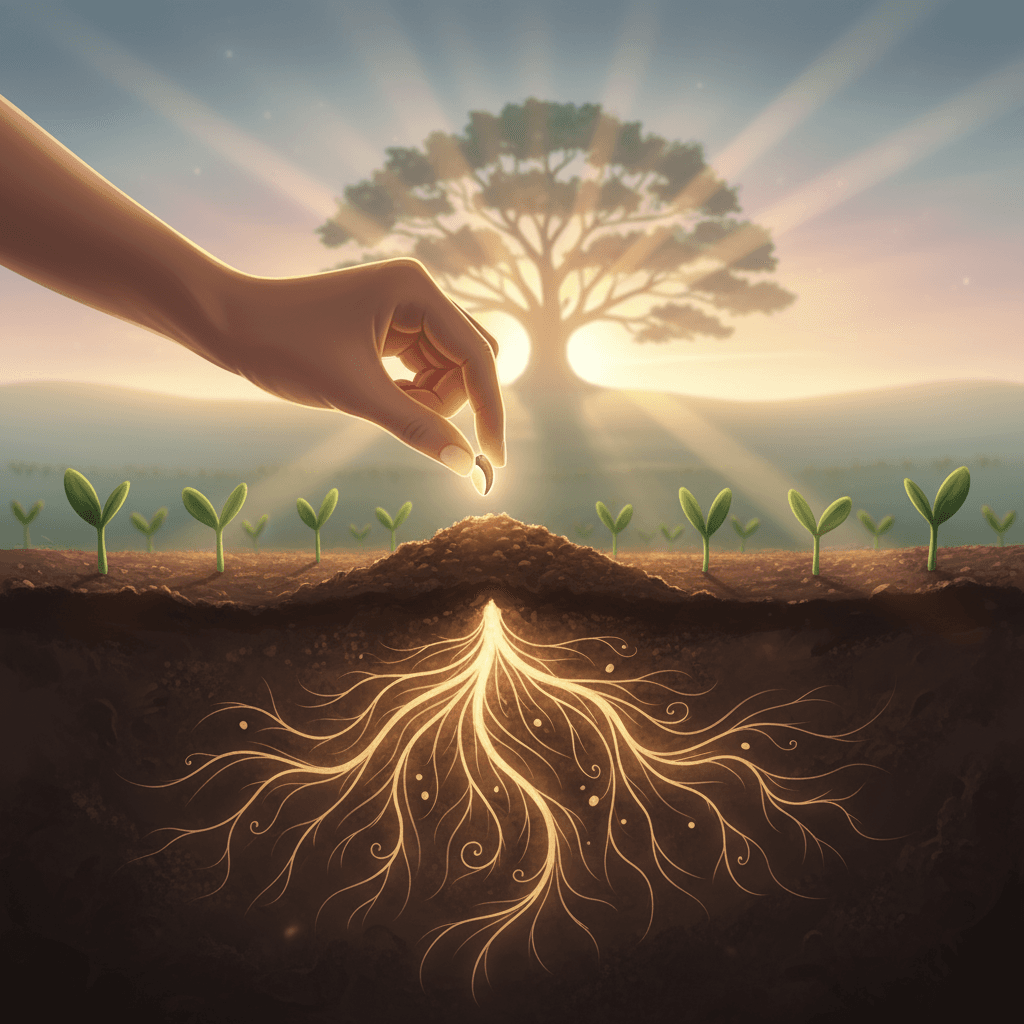
Sow a truth each day; its roots will pull you toward meaning — Kahlil Gibran
—What lingers after this line?
Interpreting Gibran’s Seed-and-Root Metaphor
At first glance, Gibran’s counsel reads like gardening advice, yet its soil is moral life. To “sow a truth each day” suggests small, steady acts of honesty—simple seeds that seem insignificant until their roots deepen. As roots stabilize a tree and seek nourishment, truthful habits anchor character and reach toward what nourishes the spirit: meaning. Gibran often braided nature and ethics, as in The Prophet (1923), where harvest imagery frames human flourishing. Thus, the aphorism is not about heroic declarations but about daily cultivation; over time, integrity grows subterraneously, and the self is quietly pulled—rather than pushed—toward purpose.
From Single Acts to Stable Habits
From metaphor to method, the path runs through habit. Aristotle’s Nicomachean Ethics (Book II) argues that we become just by doing just acts; character is the residue of repeated choices. William James, in The Principles of Psychology (1890), called habit “the enormous fly-wheel of society,” capturing how small motions accumulate momentum. A daily truth—correcting an exaggeration, naming a fear, admitting an error—does not transform a life overnight. Yet, like rings in a tree trunk, such acts thicken identity layer by layer. The compound interest of honesty eventually outgrows the sporadic bursts of performative virtue.
Meaning as a Direction, Not a Destination
Building on this practice, meaning emerges less as a trophy to grasp and more as a direction that orients. Viktor Frankl’s Man’s Search for Meaning (1946) claims that meaning “pulls” us forward; it is discovered through commitments and responsibilities rather than manufactured by comfort. The botany deepens the point: roots exhibit hydrotropism, growing toward water they cannot see. Likewise, truth-telling aligns the psyche with realities it cannot fully map in advance. We begin by sowing one true thing; gradually, our roots learn where the living water flows, and the pull of purpose becomes palpable.
The Cost—and Quiet Power—of Honesty
Yet sowing truth is not painless. Honesty may disrupt fragile consensuses and expose uncomfortable facts. Hannah Arendt’s “Truth and Politics” (1967) warns that factual truth often collides with opinion, risking social friction. Still, the short-term cost purchases long-term resilience: relationships built on candor can bear weight, and institutions clarified by evidence adapt faster. Research on vulnerability and trust echoes this dynamic; Brené Brown’s Daring Greatly (2012) shows that measured openness strengthens connection. Thus, truth’s roots can feel like strain at first, but that tension is precisely how muscles—and moral communities—grow.
Ecology of Roots and Networks
Likewise, nature models why individual honesty benefits the whole. Forest ecologists describe mycorrhizal networks through which trees share nutrients and warnings; Suzanne Simard’s Finding the Mother Tree (2021) popularizes this “wood-wide web.” Deep roots not only anchor a single tree; they interlace with others, stabilizing the soil against storms. So too with truth: personal integrity plugs into social ecosystems, transmitting reliability and correcting errors before they cascade. When each person sows one clear fact or confession, the network’s collective intelligence improves—less rot, more resilience, and a canopy that shelters future growth.
Daily Practices to Sow Truth
To move from idea to action, keep the seeds small and regular. Begin with Hemingway’s craft counsel from A Moveable Feast (1964): write “one true sentence” each morning—about your fear, your aim, or yesterday’s failure. Add a conversational practice: in one interaction daily, replace a flattering ambiguity with a precise statement. End the day with a two-minute audit: Where did I distort? Where can I repair? Keep micro-commitments you can reliably honor; truth flourishes when promises are sized to reality. Over weeks, these rituals become root-work, invisible yet decisive in steering you toward meaning.
A Well-Rooted Life
In the end, Gibran’s image invites patience. Seeds take seasons, not moments, and roots deepen mostly out of sight. The goal is not a spotless record but a cultivated orientation: by sowing one truth at a time, you let the accumulated weight of honesty tug you toward a life that fits. When storms come—as they do—a well-rooted self will bow without breaking, and its quiet strength will nourish others. Meaning, then, is less a destination arrived at than a gravity felt—a steady pull created by the daily planting of truth.
One-minute reflection
What feeling does this quote bring up for you?
Related Quotes
6 selectedTurn the ordinary into an offering; that is how meaning is forged. — Kahlil Gibran
Kahlil Gibran
At the outset, the quote invites a shift in posture: do not merely do the task—offer it. When we treat the ordinary as an offering, a cup of tea, a commute, or an email becomes a deliberate gift rather than a perfunctory...
Read full interpretation →The truth is rarely comfortable, but it is the only thing that will actually set you free. Stop hiding from your reality and start owning your choices. — Pema Chödrön
Pema Chödrön
At its core, Pema Chödrön’s statement argues that freedom does not come from denial, distraction, or carefully managed appearances. Instead, it begins with the willingness to confront what is real, even when that reality...
Read full interpretation →Be a loner. That gives you time to wonder, to search for the truth. Have holy curiosity. Make your life worth living. — Albert Einstein
Albert Einstein
At first glance, Einstein’s advice to “be a loner” may sound like a rejection of society, yet his deeper point is about protecting the inner space where thought can mature. Solitude gives a person room to hear their own...
Read full interpretation →Even in literature and art, no man who bothers about originality will ever be original: whereas if you simply try to tell the truth, you will, nine times out of ten, become original without ever having noticed it. — C.S. Lewis
C.S. Lewis
At first glance, C.S. Lewis presents a paradox: the harder an artist chases originality, the less likely it is to appear.
Read full interpretation →The task of a craftsman is not to generate meaning, but rather to cultivate in himself the skill of discerning the meanings that are already there. — Cal Newport
Cal Newport
At its core, Cal Newport’s quote overturns a popular modern assumption: that fulfillment is something we simply fabricate through self-expression alone. Instead, he argues that meaning already exists in the structure of...
Read full interpretation →If you want the truth, you must be brave enough to hear it. — Margaret Heffernan
Margaret Heffernan
At first glance, Margaret Heffernan’s remark sounds like a simple call for honesty, yet it reaches further than that. She suggests that truth is not merely something we uncover through intelligence or investigation; rath...
Read full interpretation →More From Author
More from Kahlil Gibran →Your home is your larger body. It grows in the sun and sleeps in the stillness of the night. — Kahlil Gibran
At first glance, Gibran transforms the idea of home from a mere structure into something intimate and organic: “your larger body.” In this image, a dwelling is not separate from the person who inhabits it, but an outward...
Read full interpretation →March on. Do not tarry. To go forward is to move toward perfection. — Kahlil Gibran
Gibran’s opening imperative—“March on. Do not tarry.”—sets a tone of disciplined urgency.
Read full interpretation →There must be spaces in your togetherness, and let the winds of the heavens dance between you. — Kahlil Gibran
Gibran’s line opens with a gentle paradox: he speaks to people who are already “together,” yet insists that togetherness is healthiest when it includes room. Rather than portraying love as fusion, he frames it as a relat...
Read full interpretation →Our anxiety does not come from thinking about the future, but from wanting to control it. — Kahlil Gibran
Kahlil Gibran reframes anxiety as something more specific than mere anticipation. The future itself—uncertain, unfolding, and not yet real—doesn’t automatically distress us; rather, distress appears when we demand certai...
Read full interpretation →