
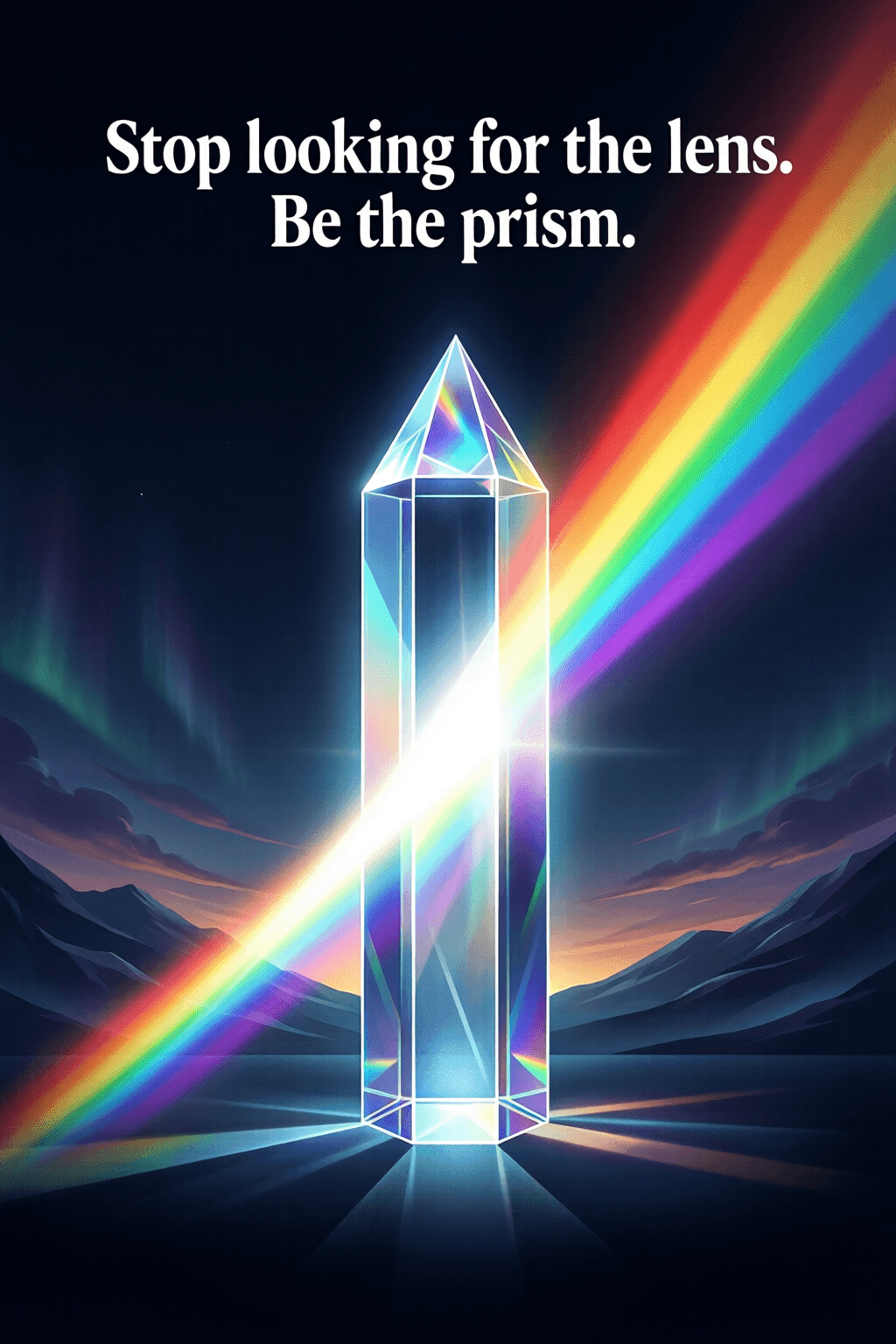
Stop looking for the lens. Be the prism. — Shaan Puri
—What lingers after this line?
From Searching to Becoming
At first glance, Shaan Puri’s line overturns a common habit: waiting for the right lens through which to view the world. A lens implies borrowed perspective, something external that clarifies reality for us. By contrast, a prism does not merely receive light—it transforms it, breaking one beam into a spectrum. In that shift from looking to being, the quote urges agency over dependence. As a result, the message feels both creative and practical. Rather than hunting endlessly for mentors, frameworks, or trends to define our vision, we are invited to develop a perspective so distinct that it reveals possibilities others cannot yet see.
The Metaphor of the Prism
More deeply, the prism metaphor suggests originality born from transformation. In physics, a prism refracts light, separating what appears singular into many colors. Likewise, an imaginative person can take one ordinary event, idea, or problem and uncover layers within it. What seemed plain becomes vivid through interpretation. This is why the quote carries entrepreneurial and artistic force. Steve Jobs often spoke of ‘connecting the dots’ in his 2005 Stanford commencement address, showing how disparate experiences can be turned into something new. In a similar spirit, being the prism means making meaning—not just consuming it.
A Critique of Passive Thinking
At the same time, the quote quietly criticizes passivity. Looking for the lens can become a form of delay: one more book, one more expert, one more perfect system before action begins. Although learning from others matters, overreliance on outside interpretation can leave a person intellectually dependent and creatively timid. Therefore, Puri’s advice reads as a call to stop outsourcing discernment. Ralph Waldo Emerson’s essay ‘Self-Reliance’ (1841) similarly argues that imitation is a kind of spiritual surrender. The prism, by contrast, symbolizes someone who processes the world internally and returns it in a form unmistakably their own.
Individuality as Creative Power
From here, the quote naturally expands into a statement about identity. To be the prism is to let your temperament, history, and curiosity shape what you produce. Two people may encounter the same information, yet one turns it into a business, another into art, and another into a social movement. Their difference lies not in the light they receive, but in how they refract it. In this way, individuality becomes more than self-expression; it becomes usefulness. Virginia Woolf’s A Room of One’s Own (1929) suggests that authentic creation requires the freedom to perceive and speak in one’s own voice. Puri’s aphorism compresses that idea into a modern imperative.
Relevance in a Saturated World
Especially today, the quote feels urgent because digital life floods us with ready-made lenses. Algorithms sort what we see, influencers explain what to value, and trends reward repetition over originality. Under such conditions, people can mistake curation for insight and consensus for truth. Yet this is precisely where the prism matters most. In a crowded information economy, the rarest asset is not access to light but a distinctive way of refracting it. Those who stand out are often not the ones who found the best framework, but the ones who interpreted common material with uncommon clarity.
A Practical Philosophy of Expression
Ultimately, the quote offers a philosophy of action: absorb widely, then transform boldly. Being the prism does not mean rejecting influence; rather, it means refusing to end with influence. You read, observe, experiment, and listen—but then you synthesize. The final product bears your signature, not merely your sources. Consequently, Puri’s words are less about rebellion for its own sake than about contribution. The world does not only need more people who understand ideas; it needs people who can refract them into new forms others can see. That is how perspective becomes value, and how identity becomes impact.
Recommended Reading
As an Amazon Associate, we earn from qualifying purchases.
One-minute reflection
What does this quote ask you to notice today?
Related Quotes
6 selectedIf you want to move forward, you must first give yourself permission to stand still. Perspective is often the result of stopping long enough to actually see. — Alain de Botton
Alain de Botton
At first glance, Alain de Botton’s line seems contradictory: how can standing still help us move forward? Yet that tension is precisely his point.
Read full interpretation →If you want to change your life, start by changing your mind—it's the only place you actually live. — Byron Katie
Byron Katie
At its core, Byron Katie’s remark reframes personal change as an inner rather than outer project. We often imagine that a new job, city, or relationship will transform our lives; however, she points to the mind as the ac...
Read full interpretation →To the river, the stone is an obstacle; to the stone, the river is erosion. Perspective births both truth and conflict. — Monika Ajay Kaul
Monika Ajay Kaul
Monika Ajay Kaul’s image of the river and the stone immediately turns a simple natural scene into a meditation on perception. To the river, the stone interrupts motion; to the stone, the river slowly wears away form.
Read full interpretation →Reflect upon your present blessings, of which every man has plenty; not on your past misfortunes, of which all men have some. — Charles Dickens
Charles Dickens
At its heart, Dickens’s sentence asks for a deliberate shift in attention. Rather than denying pain, he urges us to look first at the blessings still present in our lives, however ordinary they may seem.
Read full interpretation →Perspective is the ability to see the bigger picture rather than being focused on the immediate pain. — Robert Greene
Robert Greene
Robert Greene’s line begins with a simple but demanding claim: perspective is not the denial of pain, but the capacity to place pain within a wider frame. In other words, the moment may hurt intensely, yet it does not al...
Read full interpretation →It is a narrow mind which cannot look at a subject from various points of view. — George Eliot
George Eliot
George Eliot’s remark immediately frames narrowness not as a lack of intelligence, but as a failure of perspective. To look at only one side of a subject is to confuse partial vision with complete understanding.
Read full interpretation →More From Author
More from Shaan Puri →