
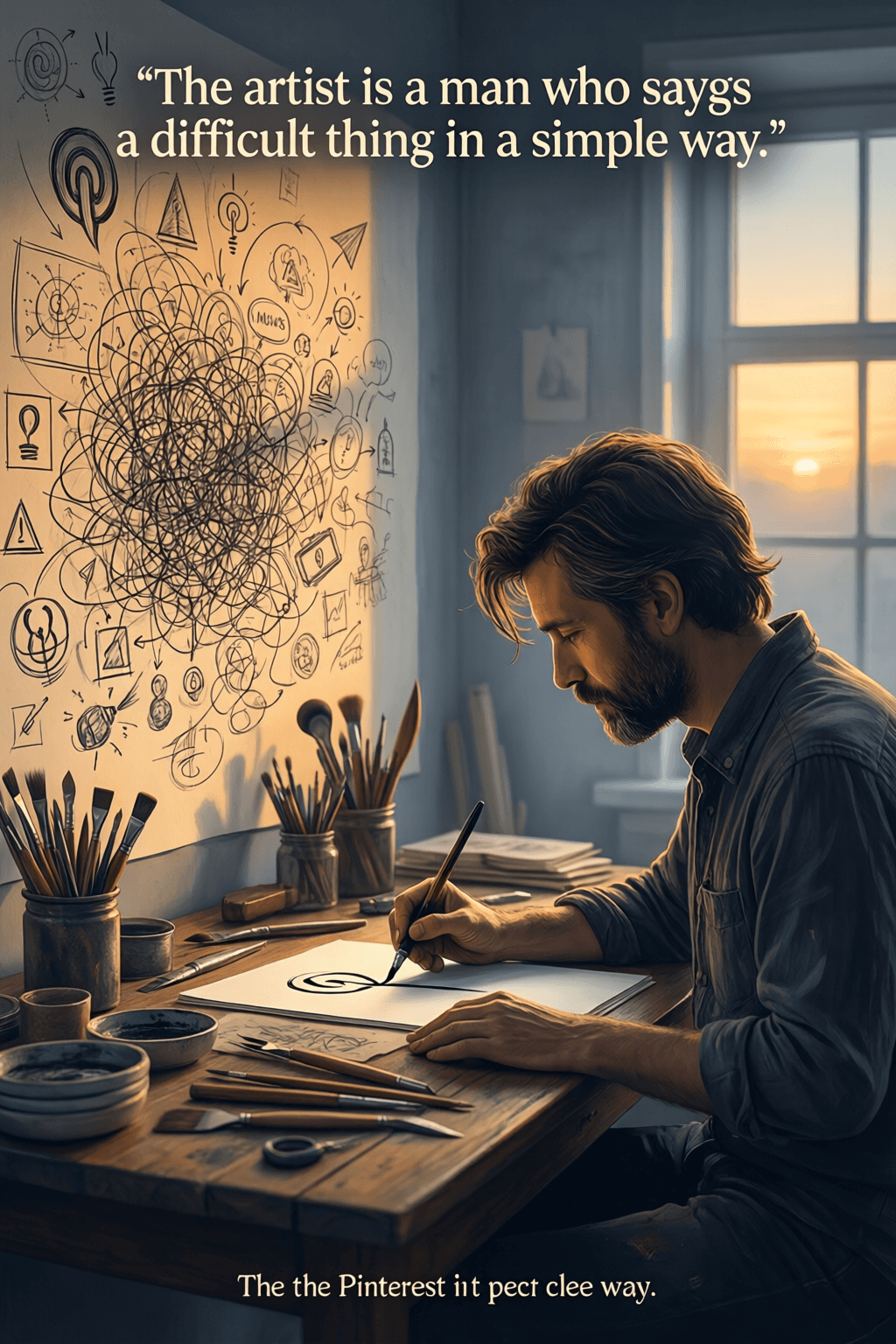
The artist is a man who says a difficult thing in a simple way. — Charles Bukowski
—What lingers after this line?
The Core of Bukowski’s Claim
Bukowski’s remark defines art not as ornament, but as compression. In his view, the artist’s task is to take what is tangled, painful, or elusive and express it so plainly that it lands with immediate force. What looks simple on the page or canvas is therefore not evidence of ease; rather, it is often the final result of deep struggle, selection, and restraint. From this starting point, the quote also challenges a common misunderstanding about sophistication. Many people equate complexity with intelligence, yet Bukowski reverses that assumption. He implies that true mastery appears when an artist can remove clutter without thinning the truth, leaving behind something direct enough to be felt by almost anyone.
Why Simplicity Is So Difficult
This leads naturally to the central paradox: saying a difficult thing simply is harder than saying it obscurely. Complicated language can hide uncertainty, but clarity demands that the artist know exactly what must be said. As Blaise Pascal observed in a 1657 letter, “I have made this longer than usual because I have not had time to make it shorter,” neatly capturing the labor behind brevity. In practice, simplicity requires painful decisions about what to cut, what to keep, and what to trust the audience to understand. Thus the artist becomes less a decorator and more an editor of experience, shaping raw emotion or insight until it feels inevitable. The finished work may seem effortless, but its ease is earned.
Literary Examples of Plainspoken Depth
Seen in literature, Bukowski’s idea has many clear echoes. Ernest Hemingway’s prose, especially in The Old Man and the Sea (1952), uses short, unadorned sentences to carry loneliness, endurance, and dignity. Likewise, William Carlos Williams’s poem “The Red Wheelbarrow” (1923) relies on ordinary words, yet its simplicity opens into a meditation on attention and dependence. Even Bukowski’s own poems often work this way. He writes about bars, rent, failure, sex, and exhaustion in language that seems almost casual, yet beneath that surface lies a difficult account of alienation and survival. In this sense, plain speech becomes not a reduction of meaning, but its sharpest delivery system.
Accessibility Without Shallowness
From there, the quote points toward an ethical dimension of art. To speak simply is to invite others in. Rather than using difficulty as a gate, the artist translates private insight into a shared human language. That is why works by writers like Raymond Carver or songs by Bob Dylan can feel intimate and immediate even when they address grief, injustice, or spiritual confusion. Importantly, accessibility does not mean shallowness. A simple expression can carry layers that unfold over time, much as Robert Frost’s “Stopping by Woods on a Snowy Evening” (1923) appears straightforward while quietly holding questions of duty, fatigue, and mortality. Simplicity, then, is not the opposite of depth; it is often the form depth takes when it has been fully understood.
The Artist as Translator of Experience
Ultimately, Bukowski casts the artist as someone who translates difficulty into recognition. The “difficult thing” may be trauma, desire, class struggle, loneliness, or the absurdity of daily life. What matters is not merely having intense experience, but finding a form in which others can suddenly say, with surprise, yes, that is exactly what it feels like. For that reason, the quote remains a durable measure of artistic success. We often remember works not because they were the most elaborate, but because they made something hard unmistakably clear. In that final sense, art succeeds when it turns confusion into clarity without draining away mystery, allowing simplicity and complexity to exist in the same breath.
One-minute reflection
What feeling does this quote bring up for you?
Related Quotes
6 selectedSimplicity is the ultimate sophistication. — Leonardo da Vinci
Leonardo da Vinci
This quote highlights the power and elegance of simplicity. It suggests that in a world filled with complexity, simplicity stands out as a mark of true sophistication.
Read full interpretation →Making the simple complicated is commonplace; making the complicated simple, awesomely simple, that’s creativity. — Charles Mingus
Charles Mingus
Charles Mingus’s observation begins by highlighting a pervasive human tendency: taking simple ideas and wrapping them in unnecessary complexity. In academic circles, jargon-laden prose is frequently criticized for obscur...
Read full interpretation →The artist must be a master of what he rejects. — Carlos Fuentes
Carlos Fuentes
At first glance, Carlos Fuentes’s remark suggests that artistic refusal is not mere negation but an act of deep knowledge. An artist earns the right to reject a style, convention, or influence only after understanding it...
Read full interpretation →The artist's duty is to stay in the fire, to keep the question alive long after the answers have gone cold. — Adrienne Rich
Adrienne Rich
Adrienne Rich presents the artist not as a maker of neat conclusions, but as someone willing to remain inside uncertainty. The image of “staying in the fire” suggests discomfort, risk, and sustained attention; in other w...
Read full interpretation →The artist must elect to fight for the beauty of the work, stitch by patient stitch, against the rush of the world. — Ursula K. Le Guin
Ursula K. Le Guin
Ursula K. Le Guin’s line begins with a deliberate verb: the artist must “elect.” In other words, beauty is not an accident or a luxury but a conscious choice made in resistance to haste.
Read full interpretation →Growth often looks more like subtraction than addition. — Brené Brown
Brené Brown
At first glance, growth seems like an act of accumulation: more skills, more confidence, more achievements. Yet Brené Brown’s line reverses that expectation by suggesting that development often begins with removal.
Read full interpretation →More From Author
More from Charles Bukowski →Discover what you love and let it kill you. — Charles Bukowski
This quote emphasizes the importance of wholeheartedly pursuing one’s passions. It suggests that deep, passionate engagement in what you love is essential, even if it comes with challenges or risks.
Read full interpretation →What matters most is how well you walk through the fire. — Charles Bukowski
This quote emphasizes the importance of resilience and strength when facing life's challenges. Walking through the fire symbolizes enduring hardships and emerging stronger.
Read full interpretation →Sometimes you climb out of bed in the morning and you think, I’m not going to make it, but you laugh inside — remembering all the times you’ve felt that way. — Charles Bukowski
Bukowski’s reflection begins in the private moments we all know: waking up and feeling overwhelmed before the day even starts. This sensation—an anxious premonition of defeat—is universal, mirroring the doubts that cloud...
Read full interpretation →Be lightning, not a little light. — Charles Bukowski
Bukowski’s metaphor invites us to consider the distinction between ordinary illumination and a dramatic, transformative force. While ‘a little light’ gently dispels darkness, lightning cuts through the night with sudden...
Read full interpretation →